


The Civil Aeronautics Administration (CAA) revoked Far Eastern Air Transport’s (FAT) air operator certificate due to repeated contraventions of the Civil Aviation Act (民用航空法), Minister of Transportation and Communications Wang Kwo-tsai (王國材) said yesterday, adding that the airline has the right to seek a judicial remedy for its plight.
Wang made the remarks on the sidelines of a meeting at the legislature’s Transportation Committee, when he was asked about FAT chairman Chang Kang-wei (張綱維) filing an administrative lawsuit against the CAA for allegedly revoking its certificate in January last year without following due procedures.
“FAT had both financial and aviation issues in the past. In 2019, the airline suspended its flights without prior notice. As such, the CAA revoked its license for contravening the Civil Aviation Act,” Wang said. “The airline certainly has the right to file administrative lawsuits, but we were following the law when we revoked its certificate.”
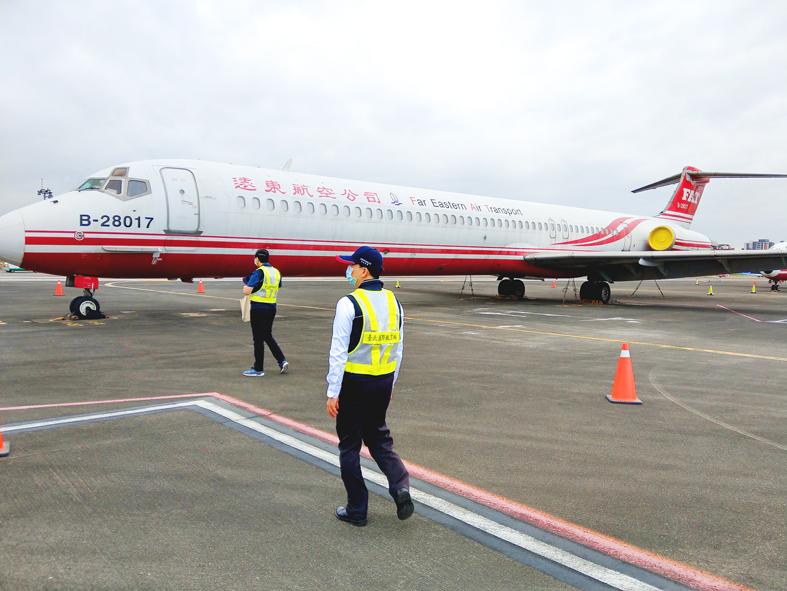
Photo: CNA
The airline on Dec. 12, 2019, applied to suspend flight services, starting the next day.
In January last year, the CAA ruled that FAT had contravened the Civil Aviation Act for canceling flights without notifying the agency and the public in advance, and asked the Ministry of Transportation and Communications for permission to revoke its certificate.
The airline was also fined NT$3 million (US$107,941 at the current exchange rate) for contravening the act.
The ministry on Jan. 31 last year approved the CAA’s ruling.
Chang appealed the CAA’s ruling twice to the ministry’s petition and appeals committee, but they were both denied.
The Taipei High Administrative Court yesterday began reviewing Chang’s case.
Chang told reporters outside the courthouse that the CAA did not dare submit the official document issued by the ministry on Jan. 31 last year and other materials requested by prosecutors, because it knew that it had broken the law.
He said the ministry dare not punish the CAA for its negligence, because it is under the pressure of “a heavyweight legislator from southern Taiwan.”
“More than 1,000 families in FAT are innocent, and taxpayers should not have to pay for the errors committed by negligent government officials. The Executive Yuan and the Control Yuan should look into a major oversight,” he said.
Earlier last week, Chang also told reporters that he would seek compensation of NT$5 billion from the government if his petition to resume flight services is again denied.
The CAA ruling caused FAT employees to lose their jobs and led to substantial financial losses for the airline, he said, adding that the punishment was disproportionate to the errors that the airline had committed.
“The compensation is not the point. What I want is for FAT to resume flight services, so our employees can have their jobs back,” he said.

The military has spotted two Chinese warships operating in waters near Penghu County in the Taiwan Strait and sent its own naval and air forces to monitor the vessels, the Ministry of National Defense (MND) said. Beijing sends warships and warplanes into the waters and skies around Taiwan on an almost daily basis, drawing condemnation from Taipei. While the ministry offers daily updates on the locations of Chinese military aircraft, it only rarely gives details of where Chinese warships are operating, generally only when it detects aircraft carriers, as happened last week. A Chinese destroyer and a frigate entered waters to the southwest
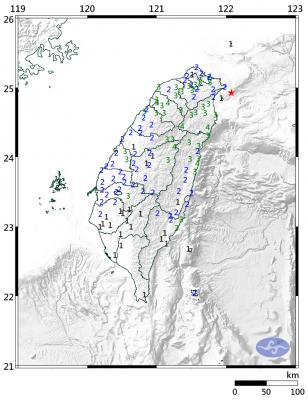
A magnitude 6.1 earthquake struck off the coast of Yilan County at 8:39pm tonight, the Central Weather Administration (CWA) said, with no immediate reports of damage or injuries. The epicenter was 38.7km east-northeast of Yilan County Hall at a focal depth of 98.3km, the CWA’s Seismological Center said. The quake’s maximum intensity, which gauges the actual physical effect of a seismic event, was a level 4 on Taiwan’s 7-tier intensity scale, the center said. That intensity level was recorded in Yilan County’s Nanao Township (南澳), Hsinchu County’s Guansi Township (關西), Nantou County’s Hehuanshan (合歡山) and Hualien County’s Yanliao (鹽寮). An intensity of 3 was

Japanese Prime Minister Sanae Takaichi’s comment last year on Tokyo’s potential reaction to a Taiwan-China conflict has forced Beijing to rewrite its invasion plans, a retired Japanese general said. Takaichi told the Diet on Nov. 7 last year that a Chinese naval blockade or military attack on Taiwan could constitute a “survival-threatening situation” for Japan, potentially allowing Tokyo to exercise its right to collective self-defense. Former Japan Ground Self-Defense Force general Kiyofumi Ogawa said in a recent speech that the remark has been interpreted as meaning Japan could intervene in the early stages of a Taiwan Strait conflict, undermining China’s previous assumptions
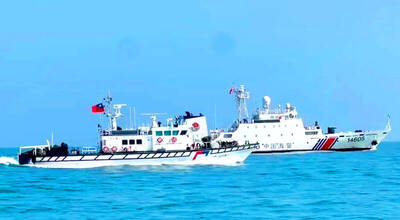
Instead of focusing solely on the threat of a full-scale military invasion, the US and its allies must prepare for a potential Chinese “quarantine” of Taiwan enforced through customs inspections, Stanford University Hoover fellow Eyck Freymann said in a Foreign Affairs article published on Wednesday. China could use various “gray zone” tactics in “reconfiguring the regional and ultimately the global economic order without a war,” said Freymann, who is also a nonresident research fellow at the US Naval War College. China might seize control of Taiwan’s links to the outside world by requiring all flights and ships entering or leaving Taiwan


 RSS
RSS