


The government should reduce the frequency of English classes and increase the amount of resources available to schools, participants said at a meeting on bilingualism hosted by the New Power Party (NPP) on Saturday.
Teachers and principals were invited to give feedback on progress regarding the government’s goal of becoming a Mandarin-English bilingual nation by 2030.
At the meeting in Taipei, participants said a lack of English-language teaching resources was the biggest factor hampering progress, adding that the government should focus on creating language environments that better facilitate the use of English by students.

Photo: George Tsorng, Taipei Times
“Students need an environment where the English they learn is used, or it just comes across as pretentious,” Taipei Municipal Zhong Zheng Senior High School principal Chiang Hui-chen (江惠真) said. “We also need better training to produce qualified bilingual teachers, and a road map for students’ progress.”
The government must clearly define what it means by “bilingualism,” and must set a clear ratio of how much focus to place on language and how much to place on subject material, Taipei Municipal Dongxin Elementary School principal Cheng Sheng-yuan (鄭盛元) said.
Very few qualified bilingual teachers take on positions in Taipei, and schools lack bilingual curricula that fit the local education system, he said.
“Teachers are doing their best to meet the expectations of parents, but they are getting worn out,” he said.
Liu Ya-hsin (柳雅馨), an English teacher at Taipei Municipal Jianguo High School, said there was a large consensus among those she asked in Taipei that the English-Mandarin bilingualism program is unpopular.
The problem is that most students who study English are familiar with some aspects of the language, but cannot speak, read or write full sentences, she said.
In a class of 40 students, at most 10 could be considered “fluent,” she said.
“One of the biggest problems is that the K-12 Education Administration has no progressive, annual plans in place for this bilingualism policy,” she said. “They do not see the results they are looking for, so salaries do not go up and the number of classes does not go down.”
If foreign teachers are employed, the school must also have bilingual teachers who can answer questions in Mandarin, she said.
Deputy Representative to Canada Po Chan-yu (柏單于), who also attended the event, cited Canada’s experience with English and French bilingualism, and said that resources must be evenly distributed to avoid unfair public policy.
“In Canada, the public has the right to decide which of the two official languages it wants services in. Taiwan should ensure that its own policy of bilingualism does not leave anyone behind,” he said.

Actor Darren Wang (王大陸) was sentenced to six months in prison, commutable to a fine, by the New Taipei District Court today for contravening the Personal Data Protection Act (個人資料保護法) in a case linked to an alleged draft-dodging scheme. Wang allegedly paid NT$3.6 million (US$114,380) to an illegal group to help him evade mandatory military service through falsified medical documents, prosecutors said. He transferred the funds to Chen Chih-ming (陳志明), the alleged mastermind of a draft-evasion ring, although he lost contact with him as he was already in detention on fraud charges, they said. Chen is accused of helping a

SECURITY: Starlink owner Elon Musk has taken pro-Beijing positions, and allowing pro-China companies to control Taiwan’s critical infrastructure is risky, a legislator said Starlink was reluctant to offer services in Taiwan because of the nation’s extremely high penetration rates in 4G and 5G services, the Ministry of Digital Affairs said yesterday. The ministry made the comments at a meeting of the legislature’s Transportation Committee, which reviewed amendments to Article 36 of the Telecommunications Management Act (電信管理法). Article 36 bans foreigners from holding more than 49 percent of shares in public telecommunications networks, while shares foreigners directly and indirectly hold are also capped at 60 percent of the total, unless specified otherwise by law. The amendments, sponsored by Chinese Nationalist Party (KMT) Legislator Ko
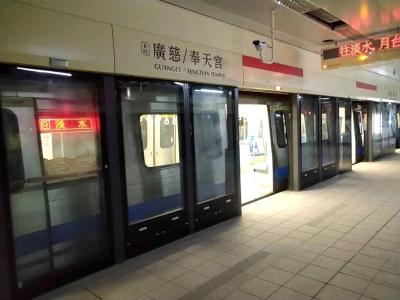
The eastern extension of the Taipei MRT Red Line could begin operations as early as late June, the Taipei Department of Rapid Transit Systems said yesterday. Taipei Rapid Transit Corp said it is considering offering one month of free rides on the new section to mark its opening. Construction progress on the 1.4km extension, which is to run from the current terminal Xiangshan Station to a new eastern terminal, Guangci/Fengtian Temple Station, was 90.6 percent complete by the end of last month, the department said in a report to the Taipei City Council's Transportation Committee. While construction began in October 2016 with an

NON-RED SUPPLY: Boosting the nation’s drone industry is becoming increasingly urgent as China’s UAV dominance could become an issue in a crisis, an analyst said Taiwan’s drone exports to Europe grew 41.7-fold from 2024 to last year, with demand from Ukraine’s fight against Russian aggression the most likely driver of growth, a study showed. The Institute for Democracy, Society and Emerging Technology (DSET) in a statement on Wednesday said it found that many of Taiwan’s uncrewed aerial vehicle (UAV) sales were from Poland and the Czech Republic. These countries likely transferred the drones to Ukraine to aid it in its fight against the Russian invasion that started in 2022, it said. Despite the gains, Taiwan is not the dominant drone exporter to these markets, ranking second and fourth


 RSS
RSS