


As many Taiwanese electronics firms are craving for business opportunities heralded by low Earth orbit (LEO) communications satellites, the National Space Organization (NSPO) is launching a “space academy” to offer them customized training sessions.
The close relationship between the NSPO and local industries was evident during the agency’s 30th anniversary celebration on Oct. 20, which was attended by several business leaders, including Quanta Computer founder and chairman Barry Lam (林百里), AU Optronics Corp chairman Paul Peng (彭双浪), and executives from Hon Hai Precision Industry Co, Wistron Corp and Pegatron Corp.
Shortly after taking office on Aug. 2, NSPO Director-General Wu Jong-shinn (吳宗信) talked about his plan to set up a “space academy” for the agency.
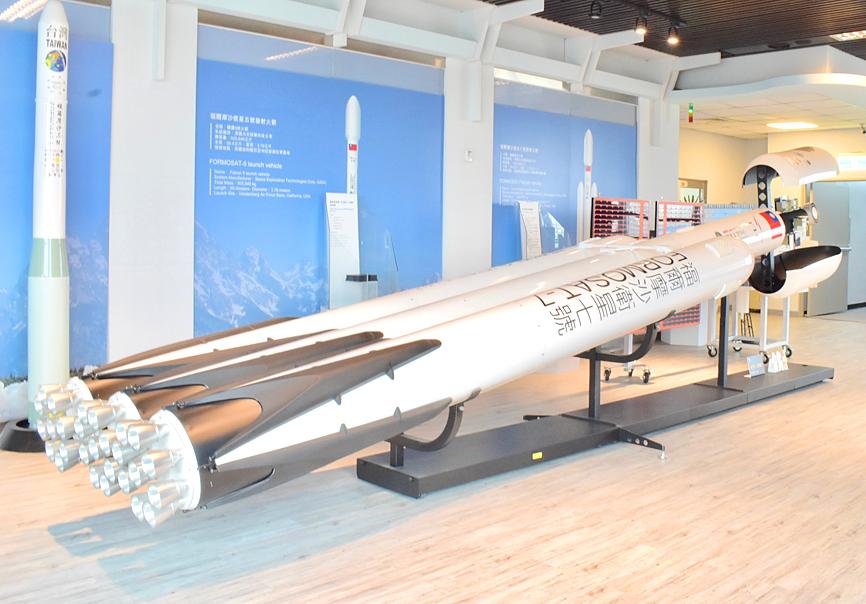
Photo: Lin Chia-nan, Taipei Times
The academy would be “a virtual institute responsible for space technology-related education for universities and industrial companies,” but its functions would not be limited to that, he said.
Seeing the thriving opportunities offered by LEO communications satellites, many local businesses have been urging the agency to share its know-how, NSPO Deputy Director-General Yu Shiann-jeng (余憲政) said in an interview on Nov. 4.
The NSPO’s partnerships with local companies were mostly conducted on a case-by-case basis, but the space academy’s aim is to facilitate talent cultivation by fortifying ties with industry and academia, he said.
“Those who can make computers are not necessarily able to make space-grade computers,” so they need experts that would introduce them to the space environment, Yu said.
Several local firms have also expressed an interest in making satellites, and the NSPO has suggested they start from making cubesats, he said.
Cubesats have lower costs and technical barriers, he said, adding that they have a shorter life cycle and are suitable for testing newly developed components.
The space academy is offering its first session on Thursday next week, with two days of training on space component verification tests, followed by a session on LEO satellite communications next month, the organization’s Web site shows.
In addition to NSPO members, lecturers from other agencies, such as the Industrial Technology Research Institute, the Institute for Information Industry and the Metal Industries Research and Development Center, are participating in the training sessions.
More sessions are to be launched next year, including those related to system engineering, satellite component manufacturing and testing, Yu said, adding that some courses would involve practice training and tests.
Two NSPO members are recognized by NASA as class B instructors in electronic component welding and satellite harness making, so their trainees can receive certificates recognized by the US space agency, he added.
Courses related to space radiation would be held at other places, such as Chang Gung Memorial Hospital, which is part of an NSPO-led space radiation testing alliance formed in July last year.
The space academy also aims to integrate existing education at universities, Yu said.
Since 2019, the NSPO has been working with the University System of Taiwan to hold a space technology and engineering program, which involves several departments of National Tsing Hua University, National Yang Ming Chiao Tung University (NYCU) and National Central University, he said.
As one of NYCU’s main campuses is adjacent to NSPO’s headquarters at the Hsinchu Science Park, Wu is working to promote the establishment of a new department on space system engineering at NYCU, but the plan needs the approval of the Ministry of Education, Yu said.
A space-tech “Silicon Valley” is likely to take shape in this region, pooling the talent and capabilities of the universities, the NSPO, businesses at the science park, as well as the radiation testing alliance’s members in Hsinchu and Taoyuan, he said.
The NSPO’s facilities, in addition to testing the components of national space programs, also support the needs of local companies to test components when there is spare time, he said.
To accommodate its increasing tasks and the industry’s growing needs, the NSPO is mulling expanding its facilities, Yu said.
The organization’s offices are located on the eighth to 10th floors of a building at the science park, and it has only one independent three-floor building for satellite integration and testing.
Over the past few years, the NSPO and its supervisor, the Ministry of Science and Technology, have been seeking new space to build a new headquarters that can better reflect its status, he said, adding they hope to create a cluster of space-related businesses.
Although the NSPO hopes to stay in Hsinchu, the science park is already fully occupied, so it would take them more time to seek space for its new headquarters, Yu said.

FUKUOKA SITUATION: Japanese media reported that the pathogen is expected to be identified by the summer, while the CDC downplayed the idea that it was hMPV A “mysterious cold-like illness” reported in Japan’s Fukuoka Prefecture does not seem to be a new disease, but Japanese authorities have been asked about the situation, the Centers for Disease Control (CDC) said yesterday. The Fukuoka Prefectural Medical Association on Wednesday told a news conference that a “mystery cold” that has become a hot topic on social media is “highly likely to be caused by some kind of viral infection,” Japan’s KBC News reported. “Many people are experiencing symptoms starting with a sore throat, followed by a runny nose, phlegm and a severe cough,” KBC News reported, citing association officials. Health authorities are

Nvidia Corp CEO Jensen Huang (黃仁勳) arrived in Taiwan yesterday ahead of upcoming AI and technology events, saying he plans to meet with clients and Taiwan Semiconductor Manufacturing Co Chairman C.C. Wei (魏哲家) during his visit. After landing at Taipei Songshan Airport, Huang posed for photos with fans and handed out Yakult drinks to reporters and supporters waiting at the scene, saying he has “a lot to do” during the trip. Asked about reports that Nvidia’s planned headquarters site in Taipei’s Beitou Shilin Technology Park could break ground on May 27, Huang said that if the company holds an event, he would

The Ministry of Finance this afternoon announced the winning numbers for the March-April uniform invoice lottery. The winning number for the NT$10 million (US$318,060) special prize is 19531471, and the winning number for the NT$2 million grand prize is 85941329. Three numbers were drawn for the NT$200,000 first prize: 07225810, 20231230 and 83518781. Those with receipts matching the last seven digits of any of the first-prize numbers will win the NT$40,000 second prize, while those matching the last six digits will win the NT$10,000 third prize. Those whose receipts match the last five digits of the first-prize numbers can claim the NT$4,000 fourth prize,
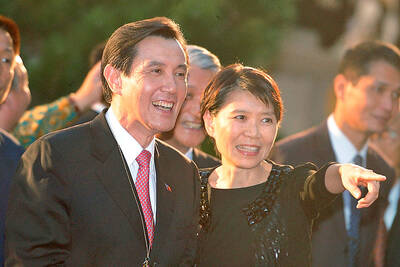
Former president Ma Ying-jeou (馬英九) yesterday expressed “shock and regret” over a statement issued by his wife without his consent, and rejected her assertion that his eldest sister, Ma Yi-nan (馬以南), would manage his medical care or act as his spokesperson amid an ongoing embezzlement probe into his foundation. Ma Ying-jeou in a statement said he was shocked by a statement by his wife, Chou Mei-ching (周美青), regarding his affairs. Ma Yi-nan “must not” be in charge of his healthcare and other personal affairs, nor can she be allowed to represent the Ma family, the former president said. He said he was also


 RSS
RSS