

Member states of the Comprehensive and Progressive Agreement for Trans-Pacific Partnership (CPTPP) have welcomed Taiwan’s application to join the trade pact, New Zealand Minister for Trade and Export Growth Damien O’Connor said yesterday.
O’Connor made the remark at news conference after a ministerial meeting at an APEC forum a day earlier.
Asked whether New Zealand supports Taiwan’s inclusion in the CPTPP, O’Connor said that the members have “always been open to ascension by applicants.”
The bloc welcomed membership applications from Taiwan, the UK and China, he said.
It would be up to “the applicant economies to reach the standards that we have set and that we believe work well for us,” he said.
The New Zealand Ministry of Foreign Affairs and Trade has said that any economy seeking CPTPP ascension must ensure “the commitments they make on access for goods, services, investment, government procurement and temporary entry for business persons meet the high standards agreed by existing CPTPP members.”
“New Zealand has all along been a supporter of growing CPTPP through accession by those economies willing to meet the agreement’s high standards,” a foreign ministry spokesperson said via e-mail, replying to a request for comment by the Central News Agency.
“The CPTPP group as a whole, through the CPTPP Commission, [will] decide whether to commence accession processes with Chinese Taipei,” the spokesperson said, referring to Taiwan.
Taiwan in September formally applied to join the trade bloc under the name “the Separate Customs Territory of Taiwan, Penghu, Kinmen and Matsu” through its representative in New Zealand, who sent the application to the foreign ministry.
New Zealand acts as a depositary for the trade pact and is responsible for passing applications to all member states.
The CPTPP was signed in March 2018 by Australia, Brunei, Canada, Chile, Japan, Malaysia, Mexico, New Zealand, Peru, Singapore and Vietnam, and took effect at the end of that year, following ratification by more than half of the 11 signatories.
Any new entry requires the unanimous support of all members.
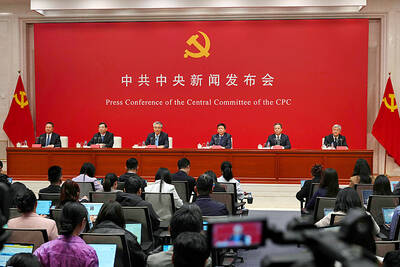
SHORT-TERM OUTLOOK: The Chinese military would most likely focus on rebuilding its organization and leadership in the next few years, experts said Chinese President Xi Jinping’s (習近平) military purge has reduced the risks of a planned war against Taiwan, yet increased the danger of a conflict sparked by a miscalculation or accident, Taiwanese experts said yesterday. They made the comments at a seminar on the Fifth Plenary Session of the Chinese Communist Party’s (CCP) 20th Central Committee held by the research group Secure Taiwan Associate Corp (STA) in Taipei. The wholesale sacking of Chinese People’s Liberation Army (PLA) officers and managers of the aerospace and defense industry is sure to set back Xi’s timetable to prepare the PLA to launch an invasion of Taiwan

BATTLE-TESTED: Czech companies’ drones, software and navigation systems have been tested in the Ukraine war, while other countries’ are lab-tested, a Czech ex-official said Czech manufacturers are interested in setting up drone assembly lines in Taiwan, former Czech Chamber of Deputies president Marketa Pekarova Adamova told a forum in Taipei yesterday. Adamova made the comments at the inauguration of the Global UAV Academy, an organization dedicated to international cooperation in drone supply chains, technological certification and pilot training. The Research Institute for Democracy, Society and Emerging Technology said the Czech Republic is the largest importer of Taiwanese drones and uncrewed aerial vehicle (UAV) components. Adamova, who transitioned to the defense industry after retiring from politics, said the Roman adage “si vis pacem, para bellum” — “If you
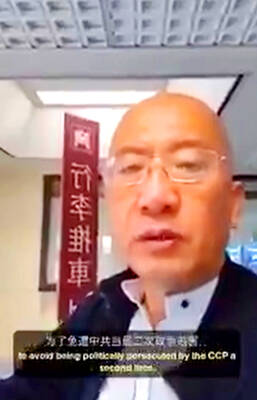
Former China Central Television (CCTV) talk show host Cheng Wanjun (程萬軍) yesterday sought political asylum in Taiwan, a day after arriving at Taiwan Taoyuan International Airport on a connecting flight from Thailand. In a video posted on X, Cheng said he was appealing to Taiwan to grant him temporary asylum on humanitarian grounds while he sought permanent resettlement in a third country. Cheng said he previously served as editor-in-chief of the journal Law and Life and hosted legal affairs programs on state-run CCTV. He said he ran afoul of Chinese authorities in 2019 after a video surfaced showing him discussing rulers whose actions

Support for Democratic Progressive Party Legislator and Taipei mayoral candidate Puma Shen (沈伯洋) reached 52.6 percent, compared with 35.3 percent for Taipei Mayor Chiang Wan-an (蔣萬安) of the Chinese Nationalist Party (KMT), a poll released yesterday by the Strategy and Public Research Institute of Taiwan showed. The poll was held after the candidates’ first debate on Saturday. It showed support for Shen surpassing 50 percent for the first time, with the gap between the two widening to 17.3 percentage points. A breakdown of voting intentions by district found that Shen led Chiang in 11 of Taipei’s 12 districts. His strongest


 RSS