


The government has yet to decide on a location for the terminal station of a planned high-speed rail extension line to Yilan County, but would not implement any plan without the consent of local residents, Minister of Transportation and Communications Wang Kwo-tsai (王國材) said yesterday.
Wang made the statement after the Executive Yuan approved amendments to the Railway Act (鐵路法) in a Cabinet meeting in the morning.
The amendments would enhance oversight of railway safety and ensure sustainable operations of state-run railway services, the Ministry of Transportation and Communications (MOTC) said.
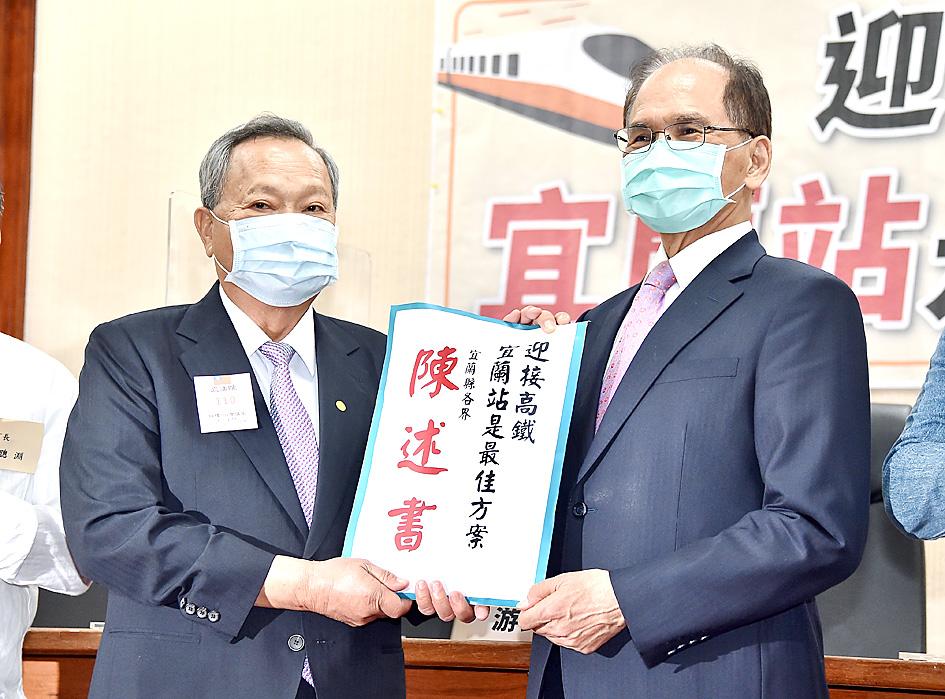
Photo: Tu Chien-jung, Taipei Times
Wang said that he would attend an information session in Yilan on Saturday next week, in which he would discuss options for the rail link with local residents, lawmakers and local government officials.
“The high-speed rail extension line was proposed to facilitate transportation between the west and east coasts, and ease traffic congestion inside the Hsuehshan Tunnel on the National Chiang Wei-shui Freeway [Freeway No.5],” Wang said.
The project is the envy of many cities and counties across the nation,” Wang said, adding that the extension would cost about NT$170 billion (US$6.13 billion).
“The last thing we want is that the extension line is not welcome by the people of Yilan, given the huge amount of money that the government plans to spend on it,” he said.
A consulting firm hired by the ministry recommended four possible terminal stations — adjacent to Yilan Station, Luodong Station, Sicheng Station or at a yet-to-be built station near the Yilan County Government building.
Local media reported that most ministry officials prefer to build the terminal at Sicheng Station, as it would involve fewer home relocations.
During the information session, officials would lay out issues related to the four locations, including land procurement and the number of residents who would need to be relocated, Wang said.
Communications with local residents would continue even if no consensus is reached, he said, adding that officials would follow administrative procedures when finalizing the selection process.
Asked why the ministry and local residents have yet to reach an agreement after several information sessions, Wang said the key lies in being open and transparent about objectively collected data.
“We understand that people want the terminal station to be built in their own towns. However, people only take the high-speed rail once in a while, not every day. As such, apart from the terminal station, we also need to build a shuttle bus system and parking lot to facilitate the transition to the high-speed rail service,” Wang said.
“We want to inform people of all the practical matters to minimize controversies that might arise once construction begins,” he said.
Residents in Yilan remain divided over where the terminal station should be.
Democratic Progressive Party (DPP) Legislator Chen Ou-po (陳歐珀) and Yilan County Council Speaker Chang Chien-rong (張建榮) of the Chinese Nationalist Party (KMT), along with about 100 Yilan residents, yesterday petitioned at the Legislative Yuan in Taipei to have the terminus built at Yilan Station.
Yilan County Commissioner Lin Tzu-miao (林姿妙) of the KMT and former acting Yilan County commissioner Chen Chin-te (陳金德) said that they support the station near the Yilan County Government building as the terminus.
Residents near Sicheng Station in Yilan’s Jiaosi Township (礁溪) welcomed the proposal to build the terminus there, saying that the ministry should honor the professional recommendations.

NATIONAL SECURITY: Authorities are working to confirm the identities of the military personnel involved and investigating possible illegal conduct and regulatory violations Authorities are probing possible national security implications after Kinmen police and immigration officers on Sunday found a Chinese woman allegedly posing as a tourist while engaging in prostitution involving more than 10 military personnel. The woman, surnamed Chen (陳), has since been deported, authorities said, adding that investigators are still working to confirm the identities of those implicated, as the records only listed code names and aliases. The case stemmed from a report received by the Kinmen District Prosecutors’ Office on Friday last week from the Jinhu Precinct of the Kinmen County Police Bureau. On Sunday, police, along with the National Immigration

GLOBALGIVING: ‘ Caving to external pressure is not acceptable for an organization that has cultivated justice reform and human rights for 30 years,’ one NGO said A slew of non-government organizations (NGOs) have withdrawn from the GlobalGiving fundraising platform after it announced it would use “Chinese Taipei” instead of “Taiwan” from next month. The Taiwan Good Rice Association wrote on Facebook on Friday that it was informed on April 28 via a teleconference call of the change, which was made because the platform wanted to operate in China. Taiwan Good Rice is to terminate all cooperative relationships with GlobalGiving in response to the platform’s “unilateral and non-negotiable” decision to remove references to Taiwan, the NGO said. “Taiwan is in the official name of Taiwan Good Rice Association and the

HEAVY WEATHER: Typhoon Jangmi is due to crash straight into the Ryukyus as airlines look to shift flights to larger aircraft or cancel flights to Okinawa entirely Taiwan’s international air carriers announced flight adjustments over the weekend as Typhoon Jangmi is forecast to hit the Ryukyu Islands today and tomorrow. The Central Weather Administration (CWA) upgraded Jangmi from a tropical storm to a typhoon at 8am yesterday, with the eye located 580km south of Naha city. It was moving north at 19kph. Today, China Airlines’ CI-120, CI-121, CI-122 and CI-123 flights between Taoyuan and Naha, Okinawa, have been canceled as well as CI-132 and CI-133 between Kaohsiung and Naha. EVA Air’s BR-112, BR-113, BR-186 and BR-185 flights between Taoyuan and Naha are also canceled. Low-cost carrier Tigerair Taiwan canceled IT-230,

Chinese Nationalist Party (KMT) Chairwoman Cheng Li-wun (鄭麗文) yesterday briefed her party’s Central Standing Committee regarding her scheduled visit to the US between Monday next week and June 16, saying that her purpose would be to persuade the US that the Republic of China (ROC) Constitution was a “one China” constitution that would foster stable and peaceful cross-strait relations. The ROC Constitution is the most important defense for all Taiwanese citizens, as it upholds our democracy and has contributed to our robust economy, which aligns with international and US interests, she said. “We would not be troublemakers and drag the US under,”


 RSS
RSS