


National Taiwan University (NTU) has agreed to house a memorial library to former president Lee Teng-hui (李登輝) at its College of Law building on Xuzhou Road in Taipei, the Lee Teng-hui Foundation announced yesterday.
On the eve of the first anniversary of the former president’s death, the foundation, the Taiwan Association of University Professors and other groups convened a news conference calling for the creation of a Lee Teng-hui memorial library.
Annie Lee (李安妮), Lee Teng-hui’s daughter and chairwoman of the foundation, said her father was unable to fulfill his dream of building a library before he died.
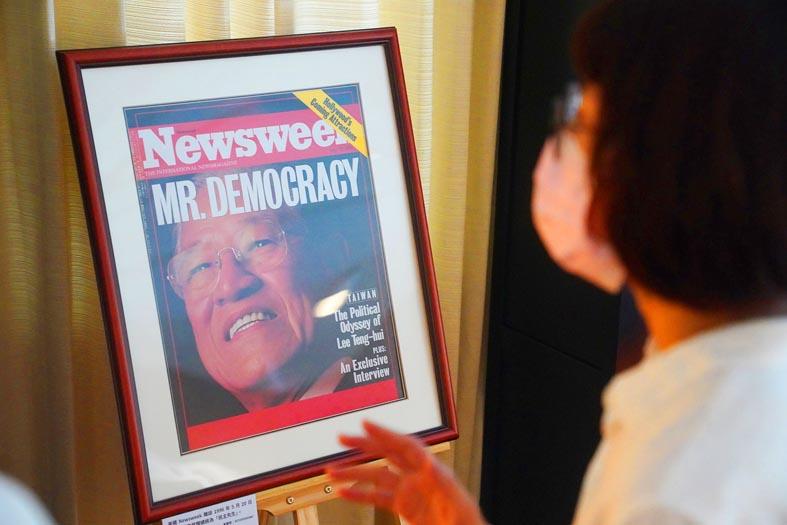
Photo: CNA
After members of the funeral committee stressed the importance of creating a library in his honor, NTU agreed to the proposal, she said.
Annie Lee said that the first time she met NTU president Kuan Chung-ming (管中閔), he gave his full support to the idea.
“At least we now have a location,” she said, adding that they would need government support.
After COVID-19 pandemic restrictions are eased, the foundation would exchange more ideas with the university, she added.
A national-level library involves a broad set of considerations, NTU Office of General Affairs president Louis Ge (葛宇甯) said.
From the facility to its collection and future operations, everything requires meticulous planning, but, most importantly, it requires long-term, stable government support, he said, adding that the university is willing to participate fully with the project.
As NTU is a public institution, the process of loaning out property is subject to numerous regulations, but if an agency supports the idea and commissions the university to assist in establishing a library, this complication could be avoided, Ge said.
Without government support, it would be difficult to rely on the university or foundation alone for the enormous undertaking, including renovations, operating expenses, maintenance, curation and acquisitions, he added.
Annie Lee said her father’s unsaid last words were a wish for Taiwanese democracy to deepen and for its people to become more united.
“We cannot tear Taiwan and its people apart because of a memorial library,” she said.
Separately yesterday, Presidential Office spokesman Xavier Chang (張惇涵) said President Tsai Ing-wen (蔡英文) and the Presidential Office support the creation of a memorial library to honor the former president’s great contributions to the nation.
Tsai and Vice President William Lai (賴清德) are to visit his grave this morning to pay their respects, he added.
Earlier, former Japanese prime minister Shinzo Abe told the Sankei Shimbun that he would also like to visit Taiwan to pay his respects to Lee Teng-hui, adding that no world leader ever thought more of Japan.
Whether speaking as leader of the foundation or as a family member, Annie Lee said they would do their best to make the visit a reality.
Considering Abe’s influence on Japanese politics and personal friendship with her father, Annie Lee said the foundation dearly hopes he can visit “no matter what.”
The timing is still being worked out, she said, adding that it does not necessarily need to happen on the anniversary of her father’s passing.

EXCUSES: Beijing is using government and research vessels as a pretext to harass the nation and enter its EEZ, and engage in ‘hegemonic expansion,’ the coast guard said The Coast Guard Administration yesterday said it drove away Chinese oceanographic research vessel Xiang Yang Hong 22 (向陽紅33) from restricted waters after warning it that it was in Taiwan’s exclusive economic zone (EEZ). The Chinese vessel entered restricted waters off the coast of Yilan County’s Suao (蘇澳) at 11:35pm on Thursday, the coast guard said, adding that it dispatched the Lanyu patrol vessel and the boat PP-10077 to shadow the Chinese ship and issue radio warnings ordering it to leave. China has no sovereignty over waters off Taiwan’s east coast, Lanyu’s crew told Xiang Yang Hong 22 over the radio, and demanded

BAIT AND SWITCH: Allowing KMT-run counties to sell to China while the threat of abrupt cancelations hangs overhead is another form of coercion, officials said Beijing is using agricultural purchase offers announced during the Straits Forum to deepen Taiwan’s dependence on the Chinese market, a Taiwanese official said yesterday as they criticized the Taitung County commissioner’s participation in the initiative. During the Straits Forum held in Xiamen on Saturday, Chinese officials announced a sales and purchase agreement for agricultural products from some counties led by the Chinese Nationalist Party (KMT). Taitung County Commissioner Yao Ching-ling (饒慶鈴), who was barred from attending the event in person by the Mainland Affairs Council, participated via video. Under the agreement, China would purchase atemoyas, pomeloes, tea and grouper harvested in Taitung,
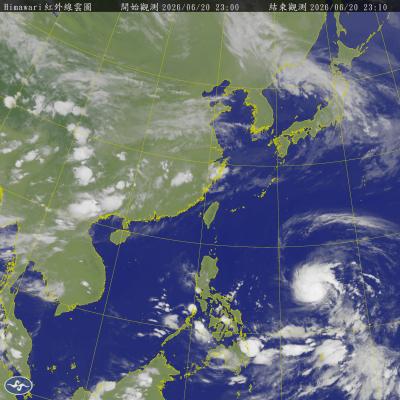
Tropical Storm Mekkhala is forecast to strengthen into a typhoon tomorrow and could come close enough to Taiwan later in the week to prompt a sea warning, the Central Weather Administration (CWA) said yesterday. As of 2 pm, the storm was located 1,870 kilometers southeast of Taiwan's southern tip and moving west- northwest at 23 km per hour. CWA forecaster Cheng Chieh-jen (鄭傑仁) said Mekkhala is expected to continue moving west-northwest through Tuesday under the influence of the Pacific high- pressure system before gradually turning north toward waters east of Taiwan or south of the Ryukyu Islands. The timing and angle of the
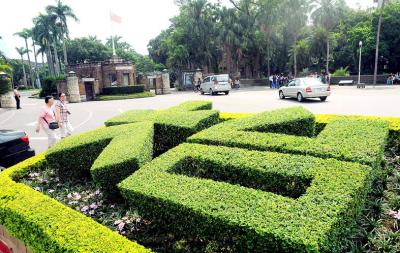
Four Taiwanese universities have been ranked among the world's top 200 institutions in the Quacquarelli Symonds (QS) World University Rankings for next year, the highest Taiwan has ever placed in the category, with National Taiwan University (NTU) achieving its best performance at 54th globally and 17th in Asia. The four Taiwanese institutions in the global top 200 are NTU (54th), National Tsing Hua University (142nd), National Yang Ming Chiao Tung University (177th) and National Cheng Kung University (191st), the rankings showed. All four universities achieved their highest-ever global rankings this year, QS data showed. National Cheng Kung University entered the top 200 for


 RSS
RSS