


The National Human Rights Commission (NHRC) yesterday released its first report, clearing pioneer democracy advocate and former Taipei City councilor Lin Shui-chuan (林水泉), who was imprisoned by the Chinese Nationalist Party (KMT).
Lin’s case was chosen for the commission’s first investigation, as it was among the most prominent cases of political persecution during the White Terror era, the NHRC said.
NHRC Chairwoman Chen Chu (陳菊) said Lin ran as an independent candidate for Taipei City councilor in 1960, but in 1961 the KMT branded him a “hoodlum,” and imprisoned him without due judicial process.
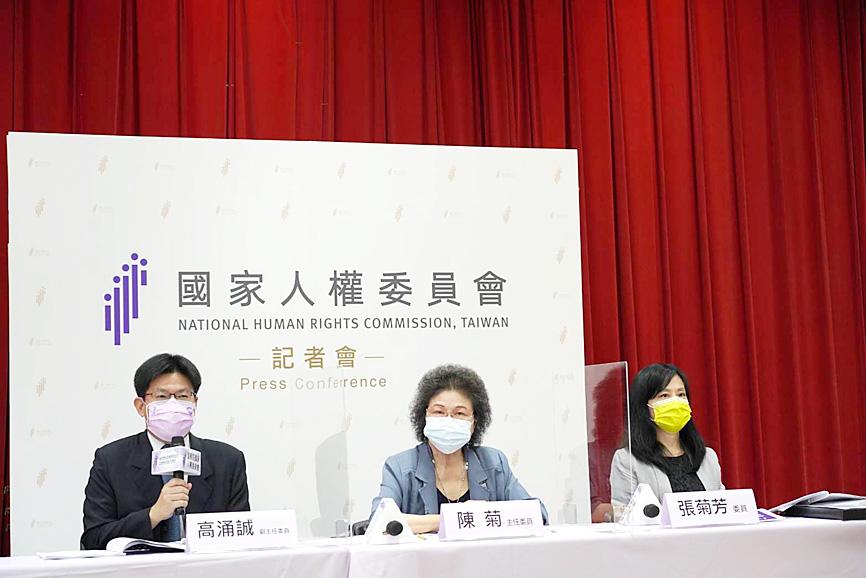
Photo courtesy of the National Human Rights Commission via CNA
Lin had the courage to criticize the KMT government for supressing people’s rights, Chen said. “What happened to Lin epitomized the many other cases of human rights abuse during the KMT’s authoritarian control of Taiwan.”
“The injustices and atrocities committed in the past have caused pain and suffering for the victims,” Chen said, adding that cases such as Lin’s are evidence of an authoritarian regime abusing its power, and can be used to educate future generations about human rights.
Lin was among the early leaders of the dangwai (黨外, “outside the party”) movement and lost the municipal election in 1960. The Taiwan Garrison Command arrested him as a hoodlum in 1961, and Lin was jailed on Siaoliouciou Island (小琉球) for just under two years.
After his release, Lin shocked the KMT by winning the Taipei City councilor race in 1964, but could not finish his term, due to a government crackdown in 1967, in which many dangwai figures were arrested.
In a military court ruling, Lin and his associates were found guilty of subversion. He was sentenced to 15 years in prison, which was later reduced to 10 years.
Lin fought for justice for years. He received compensation and the charge of subversion was overturned, but until now, government agencies had rejected his petition to clear his name of being a hoodlum.
The NHRC’s investigation was completed in April, and Lin had been informed of its findings, but the report was not released due to a local COVID-19 outbreak.
Lin, now living in the US, spoke to the Taipei Times by telephone yesterday.
He said that although the decision had taken 60 years, “I am glad that the current government has cleared my good name.”
“I never killed anyone, did not assault people, was not violent and did not do anything criminal, so I was never a hoodlum,” he said. “It was political persecution by the KMT government, because I ran in elections and won a councilor seat. While campaigning, I advocated for democracy and freedom for Taiwanese, and revealed to the public the KMT’s dictatorship and suppression of civil liberties.”
“The report and having my name cleared can never make up for the physical and mental suffering caused by the agents of the KMT regime,” he said.
Asked about his experience, he said: “Yes, I was tortured and beaten by the Taiwan Garrison Command, who forced confessions from political dissidents... What could you do at the time? KMT troops and police controlled the government and the whole society.”

Yangmingshan National Park authorities yesterday urged visitors to respect public spaces and obey the law after a couple was caught on a camera livestream having sex at the park’s Qingtiangang (擎天崗) earlier in the day. The Shilin Police Precinct in Taipei said it has identified a suspect and his vehicle registration number, and would summon him for questioning. The case would be handled in accordance with public indecency charges, it added. The couple entered the park at about 11pm on Thursday and began fooling around by 1am yesterday, the police said, adding that the two were unaware of the park’s all-day live

Fast food chain McDonald's is to raise prices by up to NT$5 on some products at its restaurants across Taiwan, starting on Wednesday next week, the company announced today. The prices of all extra value meals and sharing boxes are to increase by NT$5, while breakfast combos and creamy corn soup would go up by NT$3, the company said in a statement. The price of the main items of those meals, if ordered individually, would remain the same. Meanwhile, the price of a medium-sized lemon iced tea and hot cappuccino would rise by NT$3, extra dipping sauces for chicken nuggets would go up

Yangmingshan National Park’s Qingtiangang (擎天崗) nature area has gone viral after a park livestream camera observed a couple in the throes of intimate congress, which was broadcast live on YouTube, drawing large late-night crowds and sparking a backlash over noise, bright lights and disruption to wildlife habitat. The area’s livestream footage appeared to show a couple engaging in sexual activity on a picnic table in the park on Friday last week, with the uncensored footage streamed publicly online. The footage quickly spread across social media, prompting a tide of visitors to travel to the site to “check in” and recreate the

Minister of Digital Affairs Lin Yi-ching (林宜敬) yesterday cited regulatory issues and national security concerns as an expert said that Taiwan is among the few Asian regions without Starlink. Lin made the remarks on Facebook after funP Innovation Group chief executive officer Nathan Chiu (邱繼弘) on Friday said Taiwan and four other countries in Asia — China, North Korea, Afghanistan and Syria — have no access to Starlink. Starlink has become available in 166 countries worldwide, including Ukraine, Malaysia, the Philippines and Vietnam, in the six years since it became commercial, he said. While China and North Korea block Starlink, Syria is not


 RSS
RSS