


Movie theaters, sports centers, gyms, scenic spots and amusement parks across Taiwan reopened after two months yesterday as some COVID-19 restrictions were eased, but crowds generally stayed away.
The Central Epidemic Command Center (CECC) last week extended a nationwide level 3 COVID-19 alert to July 26, but said that some restrictions would be eased, including the reopening of movie theaters, gyms, sports centers, cultural facilities, national scenic areas and amusement parks, although with limited capacity to maintain social distancing.
However, most of the affected venues drew few people yesterday.
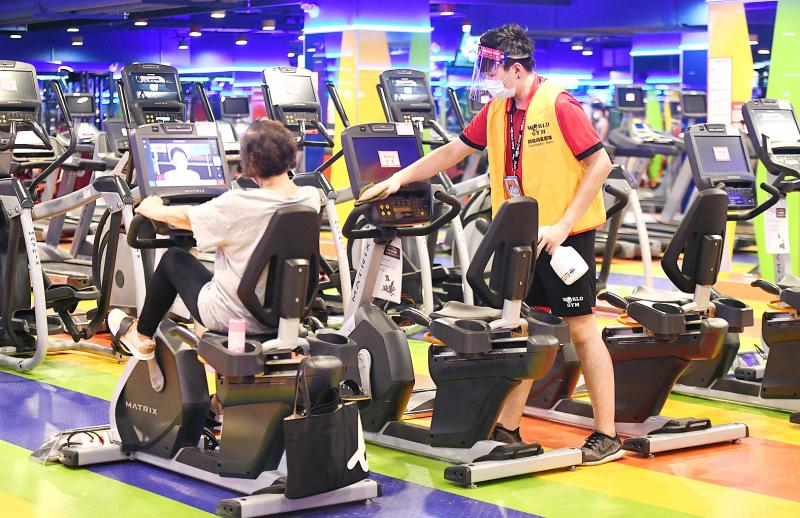
Photo: Liao Chen-huei, Taipei Times
Vieshow Cinema, the largest movie theater chain in Taiwan, said that few people bought tickets, although it attributed the low attendance to it being a weekday.
Moreover, Taoyuan and New Taipei City did not allow movie theaters to open.
Even if theaters are allowed to open, eating and drinking are not allowed, while seating restrictions are being enforced.
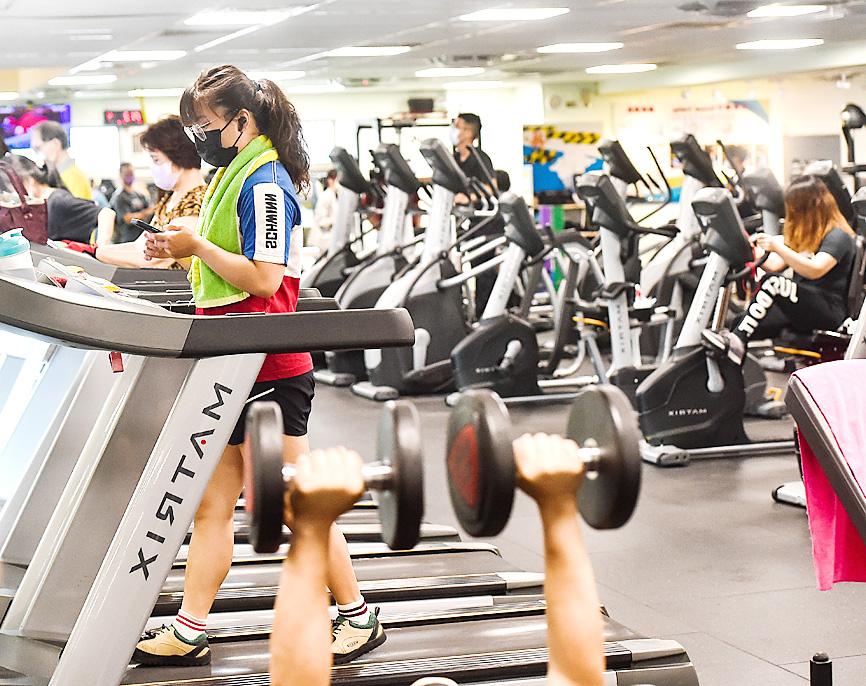
Photo: Tu Chien-jung, Taipei Times
Sales were expected to improve today, with the first showings of Marvel’s Black Widow, Vieshow said.
New Taipei City and Taoyuan were also the only two of the six special municipalities that maintained bans on gyms and sports centers reopening.
However, publicly run sports centers in Taipei began to open at 5am yesterday, said Lee Jung-chin (李榮晉), director of the Taipei Department of Sports’ sports industry division, adding that most private gyms in Taipei reopened to members early yesterday.
In Taichung, movie theaters and gyms reopened, although attendance was sparse.
Gyms and movie theater operators said that they expected more people in the next few days once people got used to the changes.
The Tainan City Government said that only one of the 13 movie theaters there opened, with others waiting until today or later this month to see if the central government lifts the nationwide alert.
In Kaohsiung, 30, 18 and 62 people were at the Chungcheng Stadium, the Sanmin Tennis Courts and the Chungshan Tennis Courts respectively as of 10am, the city government said.
The Taipei Zoo and Taipei Children’s Amusement Park remained closed.
Few people visited reopened scenic spots in New Taipei City.
City authorities said that the sites are limited to 40 percent of their normal capacity and no eating is allowed.
They pledged to close them if too many people show up at once.
Taoyuan’s Shihmen Reservoir (石門水庫), a major tourism site, was one of the few well-attended spots.
Three of Taiwan’s biggest amusement parks — Janfusun Fancyworld in Yunlin County, Lihpao Discovery Land in Taichung and Farglory Ocean Park in Hualien — said that about 100 visitors had entered each of their reopened parks as of noon.
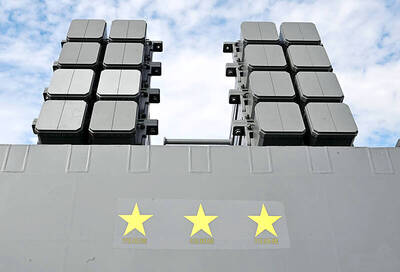
UPGRADE: The Kang Ding-class frigate is replacing its Chaparall missiles with Tien Chien II and Hua Yang VLS, which would provide it with long-range, 360° air defense Taiwan plans to produce 1,200 to 1,376 Hai Chien II missiles (海劍二, Sea Sword II) — also known as TC-2N — to serve as the standard air defense system of the navy’s surface combatant fleet, a source said yesterday. Last week, the Hai Chien II, the naval version of the Tien Kung II missile (天劍二, Sky Sword II), completed a live-fire test in waters off the National Chungshan Institute of Science and Technology’s Jiupeng facility (九鵬) in Pingtung County’s Manjhou Township (滿州). The MIM72 Chaparral and other dated air defense missiles that currently arm Taiwanese ships have inadequate range to combat Chinese

REASONS FOR TRAVEL: An assistant professor said that proposed amendments to penalize drivers if they used drugs overseas would not deter people from traveling People who operate a motor vehicle under the influence of marijuana would have their driver’s license revoked, even if they used the substance while overseas, the Ministry of Transportation and Communications said yesterday, citing proposed amendments to the Road Traffic Management and Penalty Act (道路交通管理處罰條例). The amendments would also authorize the government to revoke the licenses of people determined to have used Category 1 or Category 2 narcotics, even if they were not operating a vehicle while under the influence of drugs, as well as ban them from taking the license test for three years, the ministry said. People aged 18 or

HEAVY WEATHER: Typhoon Jangmi is due to crash straight into the Ryukyus as airlines look to shift flights to larger aircraft or cancel flights to Okinawa entirely Taiwan’s international air carriers announced flight adjustments over the weekend as Typhoon Jangmi is forecast to hit the Ryukyu Islands today and tomorrow. The Central Weather Administration (CWA) upgraded Jangmi from a tropical storm to a typhoon at 8am yesterday, with the eye located 580km south of Naha city. It was moving north at 19kph. Today, China Airlines’ CI-120, CI-121, CI-122 and CI-123 flights between Taoyuan and Naha, Okinawa, have been canceled as well as CI-132 and CI-133 between Kaohsiung and Naha. EVA Air’s BR-112, BR-113, BR-186 and BR-185 flights between Taoyuan and Naha are also canceled. Low-cost carrier Tigerair Taiwan canceled IT-230,
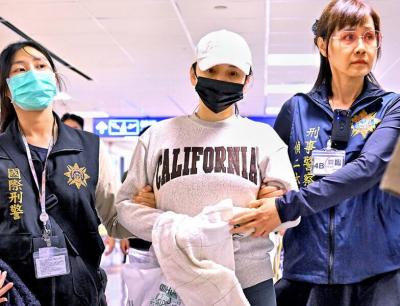
Johanne Liou (劉喬安), a Taiwanese woman who shot to unwanted fame during the Sunflower movement protests in 2014, returned to Taiwan last night after being deported from the US. She is to stand trial in Taiwan for charges involving embezzlement, fraud and drug crimes. The Criminal Investigation Bureau (CIB) said it took her into custody at Taiwan Taoyuan International Airport and would first question her before transferring her to the New Taipei District Prosecutors’ Office. She was arrested upon disembarking a flight from San Francisco that landed shortly before 7pm. Liou absconded to the US in 2019 after jumping bail


 RSS
RSS