


Taiwan’s plummet in Bloomberg’s COVID Resilience Ranking of major economies that have best fought the COVID-19 pandemic should serve as “a serious warning” to the nation, the Chinese Nationalist Party (KMT) said yesterday.
In the edition of the list released on Monday, which covered 53 economies, Taiwan fell to 44th, after ranking 15th last month and second in December last year.
The nation’s slip to near the bottom of the rankings “is not only a serious warning sign for Taiwan, but it also verified warnings by the international media that the administration of President Tsai Ing-wen (蔡英文) has been overly complacent in the fight against the COVID-19 pandemic, resulting in a failure to obtain enough vaccines,” the KMT said in a statement.

Photo courtesy of the Chinese Nationalist Party
Despite early warnings from foreign media, the response of Tsai’s administration “drifted into arbitrariness,” the party added.
The KMT accused the central government of refusing to heed the advice of experts, saying that its decision to implement a three-day quarantine for airline crews had been made “rashly.”
The self-discipline and cooperation of the public had earned Taiwan international approval early in the pandemic, the KMT said.
“However, the central government neglected its responsibility to procure vaccines,” it said.
The KMT also accused the government of placing extensive limits on the ability of private groups to assist in the procurement of COVID-19 vaccines.
This has resulted in a stagnant domestic vaccine supply, as well as the nation’s reliance on vaccine donations from other countries, it added.
The arrival of the SARS-CoV-2 Delta variant has put the health and safety of Taiwanese at greater risk, the KMT said.
The party urged the Tsai administration to “humbly review and improve” its response to COVID-19 and called for a more vigorous effort to obtain internationally approved vaccines.
Separately yesterday, KMT Chairman Johnny Chiang (江啟臣) also commented on Taiwan’s ranking in the Bloomberg list.
The ranking "may just be a number, but the lives and jobs we have lost are not,” he wrote on Twitter, adding the hashtag #TaiwanNeedsVaccines.
Chiang wrote on Facebook that at the beginning of this year, other countries were rushing to purchase vaccines — in some cases preordering enough doses to inoculate their populations several times over.
However, the Central Epidemic Command Center “was still not thinking about actively seeking out vaccines,” he said.
In February, Premier Su Tseng-chang (蘇貞昌) said that there was no urgent need for vaccinations, Chiang said, adding that the government had been arrogant and displayed a lack of risk awareness “from top to bottom.”
After the local outbreak began, the government should have “woken up,” Chiang said.
People are dying every day from infections, he said, urging the government to “feel the public’s pain.”
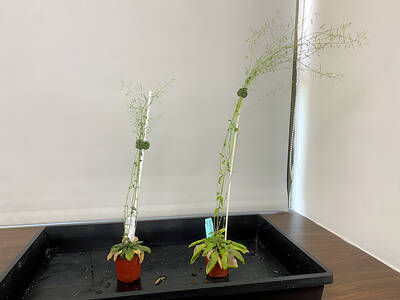
Taiwanese scientists have engineered plants that can capture about 50 percent more carbon dioxide and produce more than twice as many seeds as unmodified plants, a breakthrough they hope could one day help mitigate global warming and grow more food staples such as rice. If applied to major food crops, the new system could cut carbon emissions and raise yields “without additional equipment or labor costs,” Academia Sinica researcher and lead author the study Lu Kuan-jen (呂冠箴) said. Academia Sinica president James Liao (廖俊智) said that as humans emit 9.6 billion tonnes of carbon dioxide compared with the 220 billion tonnes absorbed
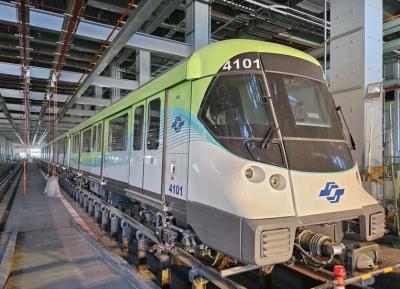
The Taipei Mass Rapid Transit (MRT) Wanda-Zhonghe Line is 81.7 percent complete, with public opening targeted for the end of 2027, New Taipei City Mayor Hou You-yi (侯友宜) said today. Surrounding roads are to be open to the public by the end of next year, Hou said during an inspection of construction progress. The 9.5km line, featuring nine underground stations and one depot, is expected to connect Chiang Kai-shek Memorial Hall Station to Chukuang Station in New Taipei City’s Jhonghe District (中和). All 18 tunnels for the line are complete, while the main structures of the stations and depot are mostly finished, he
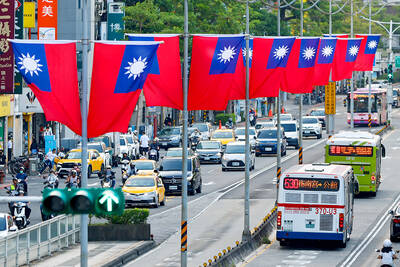
Taipei is to implement widespread road closures around Taipei 101 on Friday to make way for large crowds during the Double Ten National Day celebration, the Taipei Department of Transportation said. A four-minute fireworks display is to be launched from the skyscraper, along with a performance by 500 drones flying in formation above the nearby Nanshan A21 site, starting at 10pm. Vehicle restrictions would occur in phases, they said. From 5pm to 9pm, inner lanes of Songshou Road between Taipei City Hall and Taipei 101 are to be closed, with only the outer lanes remaining open. Between 9pm and 9:40pm, the section is
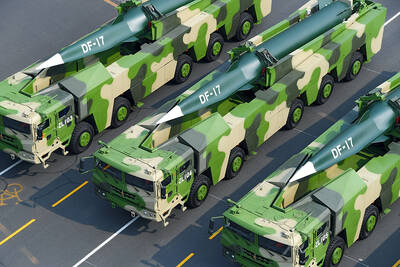
China’s plan to deploy a new hypersonic ballistic missile at a Chinese People’s Liberation Army Rocket Force (PLARF) base near Taiwan likely targets US airbases and ships in the western Pacific, but it would also present new threats to Taiwan, defense experts said. The New York Times — citing a US Department of Defense report from last year on China’s military power — on Monday reported in an article titled “The missiles threatening Taiwan” that China has stockpiled 3,500 missiles, 1.5 times more than four years earlier. Although it is unclear how many of those missiles were targeting Taiwan, the newspaper reported


 RSS
RSS