


National Taiwan University yesterday offered to let the government use its laboratories to assist in COVID-19 polymerase chain reaction (PCR) testing, university president Kuan Chung-ming (管中閔) said.
Kuan wrote on Facebook that the university would be happy to provide its facilities for COVID-19 testing, adding that the government would first need to review any legal or virus testing venue restrictions.
There are 117 P2-rated laboratories on the university’s campuses, the university said yesterday.
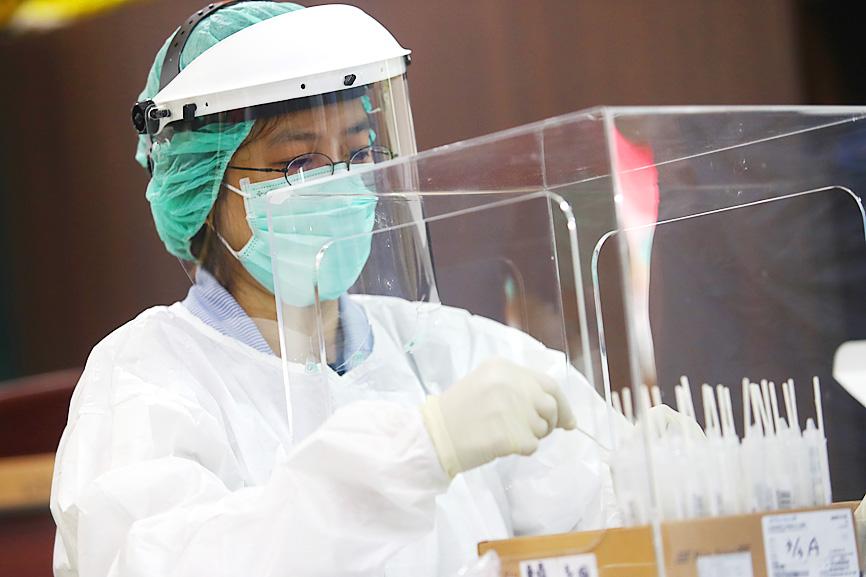
Photo: CNA
Its School of Veterinary Medicine has contacted the Central Epidemic Command Center (CECC), which would determine how to best utilize the facilities, it added.
There are 169 departments in 60 universities equipped with PCR-capable facilities in Taiwan, said Wei Chia-hui (魏佳卉), an executive director of Unews.com.tw, an online platform for students applying to universities.
With the additional facilities, the nation could increase its daily testing by 80,000, she said.
The CECC should use these facilities and personnel to help test cases, while participating universities would be happy to help, Wei said.
The Taiwan Association of Medical Technologists could also convene members licensed for virus testing to form a team of volunteers to assist local health authorities with testing at university labs, she said.
Meanwhile, Academia Sinica on Friday said that it purchased a high throughput instrument to handle 1,000 biological samples per day.
The institution contacted the Broad Institute of MIT and Harvard to learn from its experience with the equipment, it said.
It has enlisted 12 PCR facilities and 20 operators to assist the CECC with testing, Academia Sinica said.
However, the problem of delayed virus sample testing, which resulted in backlogged cases, was not caused by insufficient testing equipment or operators, but a number of factors, including sample collection and treatment, RNA extraction, and data analysis and compilation, it said.
Not anyone with a PCR-capable facility can join the virus testing, it said, adding that testing results must be consistent.
Taiwan Semiconductor Manufacturing Co (TSMC) donated to Tainan a zero-contact COVID-19 testing station, which would be operated by medical teams from Chi Mei Hospital in the city’s Yongkang District (永康), the Tainan City Government said on Friday.
The station, which is expected to be operational in two weeks, could complete PCR tests within 25 minutes, the hospital said.
All tests conducted at the station would be paid out of pocket and each exam would be expedited for faster results, it added.
In accordance with Centers for Disease Control regulations, anyone wishing to take tests at the station must register online, the hospital said.
The station could introduce a standard operating procedure for taking and analyzing samples, and reduce the number of false negative results, while lowering the risks to personnel taking the samples, it said.
This would allow hospitals to continue daily operations without interruption, it added.
The TSMC Charity Foundation said it chose to place the station in the Tainan Science Park as employees in the area would need to travel more often, and are required to provide a negative COVID-19 PCR test when traveling.
The station includes positive and negative air pressure areas, air conditioning and ultraviolet lighting for disinfection, the foundation said, adding that it is also equipped with bio-containment measures.
Additional reporting by Yang Yuan-ting

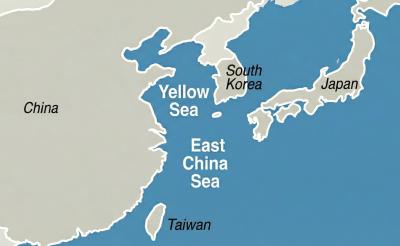
China has reserved offshore airspace in the Yellow Sea and East China Sea from March 27 to May 6, issuing alerts usually used to warn of military exercises, although no such exercises have been announced, the Wall Street Journal (WSJ) reported yesterday. Reserving such a large area for 40 days without explanation is an “unusual step,” as military exercises normally only last a few days, the paper said. These alerts, known as Notice to Air Missions (Notams), “are intended to inform pilots and aviation authorities of temporary airspace hazards or restrictions,” the article said. The airspace reserved in the alert is

South Korea is planning to revise its controversial electronic arrival card, a step Taiwanese officials said prompted them to hold off on planned retaliatory measures, a South Korean media report said yesterday. A Yonhap News Agency report said that the South Korean Ministry of Foreign Affairs is planning to remove the “previous departure place” and “next destination” fields from its e-arrival card system. The plan, reached after interagency consultations, is under review and aims to simplify entry procedures and align the electronic form with the paper version, a South Korean ministry official said. The fields — which appeared only on the electronic form

A bipartisan group of US senators has introduced a bill to enhance cooperation with Taiwan on drone development and to reduce reliance on supply chains linked to China. The proposed Blue Skies for Taiwan Act of 2026 was introduced by Republican US senators Ted Cruz and John Curtis, and Democratic US senators Jeff Merkley and Andy Kim. The legislation seeks to ease constraints on Taiwan-US cooperation in uncrewed aerial systems (UAS), including dependence on China-sourced components, limited access to capital and regulatory barriers under US export controls, a news release issued by Cruz on Wednesday said. The bill would establish a "Blue UAS
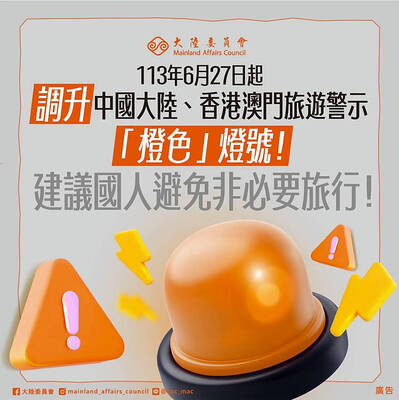
More than 6,000 Taiwanese students have participated in exchange programs in China over the past two years, despite the Mainland Affairs Council’s (MAC) “orange light” travel advisory, government records showed. The MAC’s publicly available registry showed that Taiwanese college and university students who went on exchange programs across the Strait numbered 3,592 and 2,966 people respectively. The National Immigration Agency data revealed that 2,296 and 2,551 Chinese students visited Taiwan for study in the same two years. A review of the Web sites of publicly-run universities and colleges showed that Taiwanese higher education institutions continued to recruit students for Chinese educational programs without


 RSS
RSS