


New Taipei City and Taipei have the lowest percentage of urban greenery among Taiwan’s six special municipalities, the Taiwan Forestry Research Institute said on Tuesday, citing data obtained by Formosat-5, the nation’s first domestically developed satellite.
An artificial intelligence-assisted survey of the six cities showed that Tainan has the highest greenery coverage ratio of about 32 percent, or 5,888 hectares, followed by 26 percent in Taoyuan (806 hectares), 21 percent in Taichung (2,106 hectares), 19 percent in Kaohsiung (3,112 hectares), 18 percent in Taipei (1,864 hectares) and 15 percent in New Taipei City (2,067 hectares), the institute said.
The survey is part of a research project commissioned by the Council of Agriculture to assess urban forests, institute deputy director Wu Meng-lin (吳孟玲) said, adding that the level of greenery affects the quality of a city’s living environment.
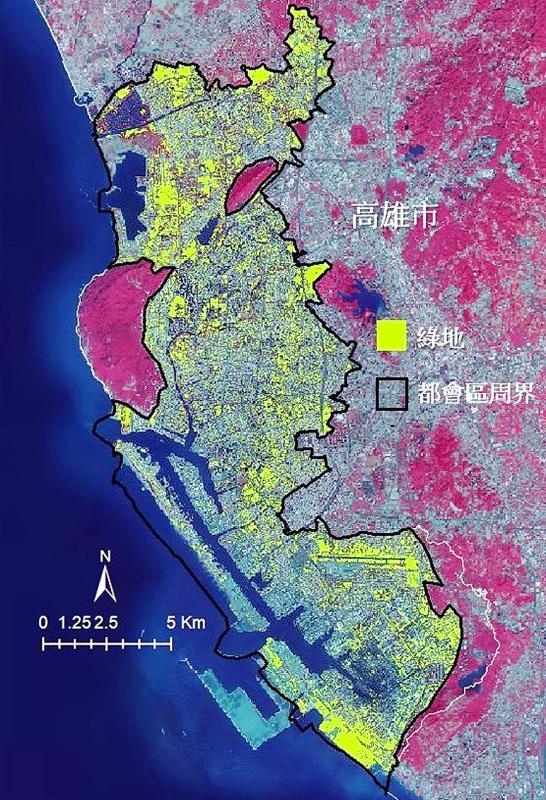
Photo courtesy of the Taiwan Forestry Research Institute
Past urban greenery surveys focused on parks, but the new tools allow researchers to analyze greenery more accurately without taking into account a city’s mountainous areas, institute researcher Hsieh Han-chin (謝漢欽) said.
For example, the survey excluded Taipei’s Yangmingshan area (陽明山) and mountain slopes with a gradient above 20 degrees, Hsieh said.
The remote sensing system of Formosat-5, which was launched on SpaceX’s Falcon 9 rocket in 2017, can transmit black-and-white photos in 2m resolution and color photos in 4m resolution, the National Space Organization (NSPO) said.
The satellite is panchromatic, operating in blue, green, red and near-infrared spectral bands, the institute added.
Thanks to the domestically operated satellite, the institute can obtain images for its surveys at low cost, Hsieh said.
However, for a more specific assessment of urban greenery, the institute would need to buy images from other sources, in which it can exactly distinguish trees from grass, Hsieh said, adding that foreign commercial satellite image suppliers can provide images that show objects as small as 50cm.
Formosat-5’s images would mainly be used to observe seasonal changes of forests or monitor large changes on land, he said, adding that the NSPO also provides researchers with images taken in the past.

Fast food chain McDonald's is to raise prices by up to NT$5 on some products at its restaurants across Taiwan, starting on Wednesday next week, the company announced today. The prices of all extra value meals and sharing boxes are to increase by NT$5, while breakfast combos and creamy corn soup would go up by NT$3, the company said in a statement. The price of the main items of those meals, if ordered individually, would remain the same. Meanwhile, the price of a medium-sized lemon iced tea and hot cappuccino would rise by NT$3, extra dipping sauces for chicken nuggets would go up

FUKUOKA SITUATION: Japanese media reported that the pathogen is expected to be identified by the summer, while the CDC downplayed the idea that it was hMPV A “mysterious cold-like illness” reported in Japan’s Fukuoka Prefecture does not seem to be a new disease, but Japanese authorities have been asked about the situation, the Centers for Disease Control (CDC) said yesterday. The Fukuoka Prefectural Medical Association on Wednesday told a news conference that a “mystery cold” that has become a hot topic on social media is “highly likely to be caused by some kind of viral infection,” Japan’s KBC News reported. “Many people are experiencing symptoms starting with a sore throat, followed by a runny nose, phlegm and a severe cough,” KBC News reported, citing association officials. Health authorities are

Nvidia Corp CEO Jensen Huang (黃仁勳) arrived in Taiwan yesterday ahead of upcoming AI and technology events, saying he plans to meet with clients and Taiwan Semiconductor Manufacturing Co Chairman C.C. Wei (魏哲家) during his visit. After landing at Taipei Songshan Airport, Huang posed for photos with fans and handed out Yakult drinks to reporters and supporters waiting at the scene, saying he has “a lot to do” during the trip. Asked about reports that Nvidia’s planned headquarters site in Taipei’s Beitou Shilin Technology Park could break ground on May 27, Huang said that if the company holds an event, he would

Carrefour Taiwan is to begin using a new name from the start of July, but it cannot divulge the name until then, the chairman of the supermarket chain's parent company said today. President Chain Store Co chairman Lo Chih-hsien (羅智先) was asked by reporters after a shareholders' meeting to confirm whether the company has settled on a new name for the supermarket brand. In March, the government-registered name of two Carrefour Taiwan branches was quietly changed to "Le Chia Kang" (樂家康) in Chinese, raising speculation that has been selected as the name. Lo said that because of local regulations and contractual obligations, the


 RSS
RSS