


A Changhua veterinarian urged pet owners not to give food not meant for animal consumption to their pets during the Lunar New Year holiday, citing a number of health issues that animals can develop if fed improperly.
Animals that are overfed are at risk of obesity, gastrointestinal inflammation, pancreatic inflammation and other problems, said Tung Meng-chih (董孟治), who also heads the Changhua County Animal Disease Control Center.
Since animals and humans have different physiological structures and metabolisms, the type of nutrition each needs is also different, he said.

Photo: Taipei Times file photo
“There is generally a lot of salt and oil in food eaten at Lunar New Year dinners, which can cause diarrhea in pets,” Tung said, adding that food high in sodium could be harmful to the kidneys of cats and dogs.
Pets older than seven years could be particularly susceptible to kidney damage, he said.
People who want to treat their pets during the holiday could give them canned meat-based pet food, Tung said.
Pet owners must also intervene if others try to feed their pets, he added.
“For example, you could tell family members that the dog has already eaten. Kidney problems in particular are common when pets are fed improperly, so that should be avoided,” Tung said.
Primo Animal Hospital president Chang Pan-chung (張泮崇) said that binge eating by pets could lead to post-holiday weight gain.
Apparent weight gain of pets should be verified at a veterinarian’s office with scales and blood tests for potential metabolic disorders, he said.
Should a pet gain more weight than normal, owners should feed them smaller portions that contain less carbohydrates, he added.
Separately, Changhua County vet Lin Ming-yuan (林明源) said pet owners should dress their pets when the temperature drops below 10°C.
“Dogs and cats generally have higher body temperatures than humans, but they might be susceptible to catching a cold during sudden drops in temperature,” he said.
Additional reporting by Cheng Hui-wen

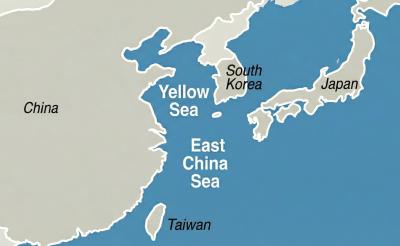
China has reserved offshore airspace in the Yellow Sea and East China Sea from March 27 to May 6, issuing alerts usually used to warn of military exercises, although no such exercises have been announced, the Wall Street Journal (WSJ) reported yesterday. Reserving such a large area for 40 days without explanation is an “unusual step,” as military exercises normally only last a few days, the paper said. These alerts, known as Notice to Air Missions (Notams), “are intended to inform pilots and aviation authorities of temporary airspace hazards or restrictions,” the article said. The airspace reserved in the alert is

NAMING SPAT: The foreign ministry called on Denmark to propose an acceptable solution to the erroneous nationality used for Taiwanese on residence permits Taiwan has revoked some privileges for Danish diplomatic staff over a Danish permit that lists “Taiwan” as “China,” Eric Huang (黃鈞耀), head of the Ministry of Foreign Affairs’ Department of European Affairs, told a news conference in Taipei yesterday. Reporters asked Huang whether the Danish government had responded to the ministry’s request that it correct the nationality on Danish residence permits of Taiwanese, which has been listed as “China” since 2024. Taiwan’s representative office in Denmark continues to communicate with the Danish government, and the ministry has revoked some privileges previously granted to Danish representatives in Taiwan and would continue to review
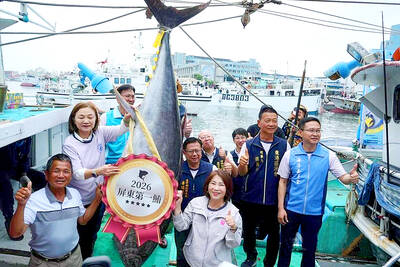
The first bluefin tuna of the season, brought to shore in Pingtung County and weighing 190kg, was yesterday auctioned for NT$10,600 (US$333.5) per kilogram, setting a record high for the local market. The auction was held at the fish market in Donggang Fishing Harbor, where the Siaoliouciou Island-registered fishing vessel Fu Yu Ching No. 2 delivered the “Pingtung First Tuna” it had caught for bidding. Bidding was intense, and the tuna was ultimately jointly purchased by a local restaurant and a local company for NT$10,600 per kilogram — NT$300 ,more than last year — for a total of NT$2.014 million. The 67-year-old skipper

China has reserved offshore airspace over the Yellow Sea and East China Sea from March 27 to May 6, issuing alerts that are usually used to warn of military exercises, although no such exercises have been announced, the Wall Street Journal (WSJ) reported on Sunday. Reserving such a large area for 40 days without explanation is an “unusual step,” as military exercises normally only last a few days, the paper said. The alerts, known as notice to air missions (NOTAMs), “are intended to inform pilots and aviation authorities of temporary airspace hazards or restrictions,” the article said. The airspace reserved in the alert


 RSS
RSS