


Judicial reform advocates yesterday called for the implementation of a jury system for criminal cases and the end of life-long tenures for judges, changes they said are needed to restore trust in the judicial system.
The call follows a Judicial Yuan report released on Monday detailing the alleged involvement of judicial officials in a corruption case centered on former Supreme Court judge Shih Mu-chin (石木欽) and Chia Her Industrial Co (佳和集團) president Weng Mao-chung (翁茂鍾).
Legal experts and media reports have called the case “the biggest corruption scandal in the history of Taiwan’s judiciary,” due to allegations of widespread bribe-taking, abuse of authority, conflict of interest and other alleged illicit activities by more than 200 judicial and government officials, including judges, prosecutors, investigators, military and police officials, and some political figures, to whom Shih reportedly introduced Weng.
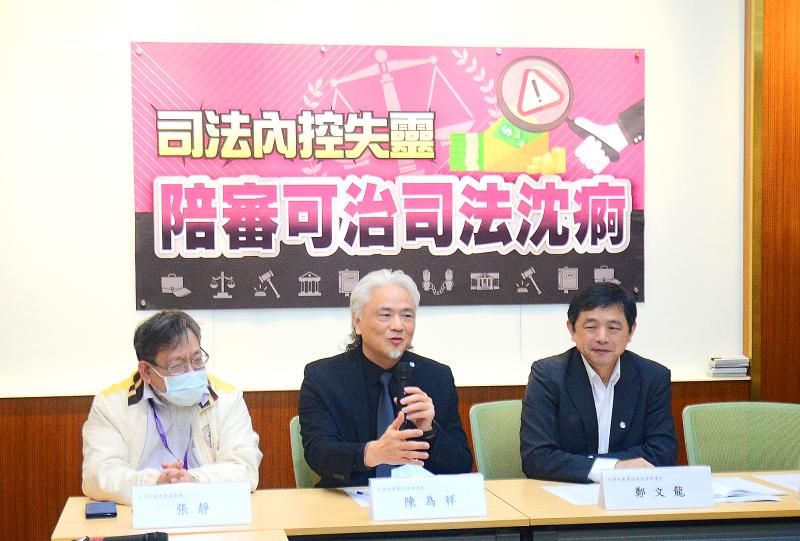
Photo: Wang Yi-sung, Taipei Times
Taiwan Jury Association members said the report had shown that control mechanisms at the Judicial Yuan and Ministry of Justice have broken down.
A more comprehensive probe into the matter is needed to root out corruption, association director Chen Wei-shyang (陳為祥) told a news conference in Taipei.
“Another serious problem is controlling materials and court files pertaining to the scandal, which are in the possession of the justice system,” Chen said, adding that the ministry only made a portion of the files available to Control Yuan members to conduct a probe.
Association founder Jerry Cheng (鄭文龍) said the report shows that judges believe “they are above the law; that they can manipulate and play with the law.”
Cheng said the case highlights the problem in giving judges life-long tenure.
“The system allows these corrupt judges to take bribes, be bought off and still keep their jobs,” he said. “Taxpayers have to provide the salary and pension for these corrupt judges for life. This goes against reason.”
“Life-long tenure for judges must be changed. It is not possible to determine whether a person has moral principles and good ethics just by passing an examination to become a judge. Limited terms are needed, and some posts should be filled with attorneys and prosecutors who have shown good conduct and that they are not tainted by unscrupulous behavior,” Cheng said.
Attorney Chang Ching (張靜), who previously worked as a judge and prosecutor, said that he hoped the ministry and Judicial Yuan would take this opportunity to reflect on themselves “and make real changes” to fix problems revealed in the case.
“If they do not, Taiwanese will no longer have faith in the justice system, nor will they expect to have true judicial reform,” Chang said.
Control Yuan member Wang Mei-yu (王美玉), in presenting the report, said that “this case has severely damaged our nation’s justice system, its reputation to carry out justice based on the principles of equality and fairness for all people, and eroded the public’s trust in the government.”
Following criticism of shortcomings and deficiencies in reports on the case, Judicial Yuan President Hsu Tzong-li (許宗力) said he would launch a comprehensive investigation that would name all the judges found to have engaged in improper conduct with Weng.
Minister of Justice Tsai Ching-hsiang (蔡清祥) said that the ministry would root out all officials found to have been involved in the case, would submit materials and documents from the ministry’s Investigation Bureau, and seek to clarify aspects of the report that lack details.

Yangmingshan National Park authorities yesterday urged visitors to respect public spaces and obey the law after a couple was caught on a camera livestream having sex at the park’s Qingtiangang (擎天崗) earlier in the day. The Shilin Police Precinct in Taipei said it has identified a suspect and his vehicle registration number, and would summon him for questioning. The case would be handled in accordance with public indecency charges, it added. The couple entered the park at about 11pm on Thursday and began fooling around by 1am yesterday, the police said, adding that the two were unaware of the park’s all-day live

Fast food chain McDonald's is to raise prices by up to NT$5 on some products at its restaurants across Taiwan, starting on Wednesday next week, the company announced today. The prices of all extra value meals and sharing boxes are to increase by NT$5, while breakfast combos and creamy corn soup would go up by NT$3, the company said in a statement. The price of the main items of those meals, if ordered individually, would remain the same. Meanwhile, the price of a medium-sized lemon iced tea and hot cappuccino would rise by NT$3, extra dipping sauces for chicken nuggets would go up

Yangmingshan National Park’s Qingtiangang (擎天崗) nature area has gone viral after a park livestream camera observed a couple in the throes of intimate congress, which was broadcast live on YouTube, drawing large late-night crowds and sparking a backlash over noise, bright lights and disruption to wildlife habitat. The area’s livestream footage appeared to show a couple engaging in sexual activity on a picnic table in the park on Friday last week, with the uncensored footage streamed publicly online. The footage quickly spread across social media, prompting a tide of visitors to travel to the site to “check in” and recreate the

Minister of Digital Affairs Lin Yi-ching (林宜敬) yesterday cited regulatory issues and national security concerns as an expert said that Taiwan is among the few Asian regions without Starlink. Lin made the remarks on Facebook after funP Innovation Group chief executive officer Nathan Chiu (邱繼弘) on Friday said Taiwan and four other countries in Asia — China, North Korea, Afghanistan and Syria — have no access to Starlink. Starlink has become available in 166 countries worldwide, including Ukraine, Malaysia, the Philippines and Vietnam, in the six years since it became commercial, he said. While China and North Korea block Starlink, Syria is not


 RSS
RSS