


Jabali has garnered the most votes to be the name for the first gorilla born at the Taipei Zoo in its 106-year history, the zoo said yesterday.
The zoo on Saturday last week started an online poll for people to choose a name for the baby gorilla, born on Oct. 31.
People had until noon on Friday to choose from one of four names for the male gorilla, which were put forward by organizations involved in the zoo’s gorilla conservation program, it said.
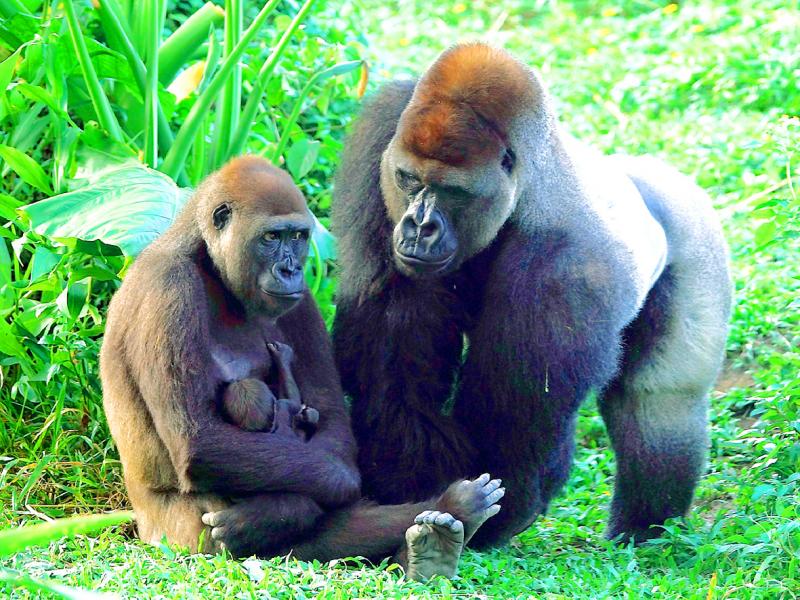
Photo provided by Taipei Zoo
Jabali (“brave and strong”) was proposed by the Netherlands Office Taipei, Ringo (a Polish game) was proposed by the Polish Office in Taipei, Kwanza (“No. 1” or “first”) was proposed by the Shin Kong Life Foundation and Mapenzi (“lively and mischievous”) was proposed by Apenheul Primate Park in Apeldoorn, the Netherlands.
Jabali received 1,004 votes, followed by Mapenzi with 228, Ringo with 213 and Kwanza with 42, the zoo said.
In other news, Taipei Rapid Transit Corp earlier this week unveiled a train decorated with various animals for a Taipei MRT railway’s Wenhu Line (Brown Line) as part of the campaign to attract more visitors to the Taipei Zoo and nearby Maokong (貓空) area.
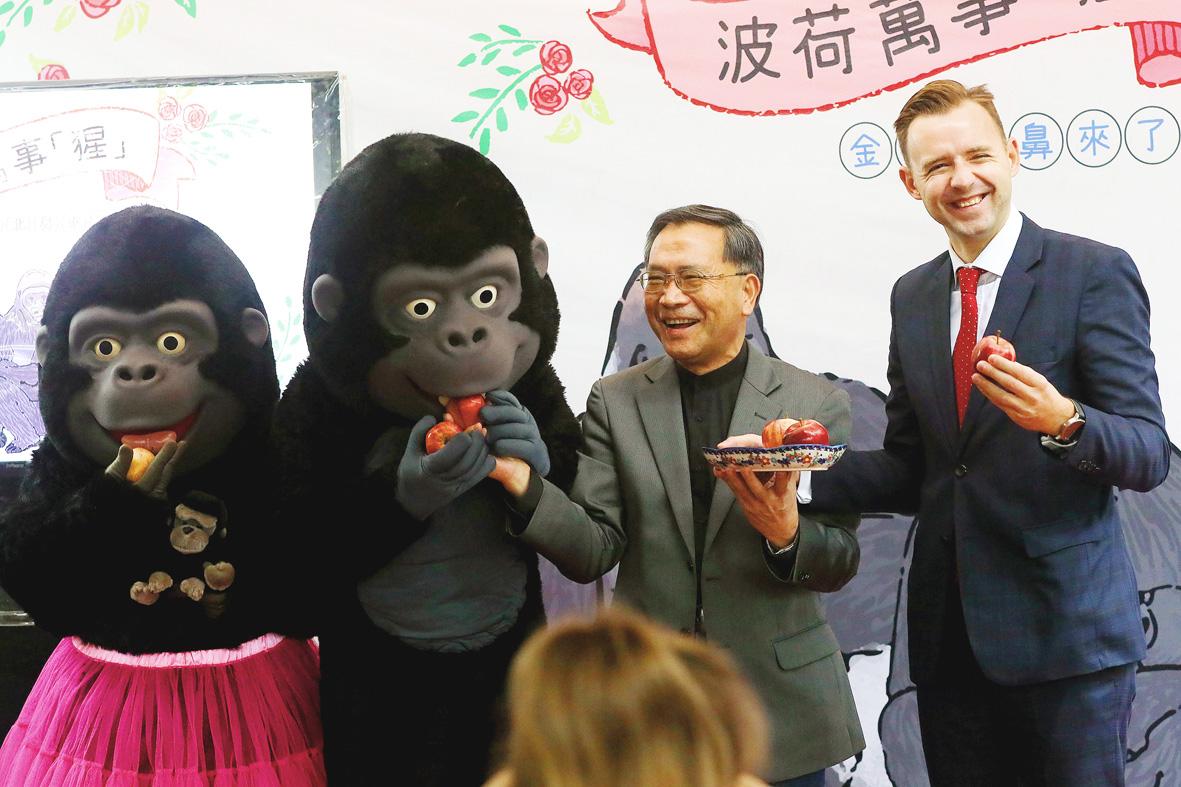
Photo: CNA
The train features images of the newborns the zoo welcomed this year, including the gorilla, a giant panda named Yuan Bao (圓寶), Malayan tapir Modou (貘豆), a Eurasian otter and three jackass penguins, Taipei Deputy Mayor Tsai Ping-kun (蔡炳坤) said.
The train would operate between Nangang District (南港) and the Taipei Zoo in Wenshan District (文山) until March 15, and would be available for people to ride to the zoo for Yuan Bao’s first public appearance on Jan. 1, the Taipei Department of Information and Tourism said.
The 170-day-old panda cub has been taken to the indoor enclosure in the giant panda house so she can familiarize herself with the space, the zoo said.
People are also encouraged to visit Maokong for the cherry blossom season around the Lunar New Year holiday in February, the department said.

The military has spotted two Chinese warships operating in waters near Penghu County in the Taiwan Strait and sent its own naval and air forces to monitor the vessels, the Ministry of National Defense (MND) said. Beijing sends warships and warplanes into the waters and skies around Taiwan on an almost daily basis, drawing condemnation from Taipei. While the ministry offers daily updates on the locations of Chinese military aircraft, it only rarely gives details of where Chinese warships are operating, generally only when it detects aircraft carriers, as happened last week. A Chinese destroyer and a frigate entered waters to the southwest

A magnitude 6.1 earthquake struck off the coast of Yilan County at 8:39pm tonight, the Central Weather Administration (CWA) said, with no immediate reports of damage or injuries. The epicenter was 38.7km east-northeast of Yilan County Hall at a focal depth of 98.3km, the CWA’s Seismological Center said. The quake’s maximum intensity, which gauges the actual physical effect of a seismic event, was a level 4 on Taiwan’s 7-tier intensity scale, the center said. That intensity level was recorded in Yilan County’s Nanao Township (南澳), Hsinchu County’s Guansi Township (關西), Nantou County’s Hehuanshan (合歡山) and Hualien County’s Yanliao (鹽寮). An intensity of 3 was

Japanese Prime Minister Sanae Takaichi’s comment last year on Tokyo’s potential reaction to a Taiwan-China conflict has forced Beijing to rewrite its invasion plans, a retired Japanese general said. Takaichi told the Diet on Nov. 7 last year that a Chinese naval blockade or military attack on Taiwan could constitute a “survival-threatening situation” for Japan, potentially allowing Tokyo to exercise its right to collective self-defense. Former Japan Ground Self-Defense Force general Kiyofumi Ogawa said in a recent speech that the remark has been interpreted as meaning Japan could intervene in the early stages of a Taiwan Strait conflict, undermining China’s previous assumptions

Instead of focusing solely on the threat of a full-scale military invasion, the US and its allies must prepare for a potential Chinese “quarantine” of Taiwan enforced through customs inspections, Stanford University Hoover fellow Eyck Freymann said in a Foreign Affairs article published on Wednesday. China could use various “gray zone” tactics in “reconfiguring the regional and ultimately the global economic order without a war,” said Freymann, who is also a nonresident research fellow at the US Naval War College. China might seize control of Taiwan’s links to the outside world by requiring all flights and ships entering or leaving Taiwan


 RSS
RSS