


A group of advocates yesterday announced the formation of an alliance in Taipei called Business Action on Climate Change (BACC), aimed at facilitating a more integrated effort to fight climate change among the private sector, the government and the public.
The alliance was cofounded by Niven Huang (黃正忠), managing director of KPMG Sustainability Consulting and regional leader of KPMG Sustainability Services in the Asia-Pacific; Robert Shih (石信智), general manager of YC Consultants; and Camyale Chao (趙恭岳), executive director of the International Climate Development Institute.
At a news conference to launch the alliance, Huang said that while the global “economic lockdown” brought upon by the COVID-19 pandemic has contributed to efforts to save energy and reduce carbon emissions, wildfires last year and this year have still resulted in record-breaking concentrations of atmospheric carbon dioxide worldwide.
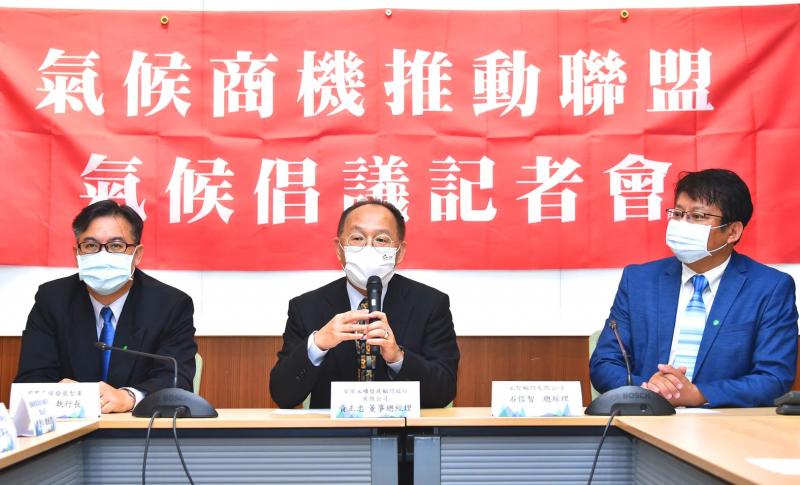
Photo: Tu Chien-jung, Taipei Times
To conserve energy and reduce carbon emissions, all main sectors of the economy must transition at the same time, he said.
As the construction, manufacturing, transport and agriculture sectors move toward a more circular and environmentally friendly future, the alliance aims to help them gain the support of the government, the market and the public, Huang said.
Although the pandemic has had a clear impact on economies worldwide, it has not slowed the climate-related plans of governments, Chao said.
Climate-related issues are not just about environmental protection, as was often viewed in the past, but are also related to development, he said.
In light of global climate advocacy, supply chains across the world are expected to reorganize, he said.
It is important for Taiwan to plan ahead for changes in climate policies, seize potential opportunities for “green” business, build a better policy environment and connect with the world, Chao said.
While in the past reducing carbon emissions was viewed by businesses as a cost, the alliance hopes to promote the idea of carbon reduction as a business opportunity, Shih said.
Even trying its hardest, Taiwan would only be able to reduce global carbon emissions by less than 1 percent, he said.
However, it could use its technology to help the world lower emissions, Shih said.
Lin Tze-luen (林子倫), deputy executive of the Executive Yuan’s Office of Energy and Carbon Reduction; Democratic Progressive Party legislators Hung Sun-han (洪申翰), Su Chiao-hui (蘇巧慧), Lai Pin-yu (賴品妤) and Mark Ho (何志偉); and Taiwan Statebuilding Party Legislator Chen Po-wei (陳柏惟) also attended the news conference.
There are now many new ways to deal with environmental issues that can give rise to new business opportunities, Su said.
When people have an incentive to invest more resources in tackling environmental issues, it ensures that environmental sustainability is something people are eager — instead of forced — to achieve, she said.
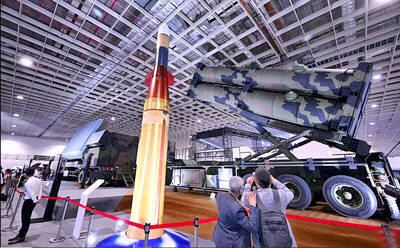
Taiwan is to commence mass production of the Tien Kung (天弓, “Sky Bow”) III, IV and V missiles by the second quarter of this year if the legislature approves the government’s NT$1.25 trillion (US$39.78 billion) special defense budget, an official said yesterday. Commenting on condition of anonymity, a defense official with knowledge of the matter said that the advanced systems are expected to provide crucial capabilities against ballistic and cruise missiles for the proposed “T-Dome,” an advanced, multi-layered air defense network. The Tien Kung III is an air defense missile with a maximum interception altitude of 35km. The Tien Kung IV and V
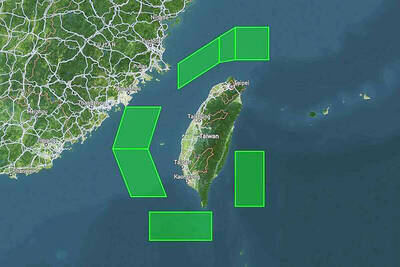
The disruption of 941 flights in and out of Taiwan due to China’s large-scale military exercises was no accident, but rather the result of a “quasi-blockade” used to simulate creating the air and sea routes needed for an amphibious landing, a military expert said. The disruptions occurred on Tuesday and lasted about 10 hours as China conducted live-fire drills in the Taiwan Strait. The Civil Aviation Administration (CAA) said the exercises affected 857 international flights and 84 domestic flights, affecting more than 100,000 travelers. Su Tzu-yun (蘇紫雲), a research fellow at the government-sponsored Institute for National Defense and Security Research, said the air
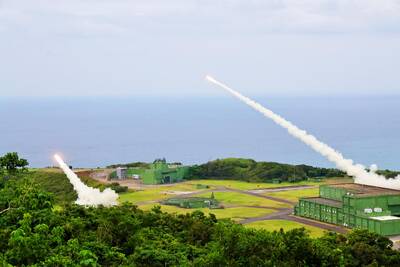
Taiwan lacks effective and cost-efficient armaments to intercept rockets, making the planned “T-Dome” interception system necessary, two experts said on Tuesday. The concerns were raised after China’s military fired two waves of rockets during live-fire drills around Taiwan on Tuesday, part of two-day exercises code-named “Justice Mission 2025.” The first wave involved 17 rockets launched at 9am from Pingtan in China’s Fujian Province, according to Lieutenant General Hsieh Jih-sheng (謝日升) of the Office of the Deputy Chief of the General Staff for Intelligence at the Ministry of National Defense. Those rockets landed 70 nautical miles (129.6km) northeast of Keelung without flying over Taiwan,
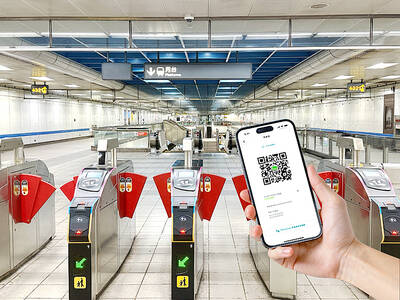
City buses in Taipei and New Taipei City, as well as the Taipei MRT, would on Saturday begin accepting QR code payments from five electronic payment providers, the Taipei Department of Transportation said yesterday. The new option would allow passengers to use the “transportation QR code” feature from EasyWallet, iPass Money, iCash Pay, Jkopay or PXPay Plus. Passengers should open their preferred electronic payment app, select the “transportation code” — not the regular payment code — unlock it, and scan the code at ticket readers or gates, General Planning Division Director-General Liu Kuo-chu (劉國著) said. People should move through the


 RSS
RSS