


Dozens of CTi News’ supporters yesterday rallied outside the National Communications Commission (NCC) in Taipei to protest the commissioners’ decision on Wednesday not to renew the news channel’s license.
Calling the decision political, protesters sprayed red paint over a Democratic Progressive Party (DPP) flag, and urged members of the public to defend freedom of speech and press freedom by attending a rally in Taipei on Sunday.
At the protest, former Chinese National Party (KMT) legislator Shen Chih-hwei (沈智慧) said the government had used the commission to shut down a news channel, and the reasons that it gave for the decision went completely against freedom of the press.
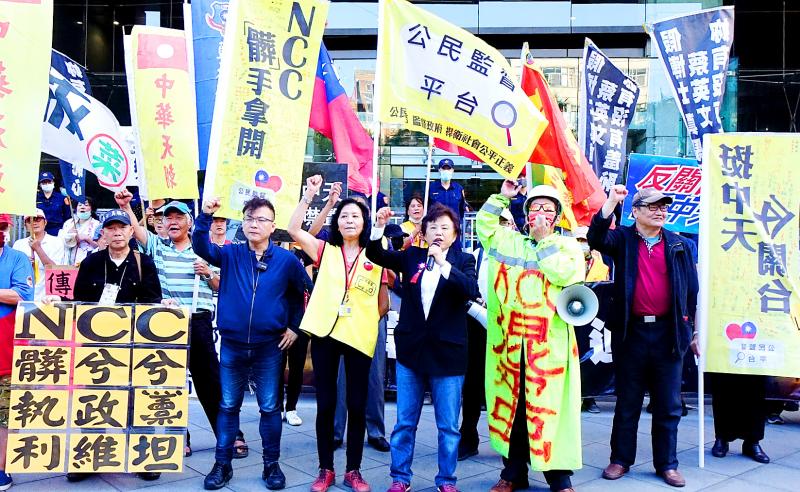
Photo: Chu Pei-hsiung, Taipei Times
The commission even told the public which channel should replace CTi News in the channel No. 52 slot, Shen said.
“We have spent so many years fighting for the freedom of the press, and yet such freedom is taken away by a party formed by dissidents during the Martial Law era,” Shen said.
University professors of communications and journalism should come out and defend such freedom.
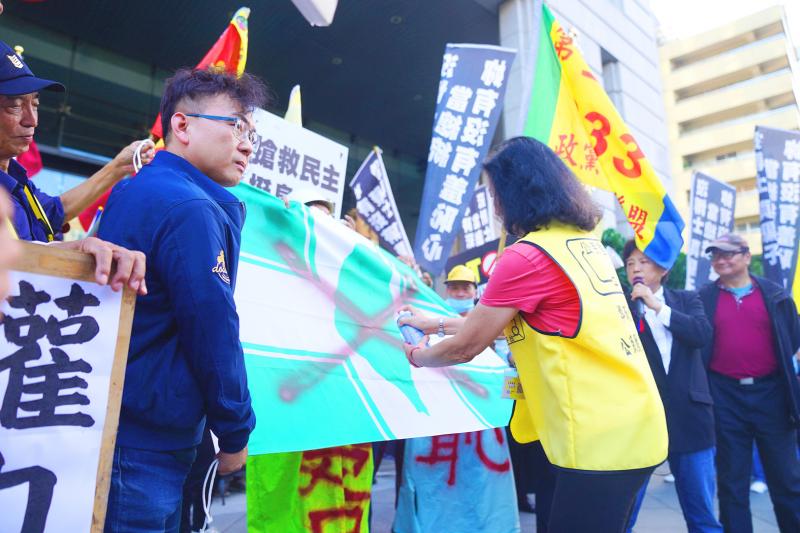
Photo: CNA
Chung Ching (鍾琴), who served as Government Information Office (GIO) director-general during former president Chen Shui-bian’s (陳水扁) administration, said that Nov. 18, 2020, should go down in history as the “Day of National Shame,” as the government shut down a news channel because its internal controls had malfunctioned and shareholders were able to interfere with the news content.
All media owners try to influence the content of their outlet, and CTi News was no exception, she said.
The commission’s decision was meant as a warning to other media outlets not to defy the government, she said.
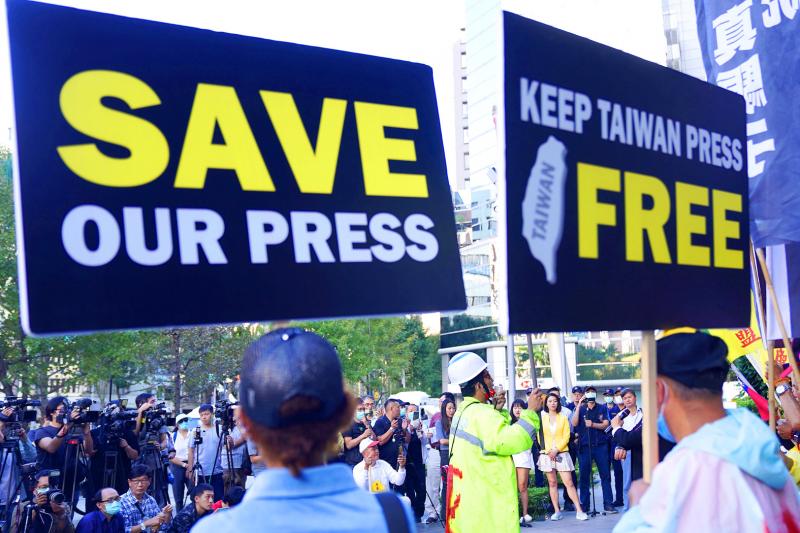
Photo: CNA
President Tsai Ing-wen (蔡英文) has taken a tough stand on cross-strait policy since she took office, and her administration does not tolerate any news media that challenge that policy, Chung said.
It has ensured that 80 percent of the nation’s broadcast media outlets sided with the pan-green camp on cross-strait issues, leaving it to handle the 20 percent that have not, she said.
“The NCC’s decision will have a chilling effect on the news media. If investors want to retain their ownership and stakes in media outlets, they had better behave,” she said.
The decision would also ensure that the KMT would no longer be a political threat to the DPP, she added.
There is nothing wrong with having channels supporting a pro-blue, pro-green or pro-China agenda in this nation, and the commission’s job is to make sure that people can freely access quality and valuable content, Chung said.
The government wants to make the public live in a “Truman Show world,” where it only shows what it wants you to know, she said, referring to the 1998 Jim Carey film.
In other developments, the Taipei City Police Department detained a man surnamed Tien (田) on criminal charges of insulting a public office after he was allegedly caught spraying green paint over an NCC flag outside the commission’s main office.
Tien reportedly told officers that he was angry that the commission denied CTi News’ license renewal application.
CTi News can continue airing programs until Dec. 11, when its license expires, the commission said.
CTi News has said it would file an administrative lawsuit against the commission.
In related news, the board of directors of the Taiwan Broadcasting System, the nation’s public broadcasting group, passed a resolution to form a special taskforce to pursue the chance to have its news channel take over the Channel 52 slot.

REASONS FOR TRAVEL: An assistant professor said that proposed amendments to penalize drivers if they used drugs overseas would not deter people from traveling People who operate a motor vehicle under the influence of marijuana would have their driver’s license revoked, even if they used the substance while overseas, the Ministry of Transportation and Communications said yesterday, citing proposed amendments to the Road Traffic Management and Penalty Act (道路交通管理處罰條例). The amendments would also authorize the government to revoke the licenses of people determined to have used Category 1 or Category 2 narcotics, even if they were not operating a vehicle while under the influence of drugs, as well as ban them from taking the license test for three years, the ministry said. People aged 18 or

GLOBALGIVING: ‘ Caving to external pressure is not acceptable for an organization that has cultivated justice reform and human rights for 30 years,’ one NGO said A slew of non-government organizations (NGOs) have withdrawn from the GlobalGiving fundraising platform after it announced it would use “Chinese Taipei” instead of “Taiwan” from next month. The Taiwan Good Rice Association wrote on Facebook on Friday that it was informed on April 28 via a teleconference call of the change, which was made because the platform wanted to operate in China. Taiwan Good Rice is to terminate all cooperative relationships with GlobalGiving in response to the platform’s “unilateral and non-negotiable” decision to remove references to Taiwan, the NGO said. “Taiwan is in the official name of Taiwan Good Rice Association and the

HEAVY WEATHER: Typhoon Jangmi is due to crash straight into the Ryukyus as airlines look to shift flights to larger aircraft or cancel flights to Okinawa entirely Taiwan’s international air carriers announced flight adjustments over the weekend as Typhoon Jangmi is forecast to hit the Ryukyu Islands today and tomorrow. The Central Weather Administration (CWA) upgraded Jangmi from a tropical storm to a typhoon at 8am yesterday, with the eye located 580km south of Naha city. It was moving north at 19kph. Today, China Airlines’ CI-120, CI-121, CI-122 and CI-123 flights between Taoyuan and Naha, Okinawa, have been canceled as well as CI-132 and CI-133 between Kaohsiung and Naha. EVA Air’s BR-112, BR-113, BR-186 and BR-185 flights between Taoyuan and Naha are also canceled. Low-cost carrier Tigerair Taiwan canceled IT-230,
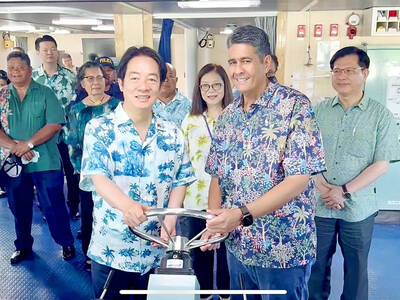
MULTIPRONGED APPROACH: China has sought to pressure Palau across a number of fronts, but the island nation has staunchly resisted overtures to ditch Taiwan Palau has been firm in backing Taiwan despite Chinese pressure that uses tourism economics, cyberattacks and criminal infiltration as tools to threaten the Pacific ally into renouncing its recognition of Taiwan as a sovereign state. The Presidential Office yesterday announced that Vice President Hsiao Bi-khim (蕭美琴) would visit Palau from Saturday to Wednesday next week at the invitation of Palauan President Surangel Whipps Jr. Whipps in April said in an interview that China had outspokenly asked Palau to “denounce Taiwan.” “And we have said: ‘We have no enemies, but nobody tells us who our friends are,’” he said. Whipps has told reporters multiple times


 RSS
RSS