


The government’s census Web site on Sunday crashed on its opening day, raising concerns that personal information could have been leaked.
More than 10,000 people visited the site when it went online at 9am, requiring contractor Acer to adjust the system to ease congestion and boost speeds, the Directorate-General of Budget, Accounting and Statistics (DGBAS) said yesterday.
Users reported having trouble signing in to the site and loading pages starting at about 10:25am, while some reported seeing other people’s information.
The site was shut down at 10:44am for repairs and went back online after 11pm.
The crash was likely caused by heavy traffic, DGBAS Minister Chu Tzer-ming (朱澤民) said.
Officials shut down the site immediately after reports that some personal information was being erroneously displayed, he added.
Chu thanked the public for their support and apologized for any inconvenience, vowing to clarify details related to the crash and resolve the matter as soon as possible.
Cybersecurity experts chastised the Executive Yuan for the blunder, saying it was not the first time it has botched an online registration system tasked with collecting personal information.
The government’s household registration Web site has crashed five times, showing that the government is unable to control such platforms, let alone supervise outside contractors, National Taiwan University electrical engineering professor Lin Tsung-nan (林宗男) said.
If the government cannot even manage to run a simple data entry system, this raises serious concerns about its implementation of electronic identification cards, Lin added.
This year’s decennial census, the nation’s seventh overall, is to take place over the course of this month.
Online counting started yesterday, while the DGBAS is to send 16,000 personnel to 1.2 million households this month to collect data on population distribution, household and family structures, long-term care and childcare services, education, employment, language use and housing conditions.

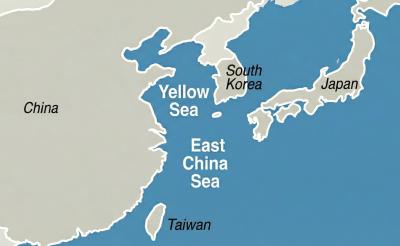
China has reserved offshore airspace in the Yellow Sea and East China Sea from March 27 to May 6, issuing alerts usually used to warn of military exercises, although no such exercises have been announced, the Wall Street Journal (WSJ) reported yesterday. Reserving such a large area for 40 days without explanation is an “unusual step,” as military exercises normally only last a few days, the paper said. These alerts, known as Notice to Air Missions (Notams), “are intended to inform pilots and aviation authorities of temporary airspace hazards or restrictions,” the article said. The airspace reserved in the alert is

South Korea is planning to revise its controversial electronic arrival card, a step Taiwanese officials said prompted them to hold off on planned retaliatory measures, a South Korean media report said yesterday. A Yonhap News Agency report said that the South Korean Ministry of Foreign Affairs is planning to remove the “previous departure place” and “next destination” fields from its e-arrival card system. The plan, reached after interagency consultations, is under review and aims to simplify entry procedures and align the electronic form with the paper version, a South Korean ministry official said. The fields — which appeared only on the electronic form

More than 6,000 Taiwanese students have participated in exchange programs in China over the past two years, despite the Mainland Affairs Council’s (MAC) “orange light” travel advisory, government records showed. The MAC’s publicly available registry showed that Taiwanese college and university students who went on exchange programs across the Strait numbered 3,592 and 2,966 people respectively. The National Immigration Agency data revealed that 2,296 and 2,551 Chinese students visited Taiwan for study in the same two years. A review of the Web sites of publicly-run universities and colleges showed that Taiwanese higher education institutions continued to recruit students for Chinese educational programs without

A bipartisan group of US senators has introduced a bill to enhance cooperation with Taiwan on drone development and to reduce reliance on supply chains linked to China. The proposed Blue Skies for Taiwan Act of 2026 was introduced by Republican US senators Ted Cruz and John Curtis, and Democratic US senators Jeff Merkley and Andy Kim. The legislation seeks to ease constraints on Taiwan-US cooperation in uncrewed aerial systems (UAS), including dependence on China-sourced components, limited access to capital and regulatory barriers under US export controls, a news release issued by Cruz on Wednesday said. The bill would establish a "Blue UAS


 RSS
RSS