


Taipei and New Taipei City yesterday said that they are willing to bear a larger share of the costs to construct a light-rail system connecting Taipei and Keelung, although neither committed to a specific amount.
Minister of Transportation and Communications Lin Chia-lung (林佳龍) met with Taipei Mayor Ko Wen-je (柯文哲), New Taipei City Mayor Hou You-yi (侯友宜) and Keelung Mayor Lin Yu-chang (林右昌) to discuss the possibility of upgrading a previously proposed system connecting Taipei and Keelung to a rapid transit line.
The four reached five preliminary agreements, which were announced at a news conference.
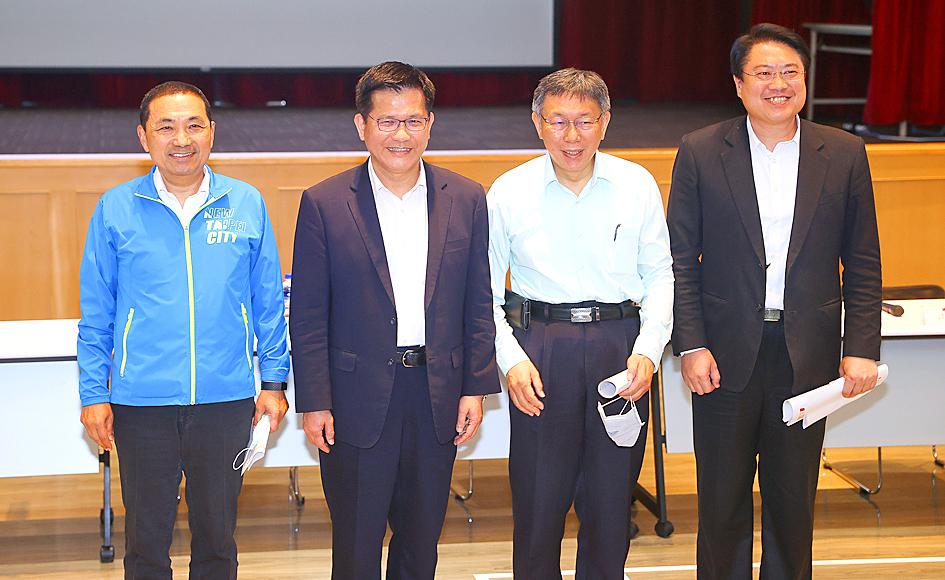
Photo: CNA
First, the light-rail system would be upgraded to be a light rail rapid transit (LRRT) system, which would have automatic train operation, they told the news conference.
Second, the system’s terminal in Taipei would be at the the Taipei Nangang Exhibition Hall MRT Station on the Bannan Line (Blue Line), and connect to the Nangang Railway Station via an underground section, they said.
This would facilitate passenger transfer to the Taiwan Railways Administration (TRA), Taiwan High Speed Rail and Taipei MRT systems, they said.
Third, as the Taipei-Keelung line would be on the same route as the proposed Minsheng-Sijhih MRT line from Jhangshuwan Neighborhood (樟樹灣) to Sijhih Science Park, the two systems would share tracks on that section to streamline construction, they said.
Fourth, the LRRT line would connect Nangang and the TRA’s Badu Station, but the section from Badu to Keelung would be designed after an evaluation by the Railway Bureau and further discussions among city officials, they said.
Fifth, a proposed extension of the high-speed rail system from Taipei to Yilan would help divert traffic from the TRA system and Chiang Wei-shui Freeway (Freeway No. 5), while expanding rail capacity in the area, they said, adding that it would also facilitate transport between the east and west coasts and address problems caused by a bottleneck in the TRA’s system between New Taipei City’s Shulin District (樹林) and Keelung’s Cidu District (七堵).
The high-speed extension should bypass Feitsui Reservoir (翡翠水壩) watersheds, they said.
Asked how costs of the LRRT line should be divided among the parties, none gave a definite response.
Ko and Hou said that they are willing to bear some extra costs.
“The Nangang Exhibition Hall is key to the city’s east gateway program,” Ko said.
“It was us who suggested building an underground section connecting the Nangang Exhibition Hall Station to the LRRT line and the TRA’s Nangang Railway Station to avoid traffic congestion,” he said. “I am not the kind of person who would ask the central government to pay for everything, but we are willing to divide the extra costs to build an underground section with the Ministry of Transportation and Communications, with us paying a bit more.”
The proposal would need to be approved by the Taipei City Council, he added.
The Taipei-Keelung line would address traffic congestion that has plagued Sijhih District (汐止) residents for years, Hou said, adding that he hoped construction would start as soon as possible.
“The LRRT line and the
Minsheng-Sijhih MRT line would converge at a station at Sijhih Science Park, which would allow people to reach the Bannan and Wenhu [Brown] MRT lines faster,” Hou said. “As such, we are willing to bear a little more of the cost.”
Lin Chia-lung said that construction costs would rise with the upgrade to an LRRT line, but the benefits would exceed the costs.
The municipality that has most of the shared section would bear a greater responsibility, and the ministry is happy that New Taipei City is willing to shoulder more costs, he said.
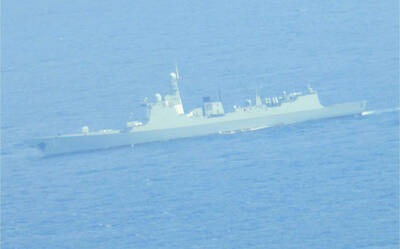
The military has spotted two Chinese warships operating in waters near Penghu County in the Taiwan Strait and sent its own naval and air forces to monitor the vessels, the Ministry of National Defense (MND) said. Beijing sends warships and warplanes into the waters and skies around Taiwan on an almost daily basis, drawing condemnation from Taipei. While the ministry offers daily updates on the locations of Chinese military aircraft, it only rarely gives details of where Chinese warships are operating, generally only when it detects aircraft carriers, as happened last week. A Chinese destroyer and a frigate entered waters to the southwest
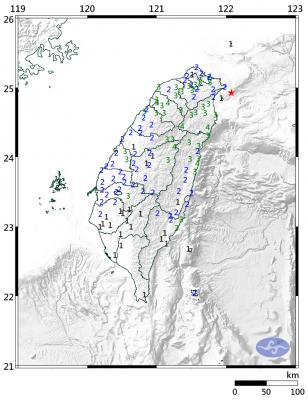
A magnitude 6.1 earthquake struck off the coast of Yilan County at 8:39pm tonight, the Central Weather Administration (CWA) said, with no immediate reports of damage or injuries. The epicenter was 38.7km east-northeast of Yilan County Hall at a focal depth of 98.3km, the CWA’s Seismological Center said. The quake’s maximum intensity, which gauges the actual physical effect of a seismic event, was a level 4 on Taiwan’s 7-tier intensity scale, the center said. That intensity level was recorded in Yilan County’s Nanao Township (南澳), Hsinchu County’s Guansi Township (關西), Nantou County’s Hehuanshan (合歡山) and Hualien County’s Yanliao (鹽寮). An intensity of 3 was
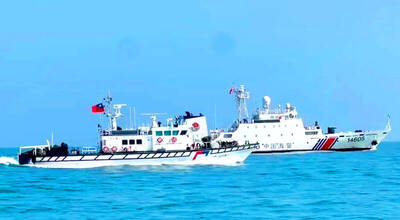
Instead of focusing solely on the threat of a full-scale military invasion, the US and its allies must prepare for a potential Chinese “quarantine” of Taiwan enforced through customs inspections, Stanford University Hoover fellow Eyck Freymann said in a Foreign Affairs article published on Wednesday. China could use various “gray zone” tactics in “reconfiguring the regional and ultimately the global economic order without a war,” said Freymann, who is also a nonresident research fellow at the US Naval War College. China might seize control of Taiwan’s links to the outside world by requiring all flights and ships entering or leaving Taiwan
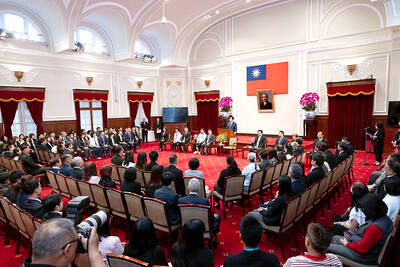
The next minimum wage hike is expected to exceed NT$30,000, President William Lai (賴清德) said yesterday during an award ceremony honoring “model workers,” including migrant workers, at the Presidential Office ahead of Workers’ Day today. Lai said he wished to thank the awardees on behalf of the nation and extend his most sincere respect for their hard work, on which Taiwan’s prosperity has been built. Lai specifically thanked 10 migrant workers selected for the award, saying that although they left their home countries to further their own goals, their efforts have benefited Taiwan as well. The nation’s industrial sector and small businesses lay


 RSS
RSS