


The National Health Insurance (NHI) system should include more out-of-pocket items and raise the fees for people who benefit more from it, experts said yesterday, citing a 95 percent increase in medical expenses covered by the government from 2000 to 2017.
The NHI system is expected to face a deficit of NT$77.1 billion (US$2.66 billion) next year, with reserve funds that could only cover one month of expenses, Ministry of Health and Welfare statistics showed.
From 2000 to 2017, although 0.3 percent fewer people visited hospitals, the average number of hospital visits per person per year increased 14 percent from 12 to 14, and medical expenses per insured person increased from NT$8,422 to NT$16,496, a 95 percent hike, Shinkong Wu Ho-su Memorial Hospital vice superintendent Hung Tzu-jen (洪子仁) said at a conference in Taipei on NHI reform.
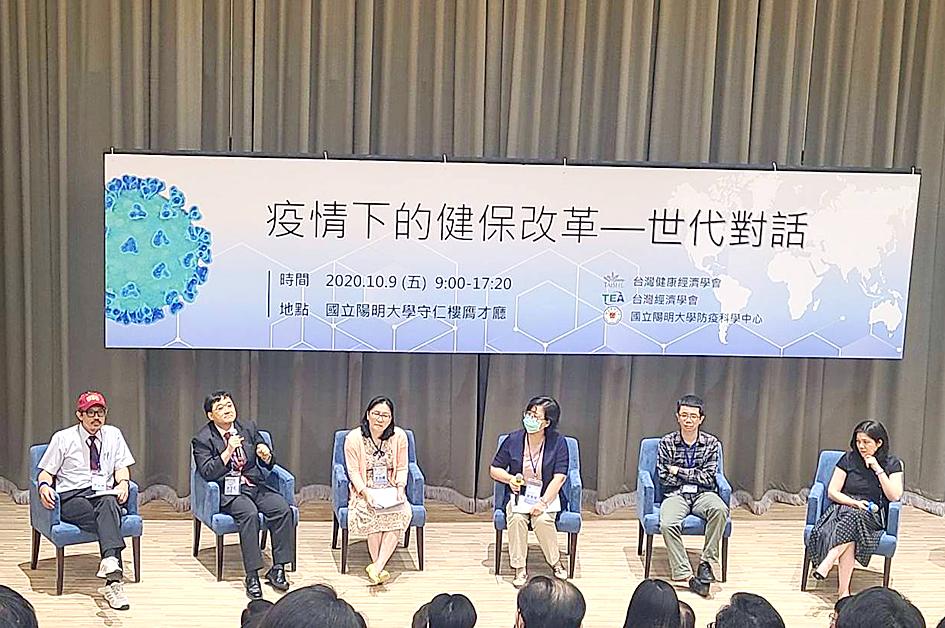
Photo: CNA
Ninety percent of people would visit a general practitioner if they have minor cold symptoms, while 85 percent would visit a hospital only if they experience more severe symptoms, Hung said, adding that the data suggest that most people try to avoid wasting medical resources.
People with chronic but stable conditions visit hospitals frequently, despite a visit to a general practitioner being sufficient, Hung said, adding that this burdens the system.
“Use more, pay more; use less, pay less; and pay nothing for urgent treatment” should be the direction of NHI reform, he said.
People should cover part of the costs for high-priced imaging examinations, unless they are in a critical condition, he said, adding that deductibles for medications should be capped at NT$500, instead of NT$200, as it is today
NHI Medical Administration section director Lee Chun-fu (李純馥) said that although raising premiums and deductibles would likely provoke strong public opposition, the steps would be necessary.
Finding consensus is difficult, because most people prioritize their own needs over the needs of others, Lee said, adding that copayments for prescribed chronic disease drugs were not a viable step, as some people might start taking medication irregularly.
Taiwan Medical Alliance for Labor Justice and Patient Safety representative Chien Li-chien (簡立建) said that premiums should only be raised for people who frequently visit hospitals, instead of burdening everybody.
People who use fewer public medical resources should pay less in premiums, or even be refunded, so that the NHI system can operate on a user-pay model, Chien said.
Too many resources are wasted on unnecessary medical care, he said, citing a great number of bed-ridden patients in a vegetative state who get frequently transferred between nursing homes, hospitals, and emergency rooms.
A great portion of the NHI budget is used to sustain the lives of these people, even though they have been unconscious for many years, Chien said, adding that these patients should be excluded from the system.

Considering that most countries issue more than five denominations of banknotes, the central bank has decided to redesign all five denominations, the bank said as it prepares for the first major overhaul of the banknotes in more than 24 years. Central bank Governor Yang Chin-lung (楊金龍) is expected to report to the Legislative Yuan today on the bank’s operations and the redesign’s progress. The bank in a report sent to the legislature ahead of today’s meeting said it had commissioned a survey on the public’s preferences. Survey results showed that NT$100 and NT$1,000 banknotes are the most commonly used, while NT$200 and NT$2,000

The Centers for Disease Control (CDC) yesterday reported the first case of a new COVID-19 subvariant — BA.3.2 — in a 10-year-old Singaporean girl who had a fever upon arrival in Taiwan and tested positive for the disease. The girl left Taiwan on March 20 and the case did not have a direct impact on the local community, it said. The WHO added the BA.3.2 strain to its list of Variants Under Monitoring in December last year, but this was the first imported case of the COVID-19 variant in Taiwan, CDC Deputy Director-General Lin Ming-cheng (林明誠) said. The girl arrived in Taiwan on

ANNUAL EVENT: Two massive Pokemon balloons are to be set up in Daan Park, with an event zone operating from 10am to 6pm This year’s Taipei Floral Picnic is to be held at Daan Park today and tomorrow, featuring an exclusive Pokemon Go event, a themed food market, a coffee rave picnic area and stage performances, the Taipei Department of Information and Tourism said yesterday. Two massive Pokemon balloons are to be set up in the park as attractions, with an exclusive event zone operating from 10am to 6pm, it said. Participants who complete designated tasks on-site would have a chance to receive limited-edition souvenirs, it added. People could also try the newly launched game Pokemon Pokopia in the trial area, the department said. Three PokeStops are

South Korea is planning to revise its controversial electronic arrival card, a step Taiwanese officials said prompted them to hold off on planned retaliatory measures, a South Korean media report said yesterday. A Yonhap News Agency report said that the South Korean Ministry of Foreign Affairs is planning to remove the “previous departure place” and “next destination” fields from its e-arrival card system. The plan, reached after interagency consultations, is under review and aims to simplify entry procedures and align the electronic form with the paper version, a South Korean ministry official said. The fields — which appeared only on the electronic form


 RSS
RSS