


Mobile apps developed by the Freeway Bureau and the Directorate-General of Highways (DGH) have been integrated into the Ministry of Transportation and Communications’ plans to ease congestion on the Chiang Wei-Shui Freeway (Freeway No. 5) over the Mid-Autumn Festival and Double Ten National Day next month.
The ministry was criticized after heavy congestion on the freeway for 32 consecutive hours on the first two days of the Dragon Boat Festival in June.
With two long weekends next month — Oct. 1 to Oct. 4 for the Mid-Autumn Festival and Oct. 9 to Oct. 11 for Double Ten National Day — the bureau yesterday said that the apps, which provide traffic information, would share their information.
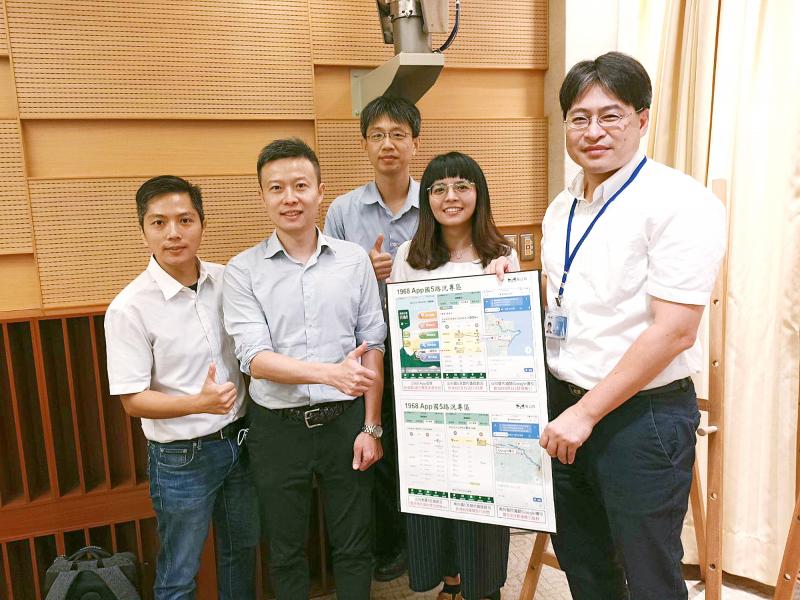
Photo: CNA
The Freeway 1968 app has an icon that can be tapped to access information related to Freeway No. 5, the bureau said.
Minister of Transportation and Communications Lin Chia-lung (林佳龍) told reporters at a news conference that if motorists want to bypass Freeway No. 5, they would have to know the alternative routes and traffic conditions on them.
“The alternative routes to Freeway No. 5 are Highway No. 2 and Highway No. 9, but drivers would want to know which route would get them to their destinations the fastest from where they are,” Lin said. “This information should be available, but it would be a hassle and dangerous for drivers to switch between apps to find it.”
“Therefore, it was necessary to integrate the apps so people can make informed decisions,” he said.
The Freeway 1968 app has been downloaded about 3.8 million times and the Highway to Happiness app more than 1 million times, he said, adding that their combined data allow more drivers to access traffic updates.
The ministry has investigated every avenue to tackle congestion issues on Freeway No. 5, Lin said.
However, whether they are effective would only be determined after they are tested over the holidays, he said.
Motorists can help ease congestion by using the apps to plan their routes and complying with the bureau’s measures, he said.
The apps would provide drivers estimated travel times to help them decide whether to use Highway No. 9 between New Taipei City’s Sindian District (新店) and Yilan County’s Toucheng Township (頭城), or alternative routes between Toucheng and Keelung’s Nuannuan District (暖暖), the bureau said.
Drivers can find expected travel times if they want to travel from Sun Yat-Sen Freeway (Freeway No. 1) or the Formosa Freeway (Freeway No. 3) to reach the Nangang (南港) Interchange in Taipei to access Freeway No. 5, including congestion data for feeder roads on southbound and northbound lanes, the bureau said.
For drivers who are not familiar with alternative routes, a Google GPS icon under the name of the route is displayed on the apps, it said.
Freeway Bureau Director-General Chao Hsin-hua (趙興華) said that traffic volumes on Freeway No. 5 over the summer rose by 20 percent on weekdays and 24 percent on weekends.
As 50 percent of the vehicles that exit the Hsuehshan Tunnel access the Suhua Highway, the Freeway 1968 app has been updated to provide reports for travel between Suao (蘇澳) and Dongao (東澳) townships in Yilan, Chao said.
Similar information is available on the Highway to Happiness app, the DGH said.
Among other measures, the bureau is to close the Shiding (石碇) and Pinglin (坪林) interchanges at certain hours and enforce a high-occupancy vehicle policy from 6am rather than 7am to ensure smooth traffic flow on Freeway No. 5, Lin said.
The DGH urged people to use public transport to help ease traffic on the long weekends, adding that there would be discounts on express bus services from Taipei to the east coast.
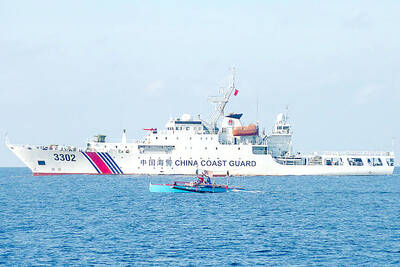
EXPANSIONIST: China deploys an average of 40 to 50 warships and coast guard vessels daily in the South China Sea, despite pledges not to militarize the region, an official said China is attempting to expand its influence across the First Island Chain and increase pressure on Japan by sending coast guard vessels into waters off of Taiwan under the pretext of maritime negotiations with Japan and the Philippines, a national security official said yesterday. China’s recent actions in the waters east of Taiwan and Japan and the Philippines’ exclusive economic zones (EEZ) are attempts to establish dominance in First Island Chain waters, said the official who declined to be named, adding that this is “expansion disguised as law enforcement.” Framing China’s actions solely as a cross-strait issue is a serious misjudgment that
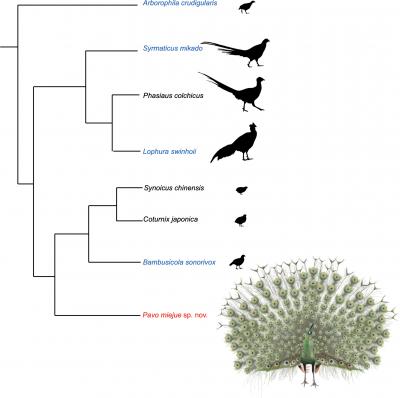
Through analyzing fossil evidence, a research team at National Taiwan University (NTU) discovered the largest endemic bird to have lived in Taiwan, naming it Pavo miejue, or extinct peafowl (滅絕孔雀). The Mikado pheasant, which is printed on the back of the NT$1,000 bank note, was previously believed to be the biggest endemic bird to Taiwan. The research team’s findings suggest that Pavo miejue lived during the Pleistocene epoch tens of thousands of years ago. It is the first endemic extinct bird species discovered and formally named in Taiwan. The study was coauthored by NTU Institute of Ecology and Evolutionary Biology professor Tsai Cheng-hsiu (蔡政修),
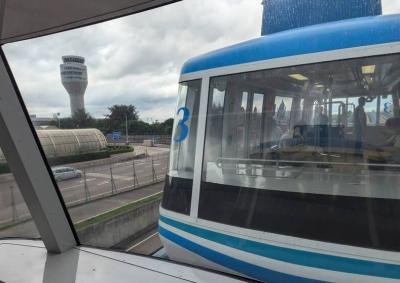
Taiwan Taoyuan International Airport is to suspend its automated Skytrain service connecting Terminal 1 and Terminal 2 starting on July 1 to facilitate connection works for the upcoming Terminal 3, the airport operator said today. Passengers and staff who need to travel between the two terminals after the suspension can instead use the Taoyuan MRT or the airport's 24-hour shuttle bus service, Taoyuan International Airport Corp said. The Taoyuan MRT Airport Line directly links the two terminals, while the shuttle buses are to operate around the clock, the company added. The Skytrain provides free transportation between the airport’s two terminals for travelers and
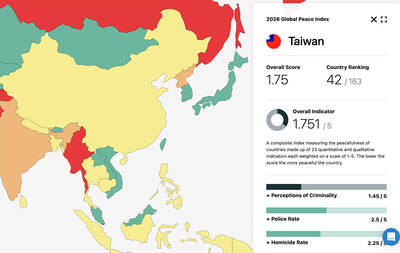
Taiwan ranked 42nd in terms of peacefulness among 163 countries, down five places from last year, according to this year’s Global Peace Index. With an overall score of 1.751, Taiwan dropped from 37th last year, the report published by the global Institute for Economics and Peace showed. The overall score measures a country’s level of peacefulness using 23 quantitative and qualitative indicators across three domains — ongoing domestic and international conflict, societal safety and security, and militarization. While Taiwan ranked 42nd worldwide, it was listed in ninth place among the 19 Asian-Pacific countries in the report, after New Zealand, Singapore, Japan, Malaysia,


 RSS
RSS