


The Taipei Parks and Street Lights Office is planning to set up a “podium of freedom” at the 228 Peace Memorial Park where people can gather and publicly voice their opinions.
Taking a leaf from the Speakers’ Corner, a site for public speeches and debates in London’s Hyde Park, the office on Monday said that the podium would be set up at the plaza in front of the Taipei 228 Memorial Museum in the park.
A historical site that is adjacent to several government agencies, the park is a popular venue for public assemblies, so setting up the podium there would be symbolically significant and in line with public demand, the office said.
The announcement follows criticism of the office by city councilors across party lines after it last month appealed a court ruling not to fine Amis singer Panai Kusui and her husband, Nabu Husungan Istanda, for holding public gatherings in the park without an official permit.
Panai and her allies are fighting a regulation enacted by the Council of Indigenous Peoples in February 2017 that defines and zones what can be classified as “traditional territories and lands,” as it excludes privately owned land, thereby limiting where Aborigines can hold traditional activities.
As of yesterday, the protest had been going on for 1,296 days.
City officials fined Panai NT$7,200 last year for contravening Article 13 of the Taipei City Park Management Ordinance (臺北市公園管理自治條例) by setting up tables, chairs, boxes, cabinets and structures in the park without permission.
However, the Taipei District Court ruled in favor of Panai in her appeal on July 27, saying that she was exercising her freedom of speech without hindering public passage through the park or damaging its facilities.
The office appealed the ruling last month, drawing criticism from several city councilors, who cited court opinions that parks and roads are traditionally places for public forums and said that the appeal goes against Taipei Mayor Ko Wen-je’s (柯文哲) description of the city as “friendly to human rights and diversity.”
Once the podium is established, it would be open to the public from 8am to 10pm every day, but audio amplifiers and similar devices are banned to avoid disturbing other park visitors and the National Taiwan University Hospital nearby, it said.
If the effect is good, the office would set up more podiums in other parks, it added.

LOUD AND PROUD Taiwan might have taken a drubbing against Australia and Japan, but you might not know it from the enthusiasm and numbers of the fans Taiwan might not be expected to win the World Baseball Classic (WBC) but their fans are making their presence felt in Tokyo, with tens of thousands decked out in the team’s blue, blowing horns and singing songs. Taiwanese fans have packed out the Tokyo Dome for all three of their games so far and even threatened to drown out home team supporters when their team played Japan on Friday. They blew trumpets, chanted for their favorite players and had their own cheerleading squad who dance on a stage during the game. The team struggled to match that exuberance on the field, with
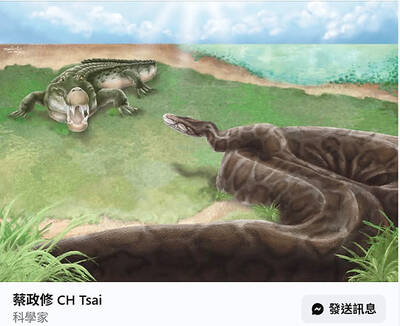
Taiwanese paleontologists have discovered fossil evidence that pythons up to 4m long inhabited Taiwan during the Pleistocene epoch, reporting their findings in the international scientific journal Historical Biology. National Taiwan University (NTU) Institute of Ecology and Evolutionary Biology associate professor Tsai Cheng-hsiu (蔡政修) led the team that discovered the largest snake fossil ever found in Taiwan. The single trunk vertebra was discovered in Tainan at the Chiting Formation, dated to between 400,000 and 800,000 years ago in the Middle Pleistocene, the paper said. The area also produced Taiwan’s first avian fossil, as well as crocodile, mammoth, saber-toothed cat and rhinoceros fossils, it said. Discoveries

Taiwanese paleontologists have discovered fossil evidence that pythons up to 4m long inhabited Taiwan during the Pleistocene epoch, reporting their findings in the international scientific journal Historical Biology. National Taiwan University (NTU) Institute of Ecology and Evolutionary Biology associate professor Tsai Cheng-hsiu (蔡政修) led the team that discovered the largest snake fossil ever found in Taiwan. A single trunk vertebra was discovered in Tainan at the Chiting Formation, dated to between 800,000 to 400,000 years ago in the Middle Pleistocene, the paper said. The area also produced Taiwan’s first avian fossil, as well as crocodile, mammoth, sabre-toothed cat and rhinoceros fossils, it said. Discoveries

Whether Japan would help defend Taiwan in case of a cross-strait conflict would depend on the US and the extent to which Japan would be allowed to act under the US-Japan Security Treaty, former Japanese minister of defense Satoshi Morimoto said. As China has not given up on the idea of invading Taiwan by force, to what extent Japan could support US military action would hinge on Washington’s intention and its negotiation with Tokyo, Morimoto said in an interview with the Liberty Times (sister paper of the Taipei Times) yesterday. There has to be sufficient mutual recognition of how Japan could provide


 RSS
RSS