


The Alliance for the Rescue of Datan Algae Reefs yesterday reiterated its call on President Tsai Ing-wen (蔡英文) to protect Taoyuan’s algae reefs, urging her to be humble and live up to her promises.
The alliance created a temporary sculpture depicting the outline of Taiwan proper with 1,000 paper cups on Taipei’s Ketagalan Boulevard.
In Mandarin, “humble” is pronounced qian bei (謙卑), which is similar to the pronunciation of “thousand cups.”
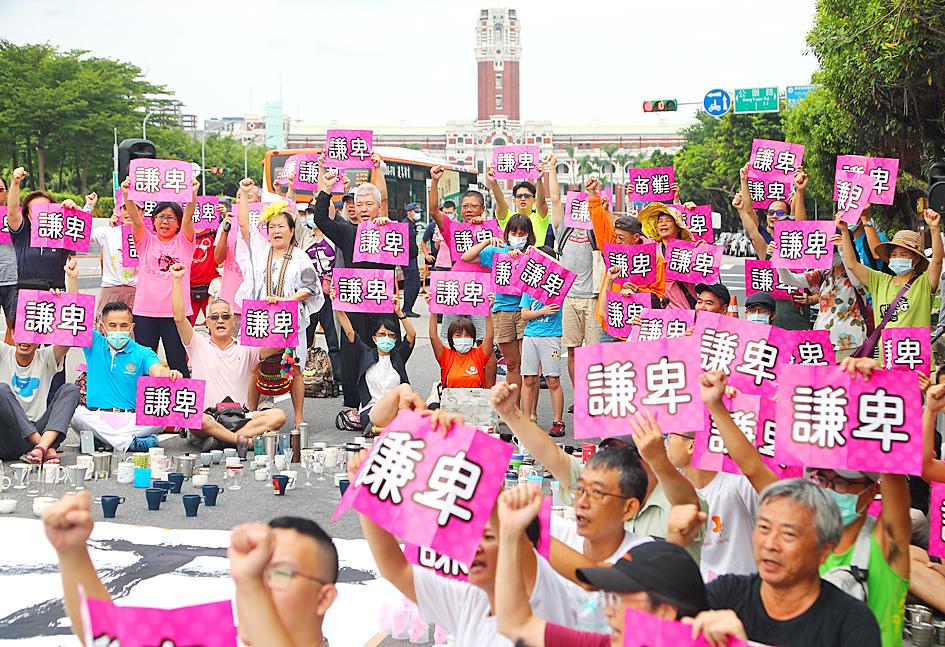
Photo: CNA
Alliance convener Pan Chong-cheng (潘忠政) said that Tsai should remember her own words, when in 2016 she asked her administration members to be “humble, humble and humble.”
The alliance has been protesting the construction of the nation’s third liquefied natural gas terminal by state-run CPC Corp, Taiwan off the coast of Datan Borough (大潭) in Taoyuan’s Guanyin District (觀音).
The intertidal zone is home to a wide stretch of endangered algae and other protected marine species, the alliance said.
Construction of the terminal started last year, after the project in 2018 passed an environmental impact assessment amid controversy.
In March, a ship commissioned by CPC was found stranded on the shore, prompting the alliance to question the company’s pledge that it would avoid damaging the environment.
Environmental advocates on June 4 met with Tsai in the Presidential Office to talk about the issue, and Tsai promised to set up a communication platform to help settle the problem, Pan said.
However, the president did not fulfill her promise, and the company continues construction without a better plan for protecting the reefs, he said.
During the event, Taiwan Citizen Participation Association chairman Ho Tsung-hsun (何宗勳) created a calligraphy piece, also reiterating the “thousand cups” slogan, while other participants held up placards.
One of the few natural coasts in Taiwan proper’s west, the Datan coast is home to algal reefs and endangered coral species, and should be protected by law, New Power Party Legislator Chen Jiau-hua (陳椒華) said.
However, the central and local governments have turned a blind eye to the fact and pushed through the project, even though there are alternative locations, Chen said.

The Centers for Disease Control (CDC) yesterday reported the first case of a new COVID-19 subvariant — BA.3.2 — in a 10-year-old Singaporean girl who had a fever upon arrival in Taiwan and tested positive for the disease. The girl left Taiwan on March 20 and the case did not have a direct impact on the local community, it said. The WHO added the BA.3.2 strain to its list of Variants Under Monitoring in December last year, but this was the first imported case of the COVID-19 variant in Taiwan, CDC Deputy Director-General Lin Ming-cheng (林明誠) said. The girl arrived in Taiwan on

South Korea is planning to revise its controversial electronic arrival card, a step Taiwanese officials said prompted them to hold off on planned retaliatory measures, a South Korean media report said yesterday. A Yonhap News Agency report said that the South Korean Ministry of Foreign Affairs is planning to remove the “previous departure place” and “next destination” fields from its e-arrival card system. The plan, reached after interagency consultations, is under review and aims to simplify entry procedures and align the electronic form with the paper version, a South Korean ministry official said. The fields — which appeared only on the electronic form

The Ministry of Foreign Affairs (MOFA) is suspending retaliation measures against South Korea that were set to take effect tomorrow, after Seoul said it is updating its e-arrival system, MOFA said today. The measures were to be a new round of retaliation after Taiwan on March 1 changed South Korea's designation on government-issued alien resident certificates held by South Korean nationals to "South Korea” from the "Republic of Korea," the country’s official name. The move came after months of protests to Seoul over its listing of Taiwan as "China (Taiwan)" in dropdown menus on its new online immigration entry system. MOFA last week

A bipartisan group of US senators has introduced a bill to enhance cooperation with Taiwan on drone development and to reduce reliance on supply chains linked to China. The proposed Blue Skies for Taiwan Act of 2026 was introduced by Republican US senators Ted Cruz and John Curtis, and Democratic US senators Jeff Merkley and Andy Kim. The legislation seeks to ease constraints on Taiwan-US cooperation in uncrewed aerial systems (UAS), including dependence on China-sourced components, limited access to capital and regulatory barriers under US export controls, a news release issued by Cruz on Wednesday said. The bill would establish a "Blue UAS


 RSS
RSS