


The Railway Bureau yesterday decided to delay the demolition of a property as part of the Tainan City Government’s railway relocation project after the owner locked himself inside.
The decision was made after protesters and homeowner Chen Chih-hsiao (陳致曉) locked themselves into the property, which was scheduled to be demolished as part of project to move city’s railway lines underground, the bureau’s central office said.
The bureau said that it wanted to avoid a heated conflict that could result in injuries.
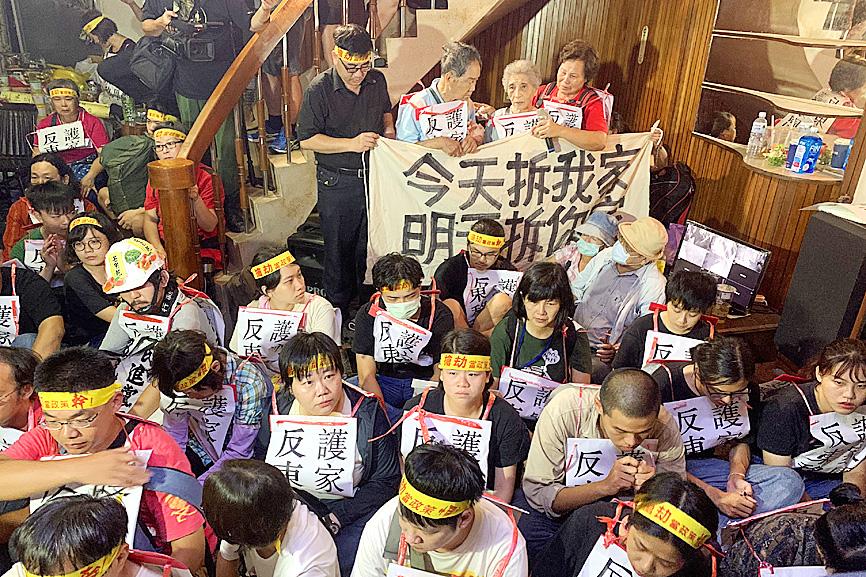
Photo: CNA
Despite arranging for police to be stationed at the site from 6am and moving machinery to Tainan’s East District (東區), the office said the protesters had still managed to enter the property and lock themselves inside.
Chen is the head of an association, formed in 2012, that advocates against the railway relocation project.
The planning for the project began in 1993 and it was approved in 2009 by then-president Ma Ying-jeou (馬英九).
Protests began when then-Tainan mayor William Lai (賴清德), now vice president, implemented the project in 2012.
Lawyer Thomas Chan (詹順貴) yesterday wrote on social media in support of Chen that it was “so ironic” that Chen’s father, who is more than 90 years old, kept a printed copy of the Democratic Progressive Party’s chapter in their home.
Officials attempted to negotiate with the protesters — as Chen had either not been present or had refused to speak to them — but failed to convince them to leave the property, the office said.
As the bureau was unable to secure Chen’s consent to enter the property, forced demolition was not possible, as it would have gone against the guiding principle of the project, it said.
Central office Division of Construction Affairs Wu Chih-jen (吳志仁) said that the office would continue to work with the city government to arrange negotiations with Chen.
Among the 340 properties in the area designated for demolition, 121 of the owners refused to move in May last year, but after negotiations and the first wave of forced demolitions, Chen’s property is the only one that remains.
Protestors say that the amount of land expropriated for the project is disproportionate to its needs and that the government intends to use part of the land for other developments.
The project to move existing railway lines underground was due to be completed in June 2024, but becuase of delays, the projected completion date has been moved to 2026, the office said.
The office previously estimated that it would be able to “obtain” the land for the project by the end of this month.
Additional reporting by Wang Chieh

LOUD AND PROUD Taiwan might have taken a drubbing against Australia and Japan, but you might not know it from the enthusiasm and numbers of the fans Taiwan might not be expected to win the World Baseball Classic (WBC) but their fans are making their presence felt in Tokyo, with tens of thousands decked out in the team’s blue, blowing horns and singing songs. Taiwanese fans have packed out the Tokyo Dome for all three of their games so far and even threatened to drown out home team supporters when their team played Japan on Friday. They blew trumpets, chanted for their favorite players and had their own cheerleading squad who dance on a stage during the game. The team struggled to match that exuberance on the field, with
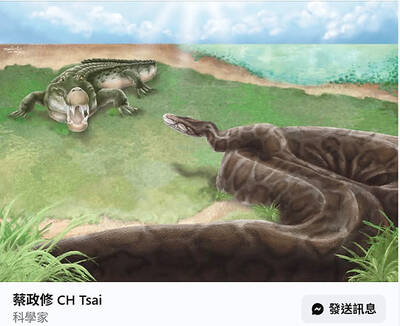
Taiwanese paleontologists have discovered fossil evidence that pythons up to 4m long inhabited Taiwan during the Pleistocene epoch, reporting their findings in the international scientific journal Historical Biology. National Taiwan University (NTU) Institute of Ecology and Evolutionary Biology associate professor Tsai Cheng-hsiu (蔡政修) led the team that discovered the largest snake fossil ever found in Taiwan. The single trunk vertebra was discovered in Tainan at the Chiting Formation, dated to between 400,000 and 800,000 years ago in the Middle Pleistocene, the paper said. The area also produced Taiwan’s first avian fossil, as well as crocodile, mammoth, saber-toothed cat and rhinoceros fossils, it said. Discoveries

Taiwanese paleontologists have discovered fossil evidence that pythons up to 4m long inhabited Taiwan during the Pleistocene epoch, reporting their findings in the international scientific journal Historical Biology. National Taiwan University (NTU) Institute of Ecology and Evolutionary Biology associate professor Tsai Cheng-hsiu (蔡政修) led the team that discovered the largest snake fossil ever found in Taiwan. A single trunk vertebra was discovered in Tainan at the Chiting Formation, dated to between 800,000 to 400,000 years ago in the Middle Pleistocene, the paper said. The area also produced Taiwan’s first avian fossil, as well as crocodile, mammoth, sabre-toothed cat and rhinoceros fossils, it said. Discoveries

Whether Japan would help defend Taiwan in case of a cross-strait conflict would depend on the US and the extent to which Japan would be allowed to act under the US-Japan Security Treaty, former Japanese minister of defense Satoshi Morimoto said. As China has not given up on the idea of invading Taiwan by force, to what extent Japan could support US military action would hinge on Washington’s intention and its negotiation with Tokyo, Morimoto said in an interview with the Liberty Times (sister paper of the Taipei Times) yesterday. There has to be sufficient mutual recognition of how Japan could provide


 RSS
RSS