


Directors Yang Hui-min (楊惠閔) and Scott Saulters took the top prizes as the Public Television Service (PTS) yesterday announced the winners of its first Hoklo-language short film competition at a ceremony in Taipei.
The “Bi Tian Iann” (眯電影) contest was organized by PTS Taigi — the PTS’ Hoklo-language channel launched in July last year —the Taipei Film Commission and the Taipei Culture Foundation.
The competition was divided into a professional and an amateur category, and submissions had to be under three minutes, with more than 80 percent of the film’s dialogue in Hoklo (also known as Taiwanese).

Photo: CNA
Organizers said they received 193 submissions from Feb. 25 to April 30, with 16 works shortlisted in each category.
Thirteen winners were chosen, including one top-prize winner, two second-prize winners and three third-prize winners for each category, as well as an Internet Choice Award.
Winners of the top prize in both categories received NT$200,000 and NT$100,000 respectively, while the Internet Choice Award, given to the film that received the most online votes last month, won NT$10,000 cash.
PTS chairwoman Chen Yu-hsiu (陳郁秀) told the ceremony that she hoped to continue holding the competition to give young filmmakers more opportunities.
Yang, who won the top prize in the professional category for Yen Ko Chi (掩咯雞), said she was at a low point in her life when she started shooting the film, and it offered her an escape.
This year has forced everyone to slow down, she said, urging people to take this opportunity to spend time alone.
Saulters, who is from Northern Ireland, won the top prize in the amateur category for Wu Yu Tzu (烏魚子), starring actress Patty Zhu (朱宥琳).
Zhu said this was her second time performing in Hoklo.
Yang Kuei-mei (楊貴媚), the celebrity spokeswoman for the competition, and Yeh Tien-lun (葉天倫), who directed the competition’s promotional video, presented the Internet Choice Award to Tainan native Ong Gan-phok (王彥博) for Hing-hok e un-too (幸福e溫度).
In a video of judges’ comments played at the ceremony, film critic Lan Tsu-wei (藍祖蔚) said conveying a story or concept in just three minutes is very difficult.
Lan praised the maturity of the many young filmmakers’ works that were nominated for the awards.

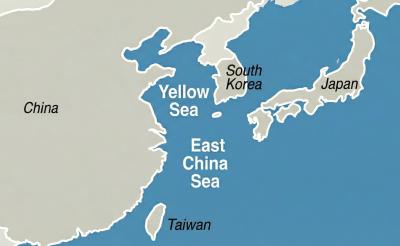
China has reserved offshore airspace in the Yellow Sea and East China Sea from March 27 to May 6, issuing alerts usually used to warn of military exercises, although no such exercises have been announced, the Wall Street Journal (WSJ) reported yesterday. Reserving such a large area for 40 days without explanation is an “unusual step,” as military exercises normally only last a few days, the paper said. These alerts, known as Notice to Air Missions (Notams), “are intended to inform pilots and aviation authorities of temporary airspace hazards or restrictions,” the article said. The airspace reserved in the alert is

South Korea is planning to revise its controversial electronic arrival card, a step Taiwanese officials said prompted them to hold off on planned retaliatory measures, a South Korean media report said yesterday. A Yonhap News Agency report said that the South Korean Ministry of Foreign Affairs is planning to remove the “previous departure place” and “next destination” fields from its e-arrival card system. The plan, reached after interagency consultations, is under review and aims to simplify entry procedures and align the electronic form with the paper version, a South Korean ministry official said. The fields — which appeared only on the electronic form

A bipartisan group of US senators has introduced a bill to enhance cooperation with Taiwan on drone development and to reduce reliance on supply chains linked to China. The proposed Blue Skies for Taiwan Act of 2026 was introduced by Republican US senators Ted Cruz and John Curtis, and Democratic US senators Jeff Merkley and Andy Kim. The legislation seeks to ease constraints on Taiwan-US cooperation in uncrewed aerial systems (UAS), including dependence on China-sourced components, limited access to capital and regulatory barriers under US export controls, a news release issued by Cruz on Wednesday said. The bill would establish a "Blue UAS

More than 6,000 Taiwanese students have participated in exchange programs in China over the past two years, despite the Mainland Affairs Council’s (MAC) “orange light” travel advisory, government records showed. The MAC’s publicly available registry showed that Taiwanese college and university students who went on exchange programs across the Strait numbered 3,592 and 2,966 people respectively. The National Immigration Agency data revealed that 2,296 and 2,551 Chinese students visited Taiwan for study in the same two years. A review of the Web sites of publicly-run universities and colleges showed that Taiwanese higher education institutions continued to recruit students for Chinese educational programs without


 RSS
RSS