


The Hakka Affairs Council on Wednesday announced that electronic travel vouchers would be issued to boost tourism and spending at Hakka villages amid the COVID-19 pandemic.
The council is to issue 280,000 sets of vouchers, it said in a statement.
People with national identification cards, and people who are married to Taiwanese and also have residency would be eligible for the vouchers, the council said.

Photo: CNA
People can enter a draw for the vouchers by registering through the council’s official account on messaging app Line within the event’s time frame, it said.
There are two types of vouchers — those reserved for families with adults aged 65 or older, and those designed for individuals, it said, adding that 140,000 vouchers would be made available in each category.
From 9am on Wednesday next week until Sunday next week, registration is open to families with adults aged 65 or older, with the winners to be announced on July 20, the council said.
From 9am on July 22 until July 26, others can register in the second draw, with the winners to be announced on July 27, it said.
Winners would be able to use the vouchers from Aug. 1 to Dec. 31 at the nation’s 70 key development areas of Hakka culture, commonly known as Hakka villages, it said.
More than 4,000 designated businesses across 11 cities and counties are part of the voucher program, the council said.
Others businesses in the food, accommodation and cultural industries at one of the 70 Hakka villages that are registered for tax purposes can apply to join the program, it said.
Draw winners would receive vouchers with a face value of NT$100 each, the council said, adding that one voucher may be used for every NT$100 spent.
The vouchers would be redeemable via QR code, it said, adding that they would not be valid in the township where the holder has their household registration.
The council said that it hopes the program encourages families to explore Hakka villages, and their rich and diverse cultural heritage, as well as driving consumption and stimulating the tourism industry.

LOUD AND PROUD Taiwan might have taken a drubbing against Australia and Japan, but you might not know it from the enthusiasm and numbers of the fans Taiwan might not be expected to win the World Baseball Classic (WBC) but their fans are making their presence felt in Tokyo, with tens of thousands decked out in the team’s blue, blowing horns and singing songs. Taiwanese fans have packed out the Tokyo Dome for all three of their games so far and even threatened to drown out home team supporters when their team played Japan on Friday. They blew trumpets, chanted for their favorite players and had their own cheerleading squad who dance on a stage during the game. The team struggled to match that exuberance on the field, with
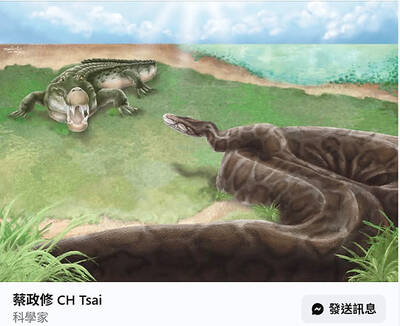
Taiwanese paleontologists have discovered fossil evidence that pythons up to 4m long inhabited Taiwan during the Pleistocene epoch, reporting their findings in the international scientific journal Historical Biology. National Taiwan University (NTU) Institute of Ecology and Evolutionary Biology associate professor Tsai Cheng-hsiu (蔡政修) led the team that discovered the largest snake fossil ever found in Taiwan. The single trunk vertebra was discovered in Tainan at the Chiting Formation, dated to between 400,000 and 800,000 years ago in the Middle Pleistocene, the paper said. The area also produced Taiwan’s first avian fossil, as well as crocodile, mammoth, saber-toothed cat and rhinoceros fossils, it said. Discoveries

Taiwanese paleontologists have discovered fossil evidence that pythons up to 4m long inhabited Taiwan during the Pleistocene epoch, reporting their findings in the international scientific journal Historical Biology. National Taiwan University (NTU) Institute of Ecology and Evolutionary Biology associate professor Tsai Cheng-hsiu (蔡政修) led the team that discovered the largest snake fossil ever found in Taiwan. A single trunk vertebra was discovered in Tainan at the Chiting Formation, dated to between 800,000 to 400,000 years ago in the Middle Pleistocene, the paper said. The area also produced Taiwan’s first avian fossil, as well as crocodile, mammoth, sabre-toothed cat and rhinoceros fossils, it said. Discoveries

Whether Japan would help defend Taiwan in case of a cross-strait conflict would depend on the US and the extent to which Japan would be allowed to act under the US-Japan Security Treaty, former Japanese minister of defense Satoshi Morimoto said. As China has not given up on the idea of invading Taiwan by force, to what extent Japan could support US military action would hinge on Washington’s intention and its negotiation with Tokyo, Morimoto said in an interview with the Liberty Times (sister paper of the Taipei Times) yesterday. There has to be sufficient mutual recognition of how Japan could provide


 RSS
RSS