


An academic yesterday drew criticism from Democratic Progressive Party (DPP) Legislator Fan Yun (范雲) after saying that President Tsai Ing-wen’s (蔡英文) nominees for a Examination Yuan president and member are unfit for the positions.
Fan hit back at Kuei Hung-chen (桂宏誠) — an assistant professor of political science at Shih Hsin University who used to head the Chinese Nationalist Party’s (KMT) Mainland Affairs Committee — describing his comments on the nominations as “too arbitrary” and “shocking.”
Fan said she felt sorry that the KMT would back an academic like him.

Photo: Tu Chien-jung, Taipei Times
Speaking yesterday at a public hearing at the Legislative Yuan in Taipei on the Examination Yuan nominees, Kuei said that former minister of education Huang Jong-tsun (黃榮村), nominated to be the body’s next president, is not a “right fit.”
If Huang, 73, assumes the position, he would be the oldest Examination Yuan president in three decades, and the wisdom that comes with age might add some advantages, Kuei said.
However, Huang has never passed a national examination for public servants, whereas all previous heads of the Examination Yuan, which is in charge of validating the qualifications of the nation’s civil servants, had relevant experience, Kuei said.
Huang might not be capable of understanding the significance of the national examination system and the role that the examinations play in social mobility, Kuei added.
Huang’s resume shows his leadership qualities, such as his considerable effort on behalf of the human rights movement during the nation’s Martial Law era, but that experience is more relevant for the Control Yuan than the Examination Yuan, he said.
Kuei also raised doubts over the nomination of Ho Yi-cheng (何怡澄), head of National Chengchi University’s public finance department, to be an Examination Yuan member.
Ho was nominated based on “having profound academic knowledge and distinctive publications or inventions,” but among her journal articles — 16 in Chinese and three in English — only one featured her as an independent author, making her nomination unjustifiable, he said.
Fan, who also has a background in academia, said that Ho’s articles are listed in the Social Science Citation Index and the Taiwan Social Sciences Citation Index, two databases that have rigorous standards for the articles they accept.
Many of Ho’s articles featured her as the first author or correspondent author, Fan said.
“On what grounds can Kuei judge that Ho has not made distinctive academic contributions?” she asked.
Kuei said that Kuo Chen-hsiung (郭振雄) — the head of National Taipei University’s accountancy department — was listed as the first author in nine of Ho’s journal articles and the correspondent author in seven.
If the DPP wants to appoint nominees based on the criterion that it claims to use, perhaps Kuo would make a better nominee, Kuei said.
Kuei said that although his remarks about Huang might have been “impolite,” he never said that Huang was not competent to serve as president of the Executive Yuan.
However, the post of Control Yuan president would probably be a much better match for his experience, Kuei said.

LOUD AND PROUD Taiwan might have taken a drubbing against Australia and Japan, but you might not know it from the enthusiasm and numbers of the fans Taiwan might not be expected to win the World Baseball Classic (WBC) but their fans are making their presence felt in Tokyo, with tens of thousands decked out in the team’s blue, blowing horns and singing songs. Taiwanese fans have packed out the Tokyo Dome for all three of their games so far and even threatened to drown out home team supporters when their team played Japan on Friday. They blew trumpets, chanted for their favorite players and had their own cheerleading squad who dance on a stage during the game. The team struggled to match that exuberance on the field, with
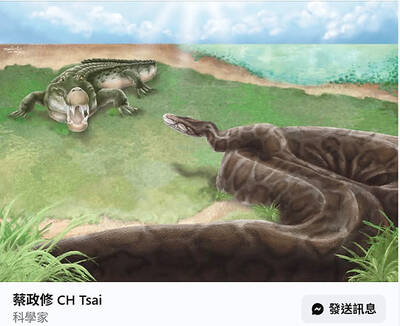
Taiwanese paleontologists have discovered fossil evidence that pythons up to 4m long inhabited Taiwan during the Pleistocene epoch, reporting their findings in the international scientific journal Historical Biology. National Taiwan University (NTU) Institute of Ecology and Evolutionary Biology associate professor Tsai Cheng-hsiu (蔡政修) led the team that discovered the largest snake fossil ever found in Taiwan. The single trunk vertebra was discovered in Tainan at the Chiting Formation, dated to between 400,000 and 800,000 years ago in the Middle Pleistocene, the paper said. The area also produced Taiwan’s first avian fossil, as well as crocodile, mammoth, saber-toothed cat and rhinoceros fossils, it said. Discoveries

Taiwanese paleontologists have discovered fossil evidence that pythons up to 4m long inhabited Taiwan during the Pleistocene epoch, reporting their findings in the international scientific journal Historical Biology. National Taiwan University (NTU) Institute of Ecology and Evolutionary Biology associate professor Tsai Cheng-hsiu (蔡政修) led the team that discovered the largest snake fossil ever found in Taiwan. A single trunk vertebra was discovered in Tainan at the Chiting Formation, dated to between 800,000 to 400,000 years ago in the Middle Pleistocene, the paper said. The area also produced Taiwan’s first avian fossil, as well as crocodile, mammoth, sabre-toothed cat and rhinoceros fossils, it said. Discoveries
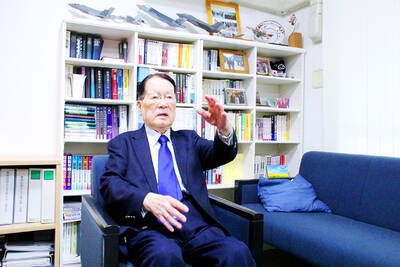
Whether Japan would help defend Taiwan in case of a cross-strait conflict would depend on the US and the extent to which Japan would be allowed to act under the US-Japan Security Treaty, former Japanese minister of defense Satoshi Morimoto said. As China has not given up on the idea of invading Taiwan by force, to what extent Japan could support US military action would hinge on Washington’s intention and its negotiation with Tokyo, Morimoto said in an interview with the Liberty Times (sister paper of the Taipei Times) yesterday. There has to be sufficient mutual recognition of how Japan could provide


 RSS
RSS