


The Ocean Conservation Administration (OCA) yesterday said it needs more data to decide whether to protect megamouth sharks, after an animal protection group said fishing vessels have been catching the species without restrictions.
A drift net vessel this week caught six of the deep-water sharks over four consecutive days off the coast of Hualien County, the Environment and Animal Society of Taiwan (EAST) wrote on Facebook on Thursday.
In 2018 and last year, another three vessels caught a total of 72 megamouth sharks, including 70 off Hualien and two off Yilan County, it wrote.
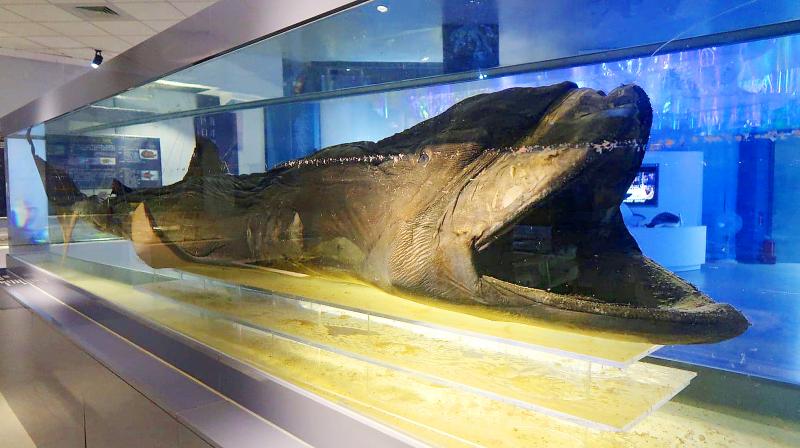
Photo provided by the Ocean Conservation Administration
As big as the protected whale sharks species, megamouth sharks are rarer, as only 226 have been documented since they were discovered and named in 1976, and 145 have been caught near Taiwan, EAST wrote.
Accusing the four vessels of purposely catching the sharks, the group urged the OCA and the Fisheries Agency to ban capturing the sharks, saying that the waters off the east coast have become a graveyard for the species due to government inaction.
The agencies said they need more data to decide whether to designate megamouth sharks as a protected species.
The International Union for Conservation of Nature and Natural Resources lists the species under “least concern,” the OCA said.
In July last year, the agency formed a work group with the Fisheries Agency, the Coast Guard Administration, experts and civic groups to promote the stock assessment and conservation of megamouth sharks, the OCA said.
It said it would work with fishers to install devices on the sharks to track their migratory paths.
Promoting the conservation of cartilaginous fishes has been the agency’s task since its founding in 2018, it said, adding that it listed whale sharks and giant oceanic manta rays as protected species on June 1.
As it takes time to complete the legal process of granting a species protected status, the Fisheries Agency could first restrict vessels’ activities if it deems they are detrimental to a species, just as it had done with whale sharks, OCA senior specialist Ko Yung-chuan (柯勇全) said.
Designating a species as protected without solid scientific evidence risks creating conflicts and setting a poor standard, Ko said.
The Fisheries Agency in 2013 started requiring fishers to file reports when catching megamouth sharks, and 136 have been reported since then, Fisheries Regulation Division chief Liu Fu-sheng (劉福昇) said.
Fishers can trade the sharks after filing reports, Liu said.
The agency needs more evidence to impose any restrictions, he said, adding that it continues to participate in the OCA work group.

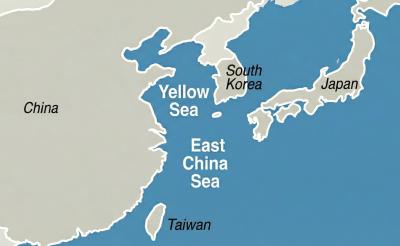
China has reserved offshore airspace in the Yellow Sea and East China Sea from March 27 to May 6, issuing alerts usually used to warn of military exercises, although no such exercises have been announced, the Wall Street Journal (WSJ) reported yesterday. Reserving such a large area for 40 days without explanation is an “unusual step,” as military exercises normally only last a few days, the paper said. These alerts, known as Notice to Air Missions (Notams), “are intended to inform pilots and aviation authorities of temporary airspace hazards or restrictions,” the article said. The airspace reserved in the alert is

NAMING SPAT: The foreign ministry called on Denmark to propose an acceptable solution to the erroneous nationality used for Taiwanese on residence permits Taiwan has revoked some privileges for Danish diplomatic staff over a Danish permit that lists “Taiwan” as “China,” Eric Huang (黃鈞耀), head of the Ministry of Foreign Affairs’ Department of European Affairs, told a news conference in Taipei yesterday. Reporters asked Huang whether the Danish government had responded to the ministry’s request that it correct the nationality on Danish residence permits of Taiwanese, which has been listed as “China” since 2024. Taiwan’s representative office in Denmark continues to communicate with the Danish government, and the ministry has revoked some privileges previously granted to Danish representatives in Taiwan and would continue to review

More than 6,000 Taiwanese students have participated in exchange programs in China over the past two years, despite the Mainland Affairs Council’s (MAC) “orange light” travel advisory, government records showed. The MAC’s publicly available registry showed that Taiwanese college and university students who went on exchange programs across the Strait numbered 3,592 and 2,966 people respectively. The National Immigration Agency data revealed that 2,296 and 2,551 Chinese students visited Taiwan for study in the same two years. A review of the Web sites of publicly-run universities and colleges showed that Taiwanese higher education institutions continued to recruit students for Chinese educational programs without

A bipartisan group of US senators has introduced a bill to enhance cooperation with Taiwan on drone development and to reduce reliance on supply chains linked to China. The proposed Blue Skies for Taiwan Act of 2026 was introduced by Republican US senators Ted Cruz and John Curtis, and Democratic US senators Jeff Merkley and Andy Kim. The legislation seeks to ease constraints on Taiwan-US cooperation in uncrewed aerial systems (UAS), including dependence on China-sourced components, limited access to capital and regulatory barriers under US export controls, a news release issued by Cruz on Wednesday said. The bill would establish a "Blue UAS


 RSS
RSS