


The reproduction of burying beetles is affected by differing daylengths, while they develop different survival mechanisms at varied elevations and latitudes, Academia Sinica Biodiversity Research Center associate research fellow Shen Sheng-feng (沈聖峰) told a news conference in Taipei yesterday.
The research team studied the behavior of burying beetles (Nicrophorus nepalensis), which are found across mountains in Asia and are sensitive to temperature changes, to examine the environmental adaptability of different populations of the species, Shen said.
Over the past three years, the team sampled beetles at nearly 327 locations in varying elevations on five mountain ranges in Asia, Shen said.
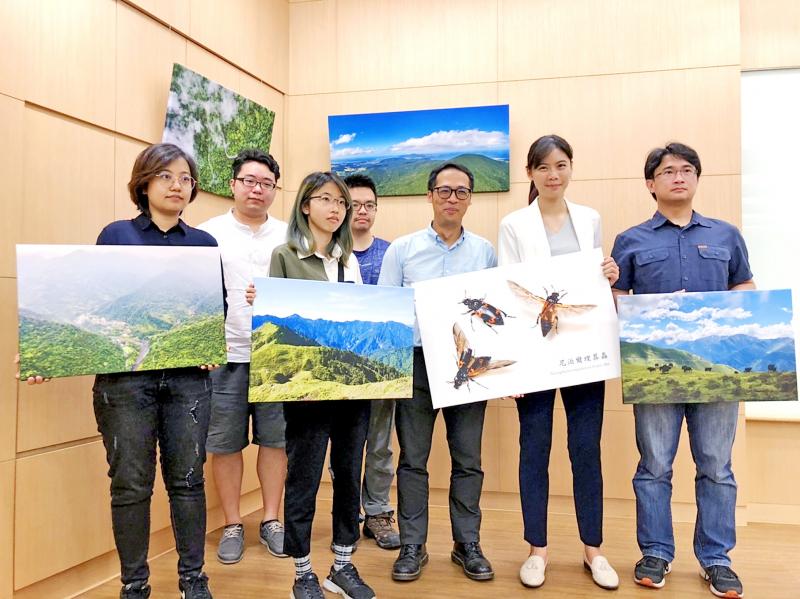
Photo: Yang Yuan-ting, Taipei Times
They included two low mountain ranges: Wulai (烏來) in Taiwan, ranging from 200m to 900m above sea level, and Amami Oshima in Japan, ranging from 60m to 700m; and three high mountain ranges — Taiwan’s Lalashan (拉拉山), ranging from 400m to 2,000m, and Hehuanshan (合歡山), ranging from 500m to 3,200m, and China’s Jiajinshan, ranging from 800m to 4,100m, their study showed.
To focus on their genetic traits, the team bred the beetles in a laboratory and studied their offspring, Shen said.
The beetles appear in areas with similar temperature ranges, but differ in their reproductive photoperiodism — their physiological reactions to varying lengths of sunlight, the team found.
Those at intermediate elevations, such as some on Hehuanshan and Lalashan, can breed in different seasons with varying daylengths, but in the team’s simulated scenarios of warmer environments, they are most susceptible to warming, as they might not be able to find places to escape the heat, he said.
Those at lower elevations can only breed at times with shorter daylengths, while those in higher mountains, such as on Jiajinshan, can only breed at times with longer daylengths, he said.
Even if the beetles at lower elevations emerged from cocoons in times with longer daylengths, they were not sexually mature, he said.
After moving the beetles to habitats of varied elevations, the team found that they could not adapt to their new environment, confirming that their photoperiodism is locally adapted, he said.
The study was published in the journal Nature Communications in March, and included contributions from National Cheng Kung University associate professor Chen I-ching (陳一菁), Columbia University associate professor Dustin Rubenstein and Chinese Academy of Sciences member Tang Yezhong (唐業忠).
Shen said that their findings can be applied to understanding the effect of climate change on other species, as they highlight the importance of studying different populations of a species, instead of a species as a whole, which was largely ignored in previous biodiversity studies.
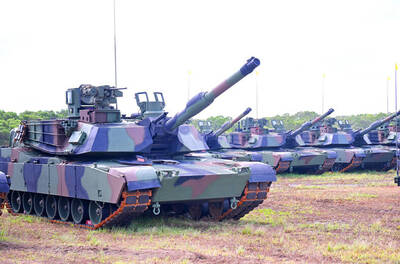
The manufacture of the remaining 28 M1A2T Abrams tanks Taiwan purchased from the US has recently been completed, and they are expected to be delivered within the next one to two months, a source said yesterday. The Ministry of National Defense is arranging cargo ships to transport the tanks to Taiwan as soon as possible, said the source, who is familiar with the matter. The estimated arrival time ranges from late this month to early next month, the source said. The 28 Abrams tanks make up the third and final batch of a total of 108 tanks, valued at about NT$40.5 billion

Two Taiwanese prosecutors were questioned by Chinese security personnel at their hotel during a trip to China’s Henan Province this month, the Mainland Affairs Council (MAC) said yesterday. The officers had personal information on the prosecutors, including “when they were assigned to their posts, their work locations and job titles,” MAC Deputy Minister and spokesman Liang Wen-chieh (梁文傑) said. On top of asking about their agencies and positions, the officers also questioned the prosecutors about the Cross-Strait Joint Crime-Fighting and Judicial Mutual Assistance Agreement, a pact that serves as the framework for Taiwan-China cooperation on combating crime and providing judicial assistance, Liang

A group from the Taiwanese Designers in Australia association yesterday represented Taiwan at the Midsumma Pride March in Melbourne. The march, held in the St. Kilda suburb, is the city’s largest LGBTQIA+ parade and the flagship event of the annual Midsumma Festival. It attracted more than 45,000 spectators who supported the 400 groups and 10,000 marchers that participated this year, the association said. Taiwanese Designers said they organized a team to march for Taiwan this year, joining politicians, government agencies, professionals and community organizations in showing support for LGBTQIA+ people and diverse communities. As the first country in Asia to legalize same-sex
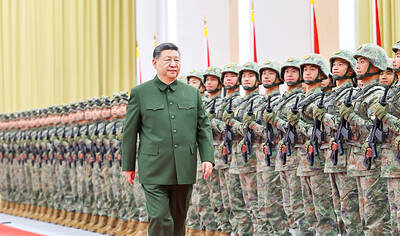
MOTIVES QUESTIONED The PLA considers Xi’s policies toward Taiwan to be driven by personal considerations rather than military assessment, the Epoch Times reports Chinese President Xi Jinping’s (習近平) latest purge of the Chinese People’s Liberation Army (PLA) leadership might have been prompted by the military’s opposition to plans of invading Taiwan, the Epoch Times said. The Chinese military opposes waging war against Taiwan by a large consensus, putting it at odds with Xi’s vision, the Falun Gong-affiliated daily said in a report on Thursday, citing anonymous sources with insight into the PLA’s inner workings. The opposition is not the opinion of a few generals, but a widely shared view among the PLA cadre, the Epoch Times cited them as saying. “Chinese forces know full well that


 RSS
RSS