


Premier Su Tseng-chang (蘇貞昌) yesterday thanked former vice premier Chen Chi-mai (陳其邁), a physician, for his contributions to the nation’s fight against COVID-19, during Chen’s last Cabinet meeting in the position.
During a morning Cabinet meeting on Dec. 31 last year, Chen pointed to a not yet unidentified disease spreading in Wuhan, China, saying that it required the government’s special attention, Su said.
That afternoon, Taiwan became the first nation to head to Wuhan to investigate the novel coronavirus, which marked the start of its disease prevention work, he said.
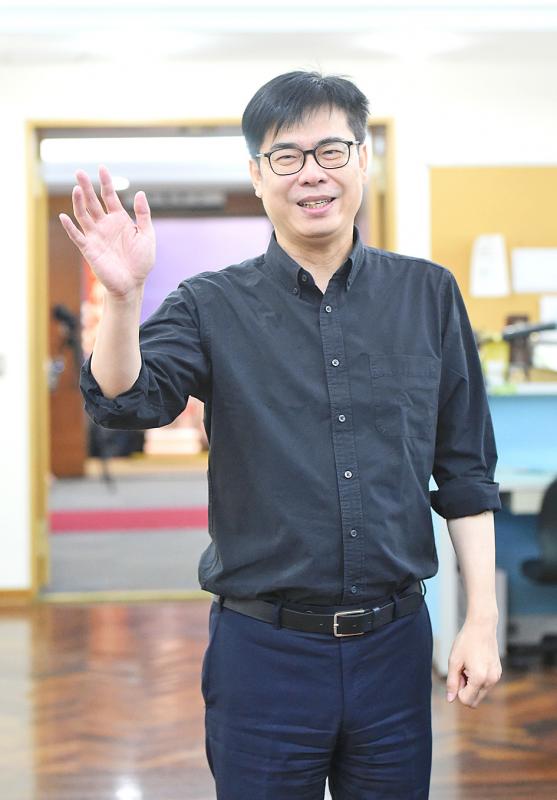
Photo: Fang Pin-chao, Taipei Times
It was the nation’s acumen in detecting the pandemic that allowed it to become a success story in fighting COVID-19, the premier said.
During his stint as vice premier, Chen, as chief information security officer, also led the Cabinet’s information technology team in pushing for 5G development and upholding information security, Su said.
Chen’s use of big data in contact tracing has significantly helped the nation’s disease prevention efforts, he said.
Su said that fate has given Chen the opportunity to apply his expertise to do something extraordinary, which he can look back on with fondness.
Some people have waited a lifetime for this opportunity, he added.
“The plot of your life has been written, you just do not know it yet,” Chen said, quoting Su.
Chen added that his tenure at the Executive Yuan was the most memorable chapter of his life.
He was fortunate to have been on an “A-team” that has a deep passion for the nation and shared ideals to make it better, Chen said.
Chen, who has been nominated by the Democratic Progressive Party as its candidate for the Aug. 15 Kaohsiung mayoral by-election, said that he prayed his colleagues would forget about him dogging them for results when pushing policies.
Chen became vice premier when Su became the premier for a second time on Jan. 14 last year.

LOUD AND PROUD Taiwan might have taken a drubbing against Australia and Japan, but you might not know it from the enthusiasm and numbers of the fans Taiwan might not be expected to win the World Baseball Classic (WBC) but their fans are making their presence felt in Tokyo, with tens of thousands decked out in the team’s blue, blowing horns and singing songs. Taiwanese fans have packed out the Tokyo Dome for all three of their games so far and even threatened to drown out home team supporters when their team played Japan on Friday. They blew trumpets, chanted for their favorite players and had their own cheerleading squad who dance on a stage during the game. The team struggled to match that exuberance on the field, with
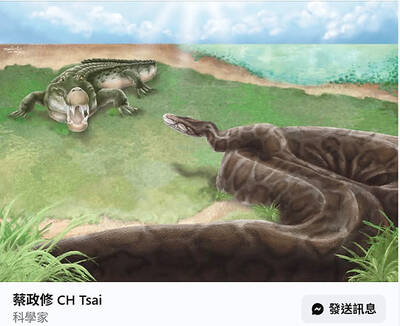
Taiwanese paleontologists have discovered fossil evidence that pythons up to 4m long inhabited Taiwan during the Pleistocene epoch, reporting their findings in the international scientific journal Historical Biology. National Taiwan University (NTU) Institute of Ecology and Evolutionary Biology associate professor Tsai Cheng-hsiu (蔡政修) led the team that discovered the largest snake fossil ever found in Taiwan. The single trunk vertebra was discovered in Tainan at the Chiting Formation, dated to between 400,000 and 800,000 years ago in the Middle Pleistocene, the paper said. The area also produced Taiwan’s first avian fossil, as well as crocodile, mammoth, saber-toothed cat and rhinoceros fossils, it said. Discoveries

Taiwanese paleontologists have discovered fossil evidence that pythons up to 4m long inhabited Taiwan during the Pleistocene epoch, reporting their findings in the international scientific journal Historical Biology. National Taiwan University (NTU) Institute of Ecology and Evolutionary Biology associate professor Tsai Cheng-hsiu (蔡政修) led the team that discovered the largest snake fossil ever found in Taiwan. A single trunk vertebra was discovered in Tainan at the Chiting Formation, dated to between 800,000 to 400,000 years ago in the Middle Pleistocene, the paper said. The area also produced Taiwan’s first avian fossil, as well as crocodile, mammoth, sabre-toothed cat and rhinoceros fossils, it said. Discoveries
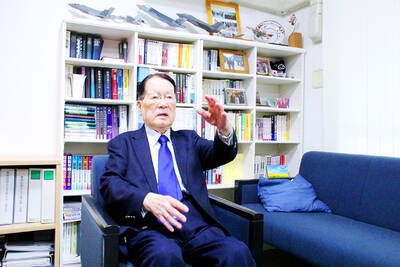
Whether Japan would help defend Taiwan in case of a cross-strait conflict would depend on the US and the extent to which Japan would be allowed to act under the US-Japan Security Treaty, former Japanese minister of defense Satoshi Morimoto said. As China has not given up on the idea of invading Taiwan by force, to what extent Japan could support US military action would hinge on Washington’s intention and its negotiation with Tokyo, Morimoto said in an interview with the Liberty Times (sister paper of the Taipei Times) yesterday. There has to be sufficient mutual recognition of how Japan could provide


 RSS
RSS