


A temple built in 1909 in Pingtung County was given its own address on Friday after a year-long campaign, and help from the township office and council, Chaojhou Township (潮州) Office Chief Secretary Wang Chien-yuan (王建元) said.
The Chaolin Temple (朝林宮), which was designated as a historical site by the county government in 2006, initially registered a neighbor’s address as its own when the government required temples to register in 1973, Wang said.
After using the neighbor’s address for more than four decades, the temple sought the office’s help last year, worried that the lack of a formal address might lead to disputes over property rights, Wang said.
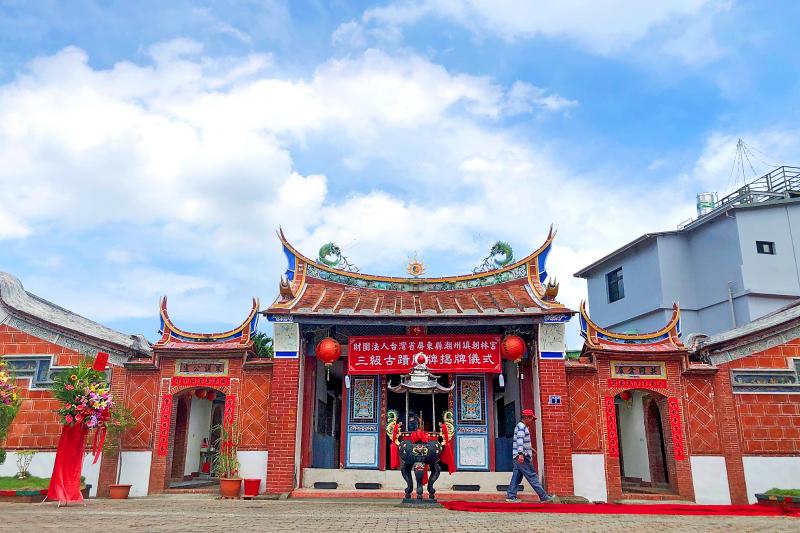
Photo: Chiu Chih-rou, Taipei Times
However, the temple’s efforts ran into bureaucratic difficulties.
The temple was built more than a century ago, when there was no such thing as a usage license — permits certifying a building to be occupied — and it never got one, but the license is required today to apply for an address through a household registration office.
The township office and council overcame the issue by using a clause in the Cultural Heritage Preservation Act (文化資產保存法) that exempts historic buildings designed by the government from the Building Act (建築法), Wang said.
The temple on Friday unveiled its own address plaque with a ceremony that included lion and dragon dances.
At the ceremony, Chaojhou Mayor Chou Pin-chuan (周品全) said that having a registered address would help the temple apply for and proceed with projects to develop its potential as a tourist attraction.
The main deity worshiped at the Taoist temple is Nezha (哪吒, also known as the Third Prince).
As the only designated historical site in the township, the temple is recognized for its architectural style and unique role of being a common religious center shared by three villages, the Ministry of the Interior’s religious heritage Web site says.

Considering that most countries issue more than five denominations of banknotes, the central bank has decided to redesign all five denominations, the bank said as it prepares for the first major overhaul of the banknotes in more than 24 years. Central bank Governor Yang Chin-lung (楊金龍) is expected to report to the Legislative Yuan today on the bank’s operations and the redesign’s progress. The bank in a report sent to the legislature ahead of today’s meeting said it had commissioned a survey on the public’s preferences. Survey results showed that NT$100 and NT$1,000 banknotes are the most commonly used, while NT$200 and NT$2,000

The Centers for Disease Control (CDC) yesterday reported the first case of a new COVID-19 subvariant — BA.3.2 — in a 10-year-old Singaporean girl who had a fever upon arrival in Taiwan and tested positive for the disease. The girl left Taiwan on March 20 and the case did not have a direct impact on the local community, it said. The WHO added the BA.3.2 strain to its list of Variants Under Monitoring in December last year, but this was the first imported case of the COVID-19 variant in Taiwan, CDC Deputy Director-General Lin Ming-cheng (林明誠) said. The girl arrived in Taiwan on

South Korea is planning to revise its controversial electronic arrival card, a step Taiwanese officials said prompted them to hold off on planned retaliatory measures, a South Korean media report said yesterday. A Yonhap News Agency report said that the South Korean Ministry of Foreign Affairs is planning to remove the “previous departure place” and “next destination” fields from its e-arrival card system. The plan, reached after interagency consultations, is under review and aims to simplify entry procedures and align the electronic form with the paper version, a South Korean ministry official said. The fields — which appeared only on the electronic form

The Ministry of Foreign Affairs (MOFA) is suspending retaliation measures against South Korea that were set to take effect tomorrow, after Seoul said it is updating its e-arrival system, MOFA said today. The measures were to be a new round of retaliation after Taiwan on March 1 changed South Korea's designation on government-issued alien resident certificates held by South Korean nationals to "South Korea” from the "Republic of Korea," the country’s official name. The move came after months of protests to Seoul over its listing of Taiwan as "China (Taiwan)" in dropdown menus on its new online immigration entry system. MOFA last week


 RSS
RSS