


The Taiwan Railways Administration (TRA) yesterday announced that it had generated a record NT$25.3 billion (US$848.91 million) in revenue last year, and broke records for earnings from its side businesses.
“What was extraordinary was that we earned NT$5.3 billion in revenue through side businesses alone last year. We also began to gradually reduce the occurrence of railway incidents last year. Between January and April this year, our train punctuality rate has greatly improved to 95.3 percent,” TRA Director-General Chang Cheng-yuan (張政源) said at a ceremony at Taiwan Railway Station to mark Railway Day and the agency’s annual Railway Festival.
“These accomplishments are made through the collective efforts of all TRA employees,” he added.

Photo: CNA
The signing of an agreement with the Taiwan Railway Labor Union after nearly 30 years of negotiations was another of the TRA’s major achievements last year, Chang said.
The TRA faces many challenges this year, from passenger demand over the seven-day Lunar New Year holiday and several long weekends to adhering to the nation’s disease-prevention measures against COVID-19, he said.
Although the agency has 239 railway stations and serves more than 500,000 passengers per day, it has not become a weak link in the nation’s disease-prevention efforts, Chang said.
“We have also shown our appreciation for healthcare providers, the police and firefighters by delivering TRA lunchboxes to them,” Chang said.
“I also want to thank President Tsai Ing-wen (蔡英文) and Premier Su Tseng-chang (蘇貞昌) for agreeing to raise employees’ allowances, a decision that has benefited 1,129 TRA employees,” he said. “We will soon submit our proposed salary adjustment plan to the Ministry of Transportation and Communications, and hope to secure approval from the Executive Yuan.”

UPGRADE: The Kang Ding-class frigate is replacing its Chaparall missiles with Tien Chien II and Hua Yang VLS, which would provide it with long-range, 360° air defense Taiwan plans to produce 1,200 to 1,376 Hai Chien II missiles (海劍二, Sea Sword II) — also known as TC-2N — to serve as the standard air defense system of the navy’s surface combatant fleet, a source said yesterday. Last week, the Hai Chien II, the naval version of the Tien Kung II missile (天劍二, Sky Sword II), completed a live-fire test in waters off the National Chungshan Institute of Science and Technology’s Jiupeng facility (九鵬) in Pingtung County’s Manjhou Township (滿州). The MIM72 Chaparral and other dated air defense missiles that currently arm Taiwanese ships have inadequate range to combat Chinese

REASONS FOR TRAVEL: An assistant professor said that proposed amendments to penalize drivers if they used drugs overseas would not deter people from traveling People who operate a motor vehicle under the influence of marijuana would have their driver’s license revoked, even if they used the substance while overseas, the Ministry of Transportation and Communications said yesterday, citing proposed amendments to the Road Traffic Management and Penalty Act (道路交通管理處罰條例). The amendments would also authorize the government to revoke the licenses of people determined to have used Category 1 or Category 2 narcotics, even if they were not operating a vehicle while under the influence of drugs, as well as ban them from taking the license test for three years, the ministry said. People aged 18 or
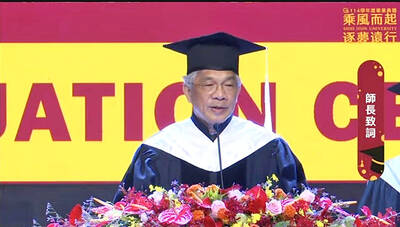
Shih Hsin University President Chen Ching-he (陳清河) yesterday issued a public apology for comments made in his commencement speech last week, stating that he has asked the school to suspend his duties and halt his wages for two months as a show of contrition. At the commencement ceremony on May 30, Chen said, “If you don’t manage your time well, or your own emotions, or your health, then I am telling every one of you — put a quick end to ‘you,’ because the world has no need for ‘you.’” The comments have sparked significant controversy online, and Chen through an open

Johanne Liou (劉喬安), a Taiwanese woman who shot to unwanted fame during the Sunflower movement protests in 2014, returned to Taiwan last night after being deported from the US. She is to stand trial in Taiwan for charges involving embezzlement, fraud and drug crimes. The Criminal Investigation Bureau (CIB) said it took her into custody at Taiwan Taoyuan International Airport and would first question her before transferring her to the New Taipei District Prosecutors’ Office. She was arrested upon disembarking a flight from San Francisco that landed shortly before 7pm. Liou absconded to the US in 2019 after jumping bail


 RSS
RSS