


The National Human Rights Museum won a Special Award for advancing education on human rights and democracy as part of this year’s Karl Wilhelm Fricke Award, the museum announced on Thursday.
The award — named for a German political journalist who dedicated his life to resisting state repression — is administered by the Federal Foundation for the Reappraisal of the SED Dictatorship, a government-funded organization established by the German parliament, to recognize people or organizations that have made a significant contribution to transitional justice.
Representative to Germany Shieh Jhy-wey (謝志偉) on Wednesday received the award, presented by foundation managing director Anna Kaminsky, on behalf of the museum at his office in Berlin, the museum said in a statement.
Kaminsky called Taiwan a strong and important partner for Germany in transitional justice and said that the two nations have much to learn from each other, even though the dictatorships they experienced were quite different, the museum said.
Shieh added that the award sends a strong signal to the world, as it was presented on the eve of the 31st anniversary of the Tiananmen Square Massacre, the museum said.
Bundestag member Axel Knoerig and German-Chinese Association-Friends of Taiwan vice chairman Michael Zickerick were also present at the ceremony.
The museum, established on Oct. 19, 2011, features the hidden history of abuses, while promoting human rights and democracy.
Museum director Chen Chun-hung (陳俊宏) said that the recognition would encourage his office to work harder after good exchanges over the years with human rights organizations such as the International Council of Museums, the Federation of International Human Rights Museums and the International Coalition of Sites of Conscience.
The museum has signed a letter of intent to enhance cooperation on transitional justice with Germany’s Stasi Records Agency, Chen said.
This year’s award committee was headed by former German federal commissioner for the Stasi Records Marianne Birthler and included former German president Horst Kohler.

FUKUOKA SITUATION: Japanese media reported that the pathogen is expected to be identified by the summer, while the CDC downplayed the idea that it was hMPV A “mysterious cold-like illness” reported in Japan’s Fukuoka Prefecture does not seem to be a new disease, but Japanese authorities have been asked about the situation, the Centers for Disease Control (CDC) said yesterday. The Fukuoka Prefectural Medical Association on Wednesday told a news conference that a “mystery cold” that has become a hot topic on social media is “highly likely to be caused by some kind of viral infection,” Japan’s KBC News reported. “Many people are experiencing symptoms starting with a sore throat, followed by a runny nose, phlegm and a severe cough,” KBC News reported, citing association officials. Health authorities are

Nvidia Corp CEO Jensen Huang (黃仁勳) arrived in Taiwan yesterday ahead of upcoming AI and technology events, saying he plans to meet with clients and Taiwan Semiconductor Manufacturing Co Chairman C.C. Wei (魏哲家) during his visit. After landing at Taipei Songshan Airport, Huang posed for photos with fans and handed out Yakult drinks to reporters and supporters waiting at the scene, saying he has “a lot to do” during the trip. Asked about reports that Nvidia’s planned headquarters site in Taipei’s Beitou Shilin Technology Park could break ground on May 27, Huang said that if the company holds an event, he would

Carrefour Taiwan is to begin using a new name from the start of July, but it cannot divulge the name until then, the chairman of the supermarket chain's parent company said today. President Chain Store Co chairman Lo Chih-hsien (羅智先) was asked by reporters after a shareholders' meeting to confirm whether the company has settled on a new name for the supermarket brand. In March, the government-registered name of two Carrefour Taiwan branches was quietly changed to "Le Chia Kang" (樂家康) in Chinese, raising speculation that has been selected as the name. Lo said that because of local regulations and contractual obligations, the
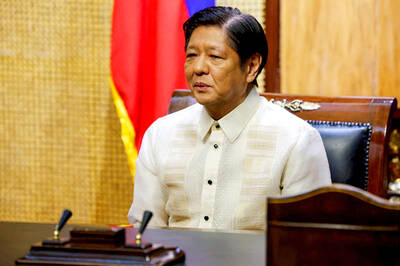
The Philippines would likely be involved in any conflict over Taiwan due to its proximity to the democracy claimed by China, President Ferdinand Marcos Jr said, reiterating a stance that risks angering Beijing. “In the Philippines, we do not have a choice because Taiwan is so close to the Philippines and we have almost 200,000 Filipino nationals living and working in Taiwan,” Marcos said in an interview with Japanese media in Manila on Monday. The Philippine leader’s comments come ahead of a state visit to Japan next week, where he is to meet with Japanese Prime Minister Sanae Takaichi to discuss security


 RSS
RSS