


The world might be divided into a China camp and a US-Europe camp following the US ban on Huawei Technologies Co, and Taiwanese firms should be cautious and prepare contingencies, an article published on Friday by a Taiwanese academic said.
Entitled “The tightening of US technology export controls to China and its impact on Taiwan,” the article by Daphne Wang (王綉雯) appeared in the Institute for National Defense and Security Research’s Chinese-language Defense Security Biweekly.
It cited a May 20 report to members of the US Congress that said the US approach to China over the past 40 years has “underestimated the will of the Chinese Communist Party to constrain the scope of economic and political reform in China,” and that the White House has adopted a “competitive approach” toward China “to respond to Beijing’s challenge.”
Photo: Tu Chu-min, Taipei Times
Fearing that it could fall behind China in the development of 5G technology, the US has asked its European allies to shift away from Huawei’s products, and its ban against US companies selling the tech giant’s computer chips is aimed at delaying Chinese 5G development, Wang said.
The US is increasingly aware of the incompatibility of its democratic government and free-market model with China’s military-civil fusion strategy, and the COVID-19 pandemic has generated a consensus to “stop Chinese expansion” throughout the US, she said.
Given these circumstances, Taiwanese businesses are likely to find it difficult to profit from both the US and China, she said.
An announcement by Taiwan Semiconductor Manufacturing Co (TSMC) on May 15 that it would build a factory in Arizona coincided with an announcement that the company was no longer accepting orders from Huawei, Wang added.
Although this could bring short-term benefits to companies such as MediaTek and Hon Hai Precision Industry Co over the medium to long-term, the US would not tolerate Taiwanese companies double-dipping or assisting China in developing its semiconductor industry, she said.
The US ban would affect everything from upstream IC design to downstream package testing and the manufacturing of components and smartphones, all of which are Taiwanese business interests, Wang wrote.
TSMC’s Arizona plant could spearhead an influx of Taiwanese investment in the US, which, along with the existing US supply chain, could form a new industrial ecology, she said.
The US is seeking cooperation from allies to form what it calls the “Economy Prosperity Network” to reduce reliance on China and establish standards across energy, infrastructure, research, trade, education and commerce, she said.
The US is also interested in a UK-proposed alliance of 10 democracies to create an alternative pool of suppliers of 5G equipment, dubbed the “D10,” Wang wrote.
The Chinese government’s response to the D10 is the “China Standard 2035” plan, a set of global standards for emerging technologies, such as 5G Internet, the Internet of Things and artificial intelligence, she added.
Until one side can completely “crush” the other, the world is likely to be divided into the two technology camps, Wang wrote.
Should the US strategy of trying to contain China while delaying its development of 5G technology succeed, it would mean that a China-developed 5G system could only be deployed within China, a possibility for which Taiwanese businesses should prepare contingency plans, she said.

The manufacture of the remaining 28 M1A2T Abrams tanks Taiwan purchased from the US has recently been completed, and they are expected to be delivered within the next one to two months, a source said yesterday. The Ministry of National Defense is arranging cargo ships to transport the tanks to Taiwan as soon as possible, said the source, who is familiar with the matter. The estimated arrival time ranges from late this month to early next month, the source said. The 28 Abrams tanks make up the third and final batch of a total of 108 tanks, valued at about NT$40.5 billion
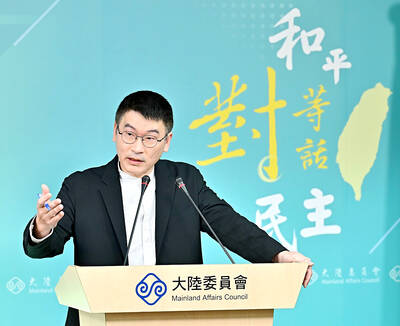
Two Taiwanese prosecutors were questioned by Chinese security personnel at their hotel during a trip to China’s Henan Province this month, the Mainland Affairs Council (MAC) said yesterday. The officers had personal information on the prosecutors, including “when they were assigned to their posts, their work locations and job titles,” MAC Deputy Minister and spokesman Liang Wen-chieh (梁文傑) said. On top of asking about their agencies and positions, the officers also questioned the prosecutors about the Cross-Strait Joint Crime-Fighting and Judicial Mutual Assistance Agreement, a pact that serves as the framework for Taiwan-China cooperation on combating crime and providing judicial assistance, Liang
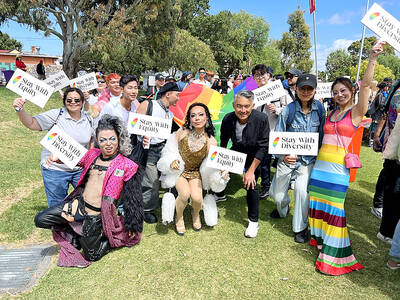
A group from the Taiwanese Designers in Australia association yesterday represented Taiwan at the Midsumma Pride March in Melbourne. The march, held in the St. Kilda suburb, is the city’s largest LGBTQIA+ parade and the flagship event of the annual Midsumma Festival. It attracted more than 45,000 spectators who supported the 400 groups and 10,000 marchers that participated this year, the association said. Taiwanese Designers said they organized a team to march for Taiwan this year, joining politicians, government agencies, professionals and community organizations in showing support for LGBTQIA+ people and diverse communities. As the first country in Asia to legalize same-sex
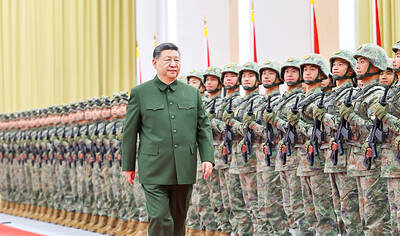
MOTIVES QUESTIONED The PLA considers Xi’s policies toward Taiwan to be driven by personal considerations rather than military assessment, the Epoch Times reports Chinese President Xi Jinping’s (習近平) latest purge of the Chinese People’s Liberation Army (PLA) leadership might have been prompted by the military’s opposition to plans of invading Taiwan, the Epoch Times said. The Chinese military opposes waging war against Taiwan by a large consensus, putting it at odds with Xi’s vision, the Falun Gong-affiliated daily said in a report on Thursday, citing anonymous sources with insight into the PLA’s inner workings. The opposition is not the opinion of a few generals, but a widely shared view among the PLA cadre, the Epoch Times cited them as saying. “Chinese forces know full well that


 RSS
RSS