


The Criminal Investigation Bureau yesterday said it had arrested six people on suspicion of illegally stockpiling and selling medical masks made by a factory in central Taiwan.
Bureau officials told a news briefing that they had seized 180,000 masks after raiding the factory and several warehouses on Friday last week.
Factory staff and management have allegedly colluded to sell a total of 700,000 masks for NT$10 (US$0.33) each — double the government-mandated price of NT$5 — and made a profit of NT$5 million, officials said.
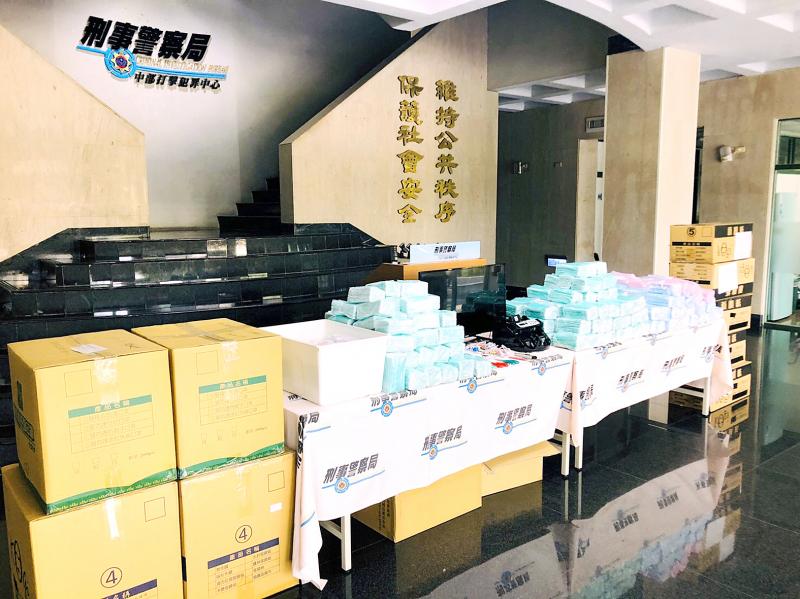
Photo: Hsu Kuo-chen, Taipei Times
The factory is reportedly connected to one of the 30 companies making up the national team for mask production, which has been working in collaboration with three government-funded research institutes since February and has a daily capacity of 22 million masks.
The six taken in for questioning were the factory’s warehouse manager, surnamed Lin (林), a sales manager, surnamed Hsieh (謝), and four warehouse staff and junior managers, said Lai Ying-men (賴英門), captain of the bureau’s Sixth Investigation Corps, which has jurisdiction over central Taiwan.
After questioning by Taichung prosecutors, Lin and Hsieh were released on bail of NT$400,000 and NT$600,000 respectively. The other four were released without bail.
Lai said that the bureau started its surveillance in late April after receiving reports that a company based in Taichung’s Wurih District (烏日) had been “stockpiling” masks.
Agents conducted an initial raid and found 490,000 masks at a warehouse, Lai said.
Further investigation revealed that while the company has been producing masks in cooperation with the government’s national requisition program, company officials also operated on the side, setting up another firm to procure materials for manufacturing masks and renting seven warehouses in Taichung and Nantou County to evade checks by police and health authorities.
Bureau agents raided 11 locations in Taichung and Nantou County on Friday, including the factory and its warehouses in Puli Township (埔里), where they seized cash, company documents, accounting books and machines.
Agents also found more than 10,000 defective items and faulty masks returned from pharmacies, which Lai said were used to supplement the under-the-table mask production.
All six are facing pending charges for allegedly breaching Article 12 of the Special Act on COVID-19 Prevention, Relief and Recovery (嚴重特殊傳染性肺炎防治及紓困振興特別條例), which states that people convicted of hoarding or driving up prices of medical equipment, devices, drugs, and disease prevention supplies deemed as such by health authorities for combating the virus outbreak may be jailed for up to five years and fined up to NT$5 million.
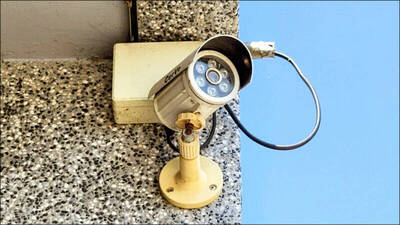
UNREASONABLE SURVEILLANCE: A camera targeted on an road by a neighbor captured a man’s habitual unsignaled turn into home, netting him dozens of tickets The Taichung High Administrative Court has canceled all 45 tickets given to a man for failing to use a turn signal while driving, as it considered long-term surveillance of his privacy more problematic than the traffic violations. The man, surnamed Tseng (曾), lives in Changhua County and was reported 45 times within a month for failing to signal while driving when he turned into the alley where his residence is. The reports were filed by his neighbor, who set up security cameras that constantly monitored not only the alley but also the door and yard of Tseng’s house. The surveillance occurred from July
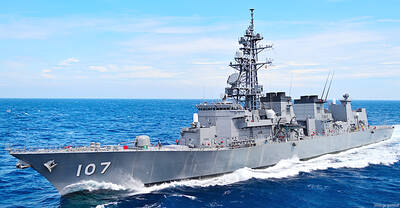
A Japan Self-Defense Forces vessel entered the Taiwan Strait yesterday, Japanese media reported. After passing through the Taiwan Strait, the Ikazuchi was to proceed to the South China Sea to take part in a joint military exercise with the US and the Philippines, the reports said. Japan Self-Defense Force vessels were first reported to have passed through the strait in September, 2024, with two further transits taking place in February and June last year, the Asahi Shimbun reported. Yesterday’s transit also marked the first time since Japanese Prime Minister Sanae Takaichi took office that a Japanese warship has been sent through the Taiwan

SECURITY: Starlink owner Elon Musk has taken pro-Beijing positions, and allowing pro-China companies to control Taiwan’s critical infrastructure is risky, a legislator said Starlink was reluctant to offer services in Taiwan because of the nation’s extremely high penetration rates in 4G and 5G services, the Ministry of Digital Affairs said yesterday. The ministry made the comments at a meeting of the legislature’s Transportation Committee, which reviewed amendments to Article 36 of the Telecommunications Management Act (電信管理法). Article 36 bans foreigners from holding more than 49 percent of shares in public telecommunications networks, while shares foreigners directly and indirectly hold are also capped at 60 percent of the total, unless specified otherwise by law. The amendments, sponsored by Chinese Nationalist Party (KMT) Legislator Ko
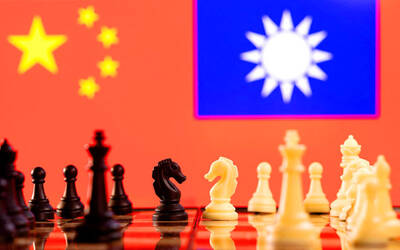
‘SAME OLD TRICK’: Even if Beijing resumes individual travel to Taiwan, it would only benefit Chinese tourism companies, the Economic Democracy Union convener said China’s 10 new “incentives” are “sugar-coated poison,” an official said yesterday, adding that Taiwanese businesses see them clearly for what they are, but that Beijing would inevitably find some local collaborators to try to drums up support. The official, speaking on condition of anonymity, made the remark ahead of a news conference the General Chamber of Commerce is to hold today. The event, titled “Industry Perspectives on China’s Recent Pro-Taiwan Policies,” is expected to include representatives from industry associations — such as those in travel, hotels, food and agriculture — to request the government cooperate with China’s new measures, people familiar with


 RSS
RSS