


The Central Epidemic Command Center (CECC) yesterday said that relaxing domestic restrictions and border controls simultaneously might complicate efforts to reopen the nation, amid discussions about Taiwan’s exclusion by other countries in their first lists of tourists.
The center hopes for there to be a period of observation following the easing of domestic restrictions, before it decides what to do next, Minister of Health and Welfare Chen Shih-chung (陳時中), who heads the center, told a daily news briefing in Taipei.
Chen was responding to a question about the reasoning behind the central government’s decision not to allow foreign students into the nation for now.

Photo courtesy of Kaohsiung Chang Gung Memorial Hospital
The Ministry of Education yesterday said that officials at a recent Cabinet meeting decided that they would have to wait until the international COVID-19 situation further subsides before deciding when to allow foreign students in based on the nation’s quarantine capacity.
Chen said the center would not adopt a “principle of reciprocity,” in which Taiwan would open its borders to travelers from countries that offer the same privilege to Taiwanese.
The COVID-19 situation is different in many places, he said, adding that every nation has its own set of standards for loosening travel restrictions, and a responsibility toward its people.
Taiwan has its own standards for lifting travel ban, he said, adding that the standards are in place to protect the public.
For important business or trade-related travel, the center might consider shortening travelers’ quarantine period while ensuring the safety of the community, he added.
The center reported no new cases of COVID-19.
Among the nation’s 443 confirmed cases, 428 patients had been released from isolation as of yesterday, it said.
The death toll remained at seven.
Meanwhile, in response to concerns about whether residents at long-term care facilities would be allowed to leave to vote in tomorrow’s recall election of Kaohsiung Mayor Han Kuo-yu (韓國瑜), Chen said only people who are undergoing mandatory quarantine or isolation are prohibited from going outside.
The center has not restricted any other groups from going out to vote, he said.
As residents at long-term care facilities tend to be older, he advised them to wear a mask and follow hand hygiene.
If social distancing cannot be maintained, they must wear a mask, he added.
After Sunday, travelers must still wear masks inside Mass Rapid Transit (MRT) stations during peak hours, but would not be required to do so during off-peak hours when social distancing can be maintained, he said.
The Ministry of Transportation and Communications in a statement on Wednesday announced that starting Sunday, travelers would still be required to wear masks and have their temperatures taken when entering public transport stations, but once inside, they may take off their masks if social distancing can be maintained or if there are barriers separating them from other travelers.
Additional reporting by CNA
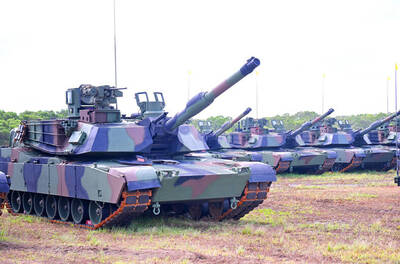
The manufacture of the remaining 28 M1A2T Abrams tanks Taiwan purchased from the US has recently been completed, and they are expected to be delivered within the next one to two months, a source said yesterday. The Ministry of National Defense is arranging cargo ships to transport the tanks to Taiwan as soon as possible, said the source, who is familiar with the matter. The estimated arrival time ranges from late this month to early next month, the source said. The 28 Abrams tanks make up the third and final batch of a total of 108 tanks, valued at about NT$40.5 billion

Two Taiwanese prosecutors were questioned by Chinese security personnel at their hotel during a trip to China’s Henan Province this month, the Mainland Affairs Council (MAC) said yesterday. The officers had personal information on the prosecutors, including “when they were assigned to their posts, their work locations and job titles,” MAC Deputy Minister and spokesman Liang Wen-chieh (梁文傑) said. On top of asking about their agencies and positions, the officers also questioned the prosecutors about the Cross-Strait Joint Crime-Fighting and Judicial Mutual Assistance Agreement, a pact that serves as the framework for Taiwan-China cooperation on combating crime and providing judicial assistance, Liang
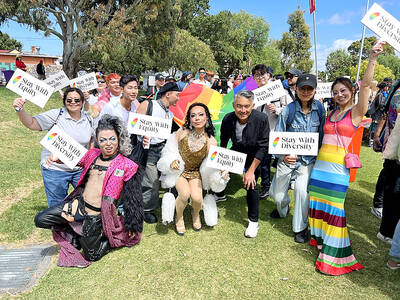
A group from the Taiwanese Designers in Australia association yesterday represented Taiwan at the Midsumma Pride March in Melbourne. The march, held in the St. Kilda suburb, is the city’s largest LGBTQIA+ parade and the flagship event of the annual Midsumma Festival. It attracted more than 45,000 spectators who supported the 400 groups and 10,000 marchers that participated this year, the association said. Taiwanese Designers said they organized a team to march for Taiwan this year, joining politicians, government agencies, professionals and community organizations in showing support for LGBTQIA+ people and diverse communities. As the first country in Asia to legalize same-sex
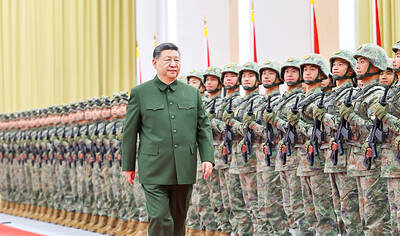
MOTIVES QUESTIONED The PLA considers Xi’s policies toward Taiwan to be driven by personal considerations rather than military assessment, the Epoch Times reports Chinese President Xi Jinping’s (習近平) latest purge of the Chinese People’s Liberation Army (PLA) leadership might have been prompted by the military’s opposition to plans of invading Taiwan, the Epoch Times said. The Chinese military opposes waging war against Taiwan by a large consensus, putting it at odds with Xi’s vision, the Falun Gong-affiliated daily said in a report on Thursday, citing anonymous sources with insight into the PLA’s inner workings. The opposition is not the opinion of a few generals, but a widely shared view among the PLA cadre, the Epoch Times cited them as saying. “Chinese forces know full well that


 RSS
RSS