


Kaohsiung Mayor Han Kuo-yu (韓國瑜) yesterday chose not to attend a televised presentation ahead of a recall vote against him, and instead visited vegetable farms devastated by torrential rain.
The recall vote is to be held on Saturday next week.
Asked yesterday morning during a visit to a farm in Kaohsiung’s Zihguan District (梓官) why he chose not to participate in the TV presentation, the Chinese Nationalist Party’s (KMT) Han said: “I am going to continue inspecting [agricultural losses].”

Photo: Hsu Lee-chuan, Taipei Times
The presentation was held at 9am by the Kaohsiung City Election Commission, and broadcast live on local television and the commission’s YouTube channel.
The commission is legally required to hold a recall briefing on public television for the lead petitioner of the recall and person being recalled, unless the parties involved agree not to hold such a briefing.
Han’s team said weeks earlier that the mayor would not take part in the briefing.
During yesterday’s TV presentation, Chen Kuan-jung (陳冠榮), the lead organizer of the recall vote, said that Han should have attended the presentation to explain to voters why he should not be recalled, and that his absence merely proved his “anti-democratic” way of approaching things.
Han has failed to deliver on his campaign promises of helping Kaohsiung people “get rich,” boosting jobs so that young people can return to Kaohsiung and resolving the city’s flooding problems, he said.
Chen urged people to vote to remove Han from office.
The Kaohsiung Information Bureau yesterday said that the local government would rather do practical things to help its citizens, such as tackling flooding, than engage in a war of words with Han’s opponents.
Civic groups initiated a recall petition in June last year, after Han announced that he would be running for president less than six months into his term as mayor.
The KMT has defended Han’s governance in Kaohsiung, saying that the number of tourists staying in the city’s hotels increased 17 percent annually last year, and the number of days with satisfactory air quality rose to 77.8 percent in the first three months of this year, from 56.7 percent last year.
In a written defense sent to the Central Election Commission this month, Han said that he has tried hard to invite businesses to invest in Kaohsiung, adding that a project to build a science park in the city’s Ciaotou District (橋頭) is expected to create about 11,000 new jobs and generate as much as NT$180 billion (US$5.99 billion) in production value every year.
For the recall motion to pass, at least 25 percent of Kaohsiung’s eligible voters — roughly 571,000 — must vote in favor of recalling Han, and the number of people voting for his removal must exceed the number voting against it by a simple majority.
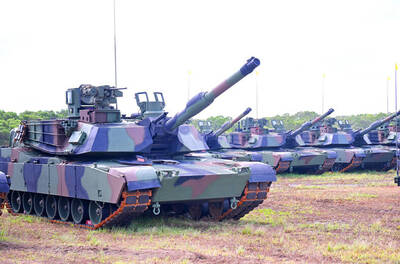
The manufacture of the remaining 28 M1A2T Abrams tanks Taiwan purchased from the US has recently been completed, and they are expected to be delivered within the next one to two months, a source said yesterday. The Ministry of National Defense is arranging cargo ships to transport the tanks to Taiwan as soon as possible, said the source, who is familiar with the matter. The estimated arrival time ranges from late this month to early next month, the source said. The 28 Abrams tanks make up the third and final batch of a total of 108 tanks, valued at about NT$40.5 billion
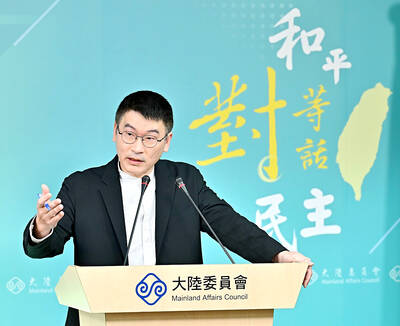
Two Taiwanese prosecutors were questioned by Chinese security personnel at their hotel during a trip to China’s Henan Province this month, the Mainland Affairs Council (MAC) said yesterday. The officers had personal information on the prosecutors, including “when they were assigned to their posts, their work locations and job titles,” MAC Deputy Minister and spokesman Liang Wen-chieh (梁文傑) said. On top of asking about their agencies and positions, the officers also questioned the prosecutors about the Cross-Strait Joint Crime-Fighting and Judicial Mutual Assistance Agreement, a pact that serves as the framework for Taiwan-China cooperation on combating crime and providing judicial assistance, Liang
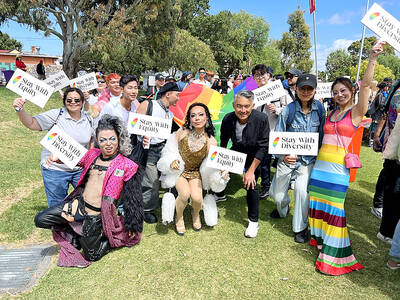
A group from the Taiwanese Designers in Australia association yesterday represented Taiwan at the Midsumma Pride March in Melbourne. The march, held in the St. Kilda suburb, is the city’s largest LGBTQIA+ parade and the flagship event of the annual Midsumma Festival. It attracted more than 45,000 spectators who supported the 400 groups and 10,000 marchers that participated this year, the association said. Taiwanese Designers said they organized a team to march for Taiwan this year, joining politicians, government agencies, professionals and community organizations in showing support for LGBTQIA+ people and diverse communities. As the first country in Asia to legalize same-sex
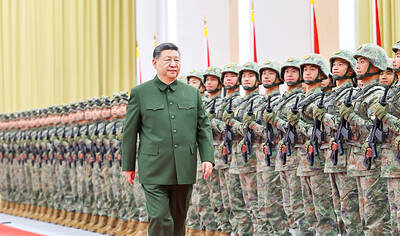
MOTIVES QUESTIONED The PLA considers Xi’s policies toward Taiwan to be driven by personal considerations rather than military assessment, the Epoch Times reports Chinese President Xi Jinping’s (習近平) latest purge of the Chinese People’s Liberation Army (PLA) leadership might have been prompted by the military’s opposition to plans of invading Taiwan, the Epoch Times said. The Chinese military opposes waging war against Taiwan by a large consensus, putting it at odds with Xi’s vision, the Falun Gong-affiliated daily said in a report on Thursday, citing anonymous sources with insight into the PLA’s inner workings. The opposition is not the opinion of a few generals, but a widely shared view among the PLA cadre, the Epoch Times cited them as saying. “Chinese forces know full well that


 RSS
RSS