


The Mandarin Oriental Taipei has not applied to the Tourism Bureau for financial relief, Minister of Transportation and Communications Lin Chia-lung (林佳龍) said yesterday, adding that his ministry would look into the hotel’s plight and offer assistance if necessary.
The five-star hotel, part of Hong Kong-based Mandarin Oriental Hotel Group, on Wednesday announced that next month it would suspend its guestroom operations and lay off related staff, but that its restaurants would remain open.
The Taipei Department of Labor yesterday said the hotel is scheduled to lay off 212 employees on Sunday next week.
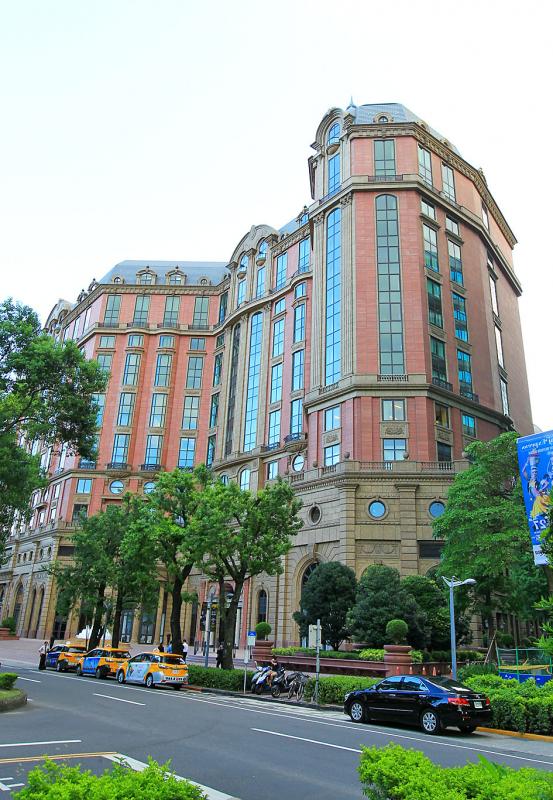
Photo: Chen Kuan-pei, Taipei Times
Prior to the announcement, the hotel had informed the department that it had laid off 39 employees.
The dismissals meet the standards for a large-scale layoff, meaning the workers would be protected under the Act for Worker Protection of Mass Redundancy (大量解僱勞工保護法), the department said.
The nation’s hoteliers have been severely affected by the COVID-19 pandemic and have different strategies to weather the financial crisis, Lin said in response to media queries about the hotel’s financial predicament.
Some five-star hotels, such as Regent Taipei, have sought to increase their occupancy rate by targeting domestic tourists, as the nation has restricted entry to foreigners, while others, like Mandarin Oriental Taipei, have chosen to close rooms and lay off workers.
The Ministry of Labor has intervened to protect Mandarin Oriental Taipei’s employees, Lin said.
The Tourism Bureau has prepared bailout funds for hoteliers, but Mandarin Oriental Taipei has not applied, Lin said, adding that the hotel’s management likely thought that there would not be a significant increase in foreign visitor numbers in the short term.
The transportation ministry has projected that border restrictions would remain in place for most of the rest of the year, Lin said, adding that it is focusing on expanding domestic tourism by promoting “disease prevention tours.”
“We hope that participants in the first phase of disease prevention tours, who are travel industry representatives, would set an example for how the tours should be conducted and their feedback would help enhance the quality of domestic tours,” Lin said.
“For the second phase starting on July 1, which would include subsidies for individual travelers and groups on domestic tours, we will review our experience and ensure that our subsidy program covers the various aspects of the tourism industry,” he said.
Combined “with the distribution of stimulus coupons by the Executive Yuan, we hope to multiply the effects of the tours to boost the domestic tourism market,” he added.
Asked if the transportation ministry was concerned about more hotels facing financial difficulties or shutting down in the near term, Lin said that the government has offered funds to help tourism operators affected by the pandemic.
However, in the long run, they would need to adjust their business models to differentiate themselves from the competition, he said.
“Every business has its strategy to cope with competition. Some choose to upgrade their business models, while others decide to withdraw from the market. We respect the market mechanism, but we want to mitigate the effects caused by unemployment,” Lin said.

The manufacture of the remaining 28 M1A2T Abrams tanks Taiwan purchased from the US has recently been completed, and they are expected to be delivered within the next one to two months, a source said yesterday. The Ministry of National Defense is arranging cargo ships to transport the tanks to Taiwan as soon as possible, said the source, who is familiar with the matter. The estimated arrival time ranges from late this month to early next month, the source said. The 28 Abrams tanks make up the third and final batch of a total of 108 tanks, valued at about NT$40.5 billion

Two Taiwanese prosecutors were questioned by Chinese security personnel at their hotel during a trip to China’s Henan Province this month, the Mainland Affairs Council (MAC) said yesterday. The officers had personal information on the prosecutors, including “when they were assigned to their posts, their work locations and job titles,” MAC Deputy Minister and spokesman Liang Wen-chieh (梁文傑) said. On top of asking about their agencies and positions, the officers also questioned the prosecutors about the Cross-Strait Joint Crime-Fighting and Judicial Mutual Assistance Agreement, a pact that serves as the framework for Taiwan-China cooperation on combating crime and providing judicial assistance, Liang
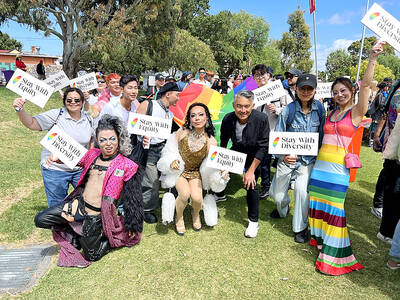
A group from the Taiwanese Designers in Australia association yesterday represented Taiwan at the Midsumma Pride March in Melbourne. The march, held in the St. Kilda suburb, is the city’s largest LGBTQIA+ parade and the flagship event of the annual Midsumma Festival. It attracted more than 45,000 spectators who supported the 400 groups and 10,000 marchers that participated this year, the association said. Taiwanese Designers said they organized a team to march for Taiwan this year, joining politicians, government agencies, professionals and community organizations in showing support for LGBTQIA+ people and diverse communities. As the first country in Asia to legalize same-sex
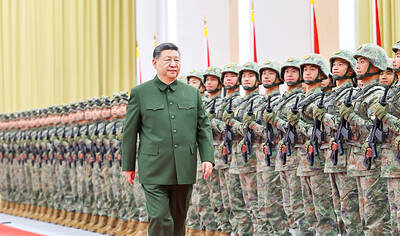
MOTIVES QUESTIONED The PLA considers Xi’s policies toward Taiwan to be driven by personal considerations rather than military assessment, the Epoch Times reports Chinese President Xi Jinping’s (習近平) latest purge of the Chinese People’s Liberation Army (PLA) leadership might have been prompted by the military’s opposition to plans of invading Taiwan, the Epoch Times said. The Chinese military opposes waging war against Taiwan by a large consensus, putting it at odds with Xi’s vision, the Falun Gong-affiliated daily said in a report on Thursday, citing anonymous sources with insight into the PLA’s inner workings. The opposition is not the opinion of a few generals, but a widely shared view among the PLA cadre, the Epoch Times cited them as saying. “Chinese forces know full well that


 RSS
RSS