


A coalition of civic groups yesterday called for the drafting of a new constitution to reflect the current political reality, as President Tsai Ing-wen (蔡英文) held a low-key inauguration ceremony to mark the start of her second term in office.
The coalition urged the president to shoulder the historic mission of writing a new constitution, leading the way by consolidating the collective will and aspiration of Taiwanese, and forging a new national identity, along with the right to self-determination.
“We need to draft a new constitution, and through the process, Taiwanese can create a new republic,” Economic Democracy Union convener Lai Chung-chiang (賴中強) told a media briefing in Taipei.
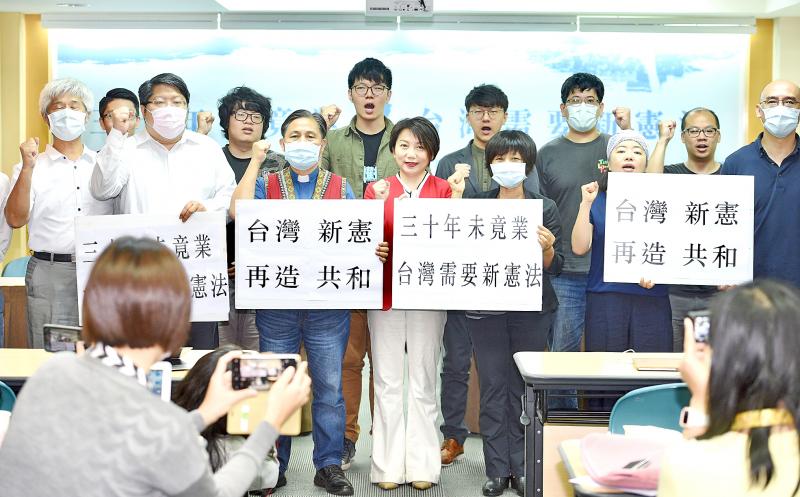
Photo: Peter Lo, Taipei Times
“What we do not need is more rounds of ‘constitutional amendments,’” he added, after Tsai in her inaugural address announced plans to set up a constitutional amendment committee in the Legislative Yuan that would serve as a platform to address government reforms and better protect people’s rights.
Lai and other civic groups have described the Republic of China Constitution as anachronistic and not reflecting the political reality in Taiwan, as it was imposed by the Chinese Nationalist Party (KMT) military dictatorship on Taiwanese after it lost the Chinese Civil War and fled to Taiwan in 1949. Its constitutional framework was based on China’s overall population and territories, which consisted of 35 provinces at the time.
Over the past three decades, Taiwan has undergone a lot of changes on the way to democratization after martial law was lifted, “but this democratic transition has not yet been completed, because Taiwanese do not have their own constitution,” he said.
DPP Legislator Fan Yun (范雲), representing the Social Democratic Party, which she founded, said the new constitution should lower the voting age to 18, and protect the rights of disadvantaged and underprivileged groups.
Taiwan had gone through seven rounds of constitutional amendments, but “the fallacy in the ROC Constitution as the governing power ruling over the population and territories of China remains, which some politicians have exploited to push for closer union with China, through the so-called ‘1992 consensus’ and the ‘one country, two systems’ framework,” Academia Sinica law professor Chiou Wen-tsong (邱文聰) said.
Also joining the call for a new consitution were the Taiwan Citizen Front Taiwan Youth Association for Democracy; the Taiwan Association of University Professors; the National Students’ Union of Taiwan; Taiwan Democracy Watch; Citizen of the Earth, Taiwan, Taiwan; the Association for Human Rights; and the Taiwan Labor Front.
“Taiwanese have shown vigorous growth and are forging a new national identity, despite China’s unending threats of military invasion and annexation, and the menace of the Wuhan virus outbreak. It is now the time to draft a new constitution for a democratic Taiwan and to be liberated the from the shackles of the ‘one China’ policy, to enable us as free people of a new nation to participate as an equal member of the international community,” Taiwan Citizen Front spokesman Chiang Min-yen (江旻諺) said.
This story has been corrected since it was first published.
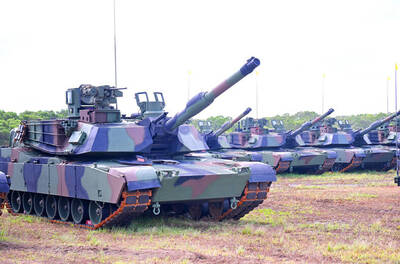
The manufacture of the remaining 28 M1A2T Abrams tanks Taiwan purchased from the US has recently been completed, and they are expected to be delivered within the next one to two months, a source said yesterday. The Ministry of National Defense is arranging cargo ships to transport the tanks to Taiwan as soon as possible, said the source, who is familiar with the matter. The estimated arrival time ranges from late this month to early next month, the source said. The 28 Abrams tanks make up the third and final batch of a total of 108 tanks, valued at about NT$40.5 billion
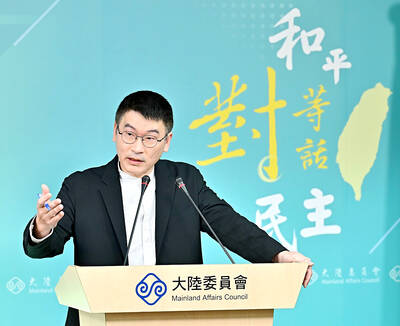
Two Taiwanese prosecutors were questioned by Chinese security personnel at their hotel during a trip to China’s Henan Province this month, the Mainland Affairs Council (MAC) said yesterday. The officers had personal information on the prosecutors, including “when they were assigned to their posts, their work locations and job titles,” MAC Deputy Minister and spokesman Liang Wen-chieh (梁文傑) said. On top of asking about their agencies and positions, the officers also questioned the prosecutors about the Cross-Strait Joint Crime-Fighting and Judicial Mutual Assistance Agreement, a pact that serves as the framework for Taiwan-China cooperation on combating crime and providing judicial assistance, Liang
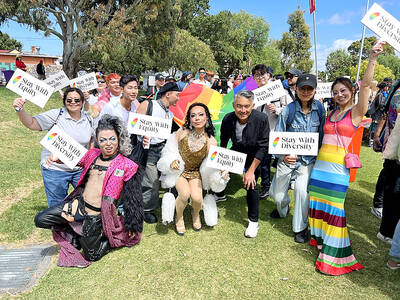
A group from the Taiwanese Designers in Australia association yesterday represented Taiwan at the Midsumma Pride March in Melbourne. The march, held in the St. Kilda suburb, is the city’s largest LGBTQIA+ parade and the flagship event of the annual Midsumma Festival. It attracted more than 45,000 spectators who supported the 400 groups and 10,000 marchers that participated this year, the association said. Taiwanese Designers said they organized a team to march for Taiwan this year, joining politicians, government agencies, professionals and community organizations in showing support for LGBTQIA+ people and diverse communities. As the first country in Asia to legalize same-sex
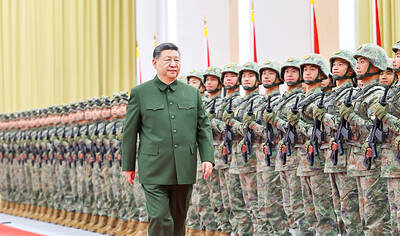
MOTIVES QUESTIONED The PLA considers Xi’s policies toward Taiwan to be driven by personal considerations rather than military assessment, the Epoch Times reports Chinese President Xi Jinping’s (習近平) latest purge of the Chinese People’s Liberation Army (PLA) leadership might have been prompted by the military’s opposition to plans of invading Taiwan, the Epoch Times said. The Chinese military opposes waging war against Taiwan by a large consensus, putting it at odds with Xi’s vision, the Falun Gong-affiliated daily said in a report on Thursday, citing anonymous sources with insight into the PLA’s inner workings. The opposition is not the opinion of a few generals, but a widely shared view among the PLA cadre, the Epoch Times cited them as saying. “Chinese forces know full well that


 RSS
RSS