


A proposal by the Taiwan Railways Administration (TRA) to permanently ban sitting in Taipei Railway Station’s main hall has received a mixed reaction online, with some social media users vowing to launch a sit-in at the station.
Gatherings at the hall have been prohibited since Feb. 29 in accordance with the Central Epidemic Command Center’s policy of reducing crowd sizes in public places.
A Facebook user organizing the sit-in said that the hall is a public space and there is no legitimate reason to ban sitting on the floor.
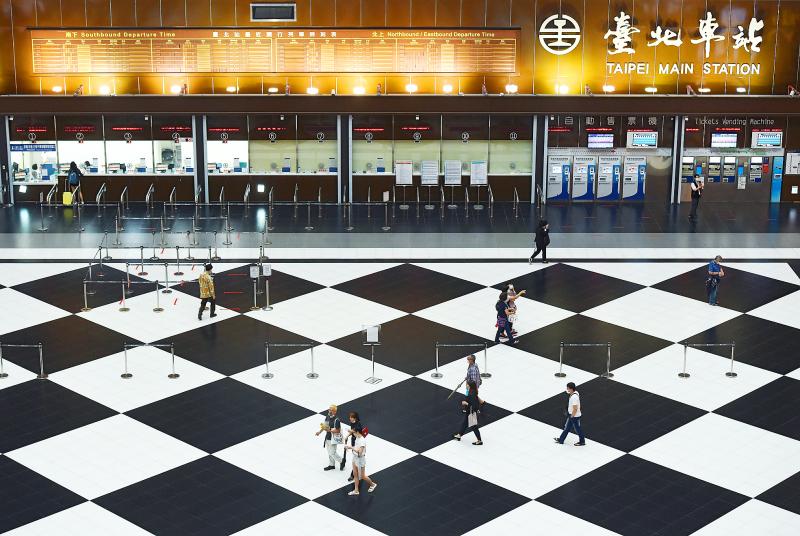
Photo: Liao Chen-huei, Taipei Times
He said he suspected that the proposal was made due to business considerations and demanded that the TRA allow people to sit in the hall again after the COVID-19 pandemic is brought under control.
One social media user, Huang Yi-chung (黃益中), said that he has fond memories of sitting in the station’s main hall.
“Before going home to Hsinchu, I would arrive at the train station at least half an hour early so that I could buy a TRA lunchbox — pork chop and rice — and sit in the hall to eat before boarding,” Huang said. “This is a memory that I share with all train travelers and migrant workers. The ban would cause the city to lose a cultural memory.”
However, another social media user questioned why people should be allowed to sit on the hall’s floor, saying that even Tokyo Station does not have such a policy.
“Following the logic [of people opposing the ban], should we not open the halls at the train stations in Taichung and Kaohsiung, or at Taiwan Taoyuan International Airport? Why do we have to turn a city’s gateway into a marketplace?” they asked.
They also rejected the argument that the ban discriminated against migrant workers, who often gather at the station on holidays or to celebrate events such as Islam’s Eid al-Fitr.
The TRA allowed people to sit on the floor because they used to have to line up at the station to buy tickets for major national holidays, and people have gradually taken it for granted and thought it was accepted practice, they said.
“‘When in Rome, do as the Romans do.’ Since when do citizens have to accommodate the cultural events of expatriates?” they added.
Another social media user, Chen Yen-shuo (陳延碩), said the issue is that there is not much seating within the station.
“Whenever I have to wait at the station, I can only stand, because I can never find a place to sit. It is even more inconvenient for those with disabilities or carrying a lot of luggage,” he said, adding that the Ministry of Transportation and Communications and the TRA should quickly come up with a solution satisfactory to all parties.
TRA Director-General Chang Cheng Yuan (張振源) said that as the nation is working to curb the spread of the novel coronavirus, the station cannot be used for Eid al-Fitr celebrations or the sit-in, adding that the policy is being enforced for the sake of public health.
Anyone sitting in the hall would be asked to leave, he said.
Minister of Transportation and Communications Lin Chia-lung (林佳龍) said that the hall is an important gathering place for travelers and migrant workers.
He said that he has told the TRA that it needs to communicate with the public and that it should not think that its job is simply to make sure that the hall looks clean.
“With the help of experts, the TRA should try to find a solution that ensures that the hall is kept clean, that all passengers can move about the station unimpeded, that people can quickly evacuate in an emergency and that migrant workers have a place to meet and gather,” Lin said.

The manufacture of the remaining 28 M1A2T Abrams tanks Taiwan purchased from the US has recently been completed, and they are expected to be delivered within the next one to two months, a source said yesterday. The Ministry of National Defense is arranging cargo ships to transport the tanks to Taiwan as soon as possible, said the source, who is familiar with the matter. The estimated arrival time ranges from late this month to early next month, the source said. The 28 Abrams tanks make up the third and final batch of a total of 108 tanks, valued at about NT$40.5 billion

Two Taiwanese prosecutors were questioned by Chinese security personnel at their hotel during a trip to China’s Henan Province this month, the Mainland Affairs Council (MAC) said yesterday. The officers had personal information on the prosecutors, including “when they were assigned to their posts, their work locations and job titles,” MAC Deputy Minister and spokesman Liang Wen-chieh (梁文傑) said. On top of asking about their agencies and positions, the officers also questioned the prosecutors about the Cross-Strait Joint Crime-Fighting and Judicial Mutual Assistance Agreement, a pact that serves as the framework for Taiwan-China cooperation on combating crime and providing judicial assistance, Liang
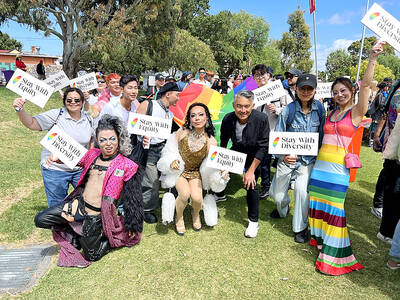
A group from the Taiwanese Designers in Australia association yesterday represented Taiwan at the Midsumma Pride March in Melbourne. The march, held in the St. Kilda suburb, is the city’s largest LGBTQIA+ parade and the flagship event of the annual Midsumma Festival. It attracted more than 45,000 spectators who supported the 400 groups and 10,000 marchers that participated this year, the association said. Taiwanese Designers said they organized a team to march for Taiwan this year, joining politicians, government agencies, professionals and community organizations in showing support for LGBTQIA+ people and diverse communities. As the first country in Asia to legalize same-sex
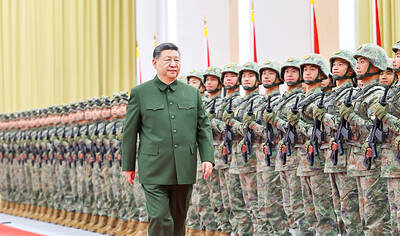
MOTIVES QUESTIONED The PLA considers Xi’s policies toward Taiwan to be driven by personal considerations rather than military assessment, the Epoch Times reports Chinese President Xi Jinping’s (習近平) latest purge of the Chinese People’s Liberation Army (PLA) leadership might have been prompted by the military’s opposition to plans of invading Taiwan, the Epoch Times said. The Chinese military opposes waging war against Taiwan by a large consensus, putting it at odds with Xi’s vision, the Falun Gong-affiliated daily said in a report on Thursday, citing anonymous sources with insight into the PLA’s inner workings. The opposition is not the opinion of a few generals, but a widely shared view among the PLA cadre, the Epoch Times cited them as saying. “Chinese forces know full well that


 RSS
RSS