


The nation’s largest railway operator yesterday said it is considering making permanent a ban on people sitting on the floor in the main hall of the Taipei Railway Station.
The hall is a popular gathering place for migrant workers in the city, particularly for some who have used it to celebrate Eid al-Fitr, which marks the end of the Muslim holy month of Ramadan.
During the festival, people often meet inside and around Taipei Railway Station to talk and eat together. These events have been used by government officials to show that Taiwan is a Muslim-friendly nation.
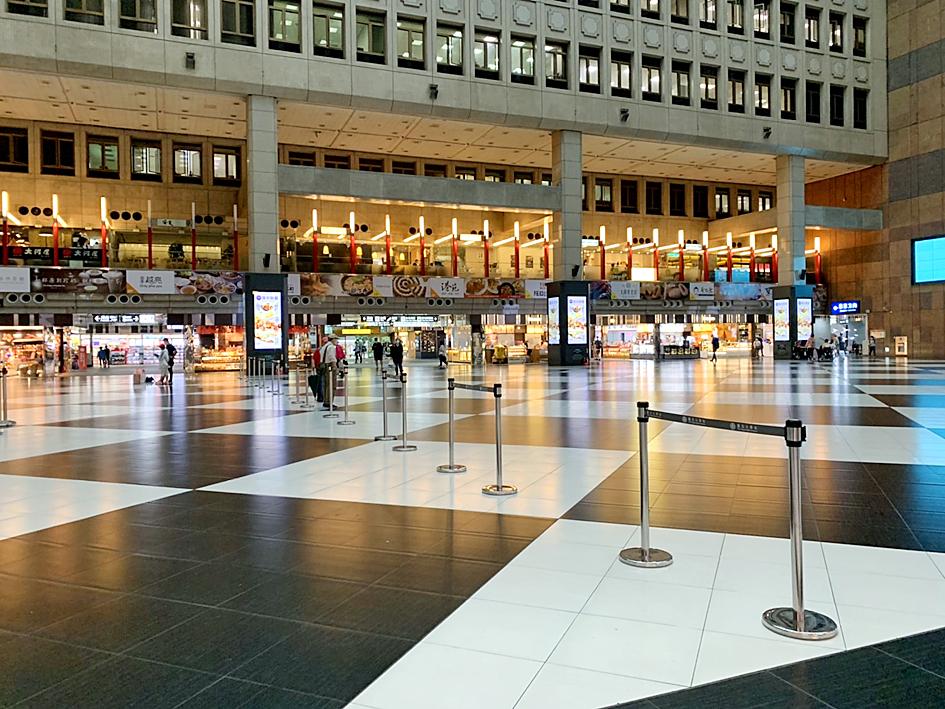
Photo: Hsiao Yu-hsin, Taipei Times
However, the Taiwan Railways Administration (TRA) has since February prohibited people from sitting in the hall to prevent the spread of COVID-19.
Eid al-Fitr is on Sunday this year, but the railway operator said it is not opening the space for public gatherings any time soon.
When the temporary sitting ban would end is dependent on guidance from the Central Epidemic Command Center (CECC), the TRA said, adding that the hall at the Taipei Railway Station was never designed for people to sit down.
It said that permanently banning people from sitting on the ground would help keep the area clean.
The policy is not meant to discriminate against Muslim migrant workers, the TRA said, adding that the station has service personnel who speak Southeast Asian languages and it serves Muslims and people from countries covered by the New Southbound Policy.
If migrant workers want to meet and celebrate Eid al-Fitr, they can still gather outside the station, it said.
As the CECC has yet to ease restrictions on large gatherings, government agencies have canceled all Eid al-Fitr events, it said.
Because people are still likely to gather at the station on Sunday, the TRA said it would dispatch personnel to entrances and escalators to facilitate the flow of people through the station.
The Expatriate Care Association is to station translators at the Railway Police Bureau’s office to assist in communicating with migrant workers, the TRA added.
It said that people who do not follow social distancing guidelines or gather and sit on the hall floor would be asked to leave.
Station staff are to hold signs in various languages to inform people about the importance of avoiding cluster infections, it said.
The Taiwan International Workers’ Association said that there are not many places in Taiwan for migrant workers to spend their holidays, and the main hall at the Taipei Railway Station is one of the few places available for them.
The TRA should not institute discriminatory policies, and it should respect the nation’s diverse cultures, the association added.

The military has spotted two Chinese warships operating in waters near Penghu County in the Taiwan Strait and sent its own naval and air forces to monitor the vessels, the Ministry of National Defense (MND) said. Beijing sends warships and warplanes into the waters and skies around Taiwan on an almost daily basis, drawing condemnation from Taipei. While the ministry offers daily updates on the locations of Chinese military aircraft, it only rarely gives details of where Chinese warships are operating, generally only when it detects aircraft carriers, as happened last week. A Chinese destroyer and a frigate entered waters to the southwest

A magnitude 6.1 earthquake struck off the coast of Yilan County at 8:39pm tonight, the Central Weather Administration (CWA) said, with no immediate reports of damage or injuries. The epicenter was 38.7km east-northeast of Yilan County Hall at a focal depth of 98.3km, the CWA’s Seismological Center said. The quake’s maximum intensity, which gauges the actual physical effect of a seismic event, was a level 4 on Taiwan’s 7-tier intensity scale, the center said. That intensity level was recorded in Yilan County’s Nanao Township (南澳), Hsinchu County’s Guansi Township (關西), Nantou County’s Hehuanshan (合歡山) and Hualien County’s Yanliao (鹽寮). An intensity of 3 was

Japanese Prime Minister Sanae Takaichi’s comment last year on Tokyo’s potential reaction to a Taiwan-China conflict has forced Beijing to rewrite its invasion plans, a retired Japanese general said. Takaichi told the Diet on Nov. 7 last year that a Chinese naval blockade or military attack on Taiwan could constitute a “survival-threatening situation” for Japan, potentially allowing Tokyo to exercise its right to collective self-defense. Former Japan Ground Self-Defense Force general Kiyofumi Ogawa said in a recent speech that the remark has been interpreted as meaning Japan could intervene in the early stages of a Taiwan Strait conflict, undermining China’s previous assumptions

Instead of focusing solely on the threat of a full-scale military invasion, the US and its allies must prepare for a potential Chinese “quarantine” of Taiwan enforced through customs inspections, Stanford University Hoover fellow Eyck Freymann said in a Foreign Affairs article published on Wednesday. China could use various “gray zone” tactics in “reconfiguring the regional and ultimately the global economic order without a war,” said Freymann, who is also a nonresident research fellow at the US Naval War College. China might seize control of Taiwan’s links to the outside world by requiring all flights and ships entering or leaving Taiwan


 RSS
RSS