


The government plans to station two retired senior military personnel at the Taipei Economic and Cultural Representative Office in Washington to enhance exchanges, Veterans Affairs Council Minister Feng Shih-kuan (馮世寬) said on Wednesday.
However, the move is dependent upon lawmakers passing draft amendments to the Organization Act of Veterans Affairs Council (國軍退除役官兵輔導委員會組織法) that the Executive Yuan approved on April 30.
Speaking at a meeting of the legislature’s Foreign and National Defense Committee, Feng said that the two council members were originally scheduled to be sent to the US in September, but now due to the COVID-19 pandemic, the move has been delayed, but is likely to take place before the end of the year.

Photo: Tu Chien-jung, Taipei Times
The initiative, estimated to cost NT$15 million (US$500,868) annually, would see the veterans, who are required to be council members, posted to the office’s defense mission, he said.
The two appointees would receive training for their posting, which would focus on building closer ties with their US counterparts and taking care of Taiwanese veterans and their family members living in North America, the council said.
Taiwan has 24 veterans’ affairs organizations in the US and Canada, where an estimated 4,966 Taiwanese live, council data showed.
The pair would also participate in veterans’ affairs activities to improve Taiwan’s visibility on the world stage, especially in terms of the contributions the Republic of China made in World War II, the council said.
One post requires someone who attained the rank of an army or air force colonel or navy captain and served as a military attache or deputy attache overseas.
The council has chosen a retired air force colonel for one of the positions and would ask the Ministry of National Defense to come up with a short list to fill the other post, Feng said.
The project was launched after representatives of American Veterans visited Taiwan last year and called for the establishment of an overseas branch of the council in the US.
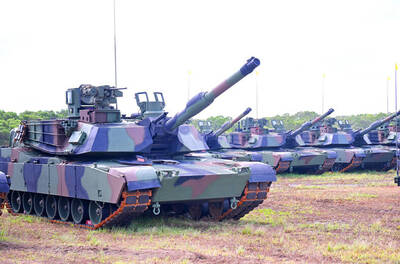
The manufacture of the remaining 28 M1A2T Abrams tanks Taiwan purchased from the US has recently been completed, and they are expected to be delivered within the next one to two months, a source said yesterday. The Ministry of National Defense is arranging cargo ships to transport the tanks to Taiwan as soon as possible, said the source, who is familiar with the matter. The estimated arrival time ranges from late this month to early next month, the source said. The 28 Abrams tanks make up the third and final batch of a total of 108 tanks, valued at about NT$40.5 billion

Two Taiwanese prosecutors were questioned by Chinese security personnel at their hotel during a trip to China’s Henan Province this month, the Mainland Affairs Council (MAC) said yesterday. The officers had personal information on the prosecutors, including “when they were assigned to their posts, their work locations and job titles,” MAC Deputy Minister and spokesman Liang Wen-chieh (梁文傑) said. On top of asking about their agencies and positions, the officers also questioned the prosecutors about the Cross-Strait Joint Crime-Fighting and Judicial Mutual Assistance Agreement, a pact that serves as the framework for Taiwan-China cooperation on combating crime and providing judicial assistance, Liang
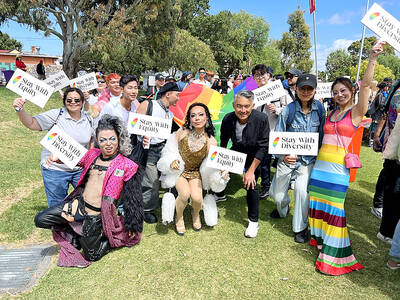
A group from the Taiwanese Designers in Australia association yesterday represented Taiwan at the Midsumma Pride March in Melbourne. The march, held in the St. Kilda suburb, is the city’s largest LGBTQIA+ parade and the flagship event of the annual Midsumma Festival. It attracted more than 45,000 spectators who supported the 400 groups and 10,000 marchers that participated this year, the association said. Taiwanese Designers said they organized a team to march for Taiwan this year, joining politicians, government agencies, professionals and community organizations in showing support for LGBTQIA+ people and diverse communities. As the first country in Asia to legalize same-sex
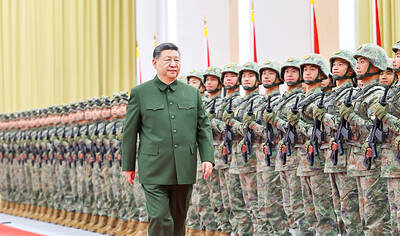
MOTIVES QUESTIONED The PLA considers Xi’s policies toward Taiwan to be driven by personal considerations rather than military assessment, the Epoch Times reports Chinese President Xi Jinping’s (習近平) latest purge of the Chinese People’s Liberation Army (PLA) leadership might have been prompted by the military’s opposition to plans of invading Taiwan, the Epoch Times said. The Chinese military opposes waging war against Taiwan by a large consensus, putting it at odds with Xi’s vision, the Falun Gong-affiliated daily said in a report on Thursday, citing anonymous sources with insight into the PLA’s inner workings. The opposition is not the opinion of a few generals, but a widely shared view among the PLA cadre, the Epoch Times cited them as saying. “Chinese forces know full well that


 RSS
RSS