


The Ministry of Transportation and Communications (MOTC) is considering easing restrictions on eating and drinking onboard trains, but added that it would continue to enforce key disease prevention measures before the Dragon Boat Festival holiday next month.
The ministry plans to gradually lift the restrictions on public transport, but passengers should still wear masks and have their temperatures taken before boarding Taiwan Railways Administration (TRA) or Taiwan High Speed Railway Corp (THSRC) trains, which are critical to curbing the spread of COVID-19, Deputy Minister of Transportation and Communications Wang Kwo-tsai (王國材) said yesterday.
“We would first consider easing the restriction on non-reserved seats and allowing people to consume food and beverages on board trains again,” he said before attending a meeting of the Legislative Yuan’s Transportation Committee.
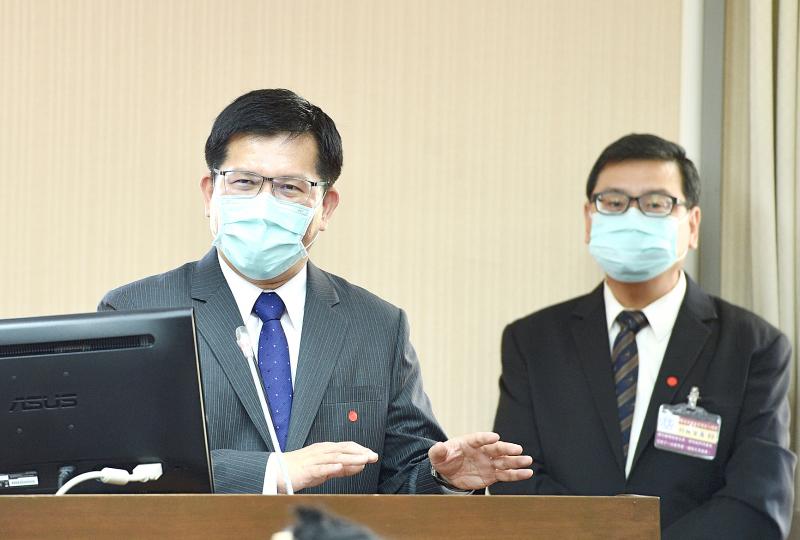
Photo: Peter Lo, Taipei Times
At present, real-name registration is required to purchase TRA and THSRC tickets, with the latter also canceling its non-reserved seat service, while food and beverage are banned onboard.
The ministry is to hold a meeting today to discuss steps to be taken to ease restrictions on domestic and overseas tourism, and public transport, Wang said, adding that conclusions reached at the meeting would be reviewed, evaluated and announced by the Central Epidemic Command Center (CECC).
The CECC has said that the TRA and THSRC have many long-
distance travelers, who might need to eat and drink during the trip, prompting the ministry to consider relaxing some restrictions for train riders, Minister of Transportation and Communications Lin Chia-lung (林佳龍) said, adding that the two railway operators are drafting enforcement measures.
Before the Dragon Boat Festival holiday on June 26, people must still have their temperatures taken before entering platforms and wear masks when they are in the train cabins, Lin said, but the restrictions for onboard food and beverage consumption and non-reserved seats could be slightly eased, depending on the final announcement from the CECC.
“We would also suggest that the TRA and THSRC continue implementing the policy of leaving one empty seat between two seated passengers, as it has proven effective in maintaining social distancing between passengers,” he said.
Before Taiwan opens up its borders to international tourists, Lin said the ministry is to promote domestic epidemic prevention tours, which would be implemented in two phases.
The first phase would involve organizing tours for trainees of tourism skill-upgrade workshops subsidized by the ministry, who would set examples on how a disease prevention tour should be conducted, he said.
The tour arrangements would be announced before Wednesday next week, he said, adding that the ministry has budgeted NT$300 million (US$10 million) for this phase.
The second phase is to subsidize domestic tour groups and individual travelers engaging in such safe tours, Lin said, adding that the budget for this phase is NT$2 billion.
Lin denied that the nation would enter the second phase of epidemic prevention tours only after the government has lifted the mask requirement for the TRA and THSRC.
“The disease could spread when people move, so the CECC insists that people wear masks and observe social distancing when they are in crowded places. As the pandemic is not fully under control in other countries, the nation might still face risks of imported infection cases,” he said.
“We hope that we can start engaging in epidemic prevention tours before the Dragon Boat Festival holiday and start preparing ourselves for the second phase. When the nation would enter the second phase would depend on how well we implement the first phase, which is to last for one to three months,” he said.
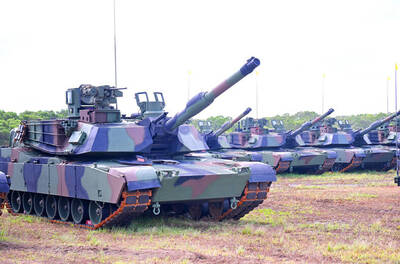
The manufacture of the remaining 28 M1A2T Abrams tanks Taiwan purchased from the US has recently been completed, and they are expected to be delivered within the next one to two months, a source said yesterday. The Ministry of National Defense is arranging cargo ships to transport the tanks to Taiwan as soon as possible, said the source, who is familiar with the matter. The estimated arrival time ranges from late this month to early next month, the source said. The 28 Abrams tanks make up the third and final batch of a total of 108 tanks, valued at about NT$40.5 billion

Two Taiwanese prosecutors were questioned by Chinese security personnel at their hotel during a trip to China’s Henan Province this month, the Mainland Affairs Council (MAC) said yesterday. The officers had personal information on the prosecutors, including “when they were assigned to their posts, their work locations and job titles,” MAC Deputy Minister and spokesman Liang Wen-chieh (梁文傑) said. On top of asking about their agencies and positions, the officers also questioned the prosecutors about the Cross-Strait Joint Crime-Fighting and Judicial Mutual Assistance Agreement, a pact that serves as the framework for Taiwan-China cooperation on combating crime and providing judicial assistance, Liang
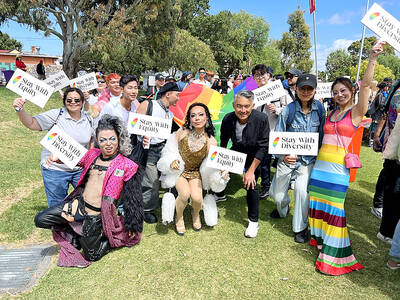
A group from the Taiwanese Designers in Australia association yesterday represented Taiwan at the Midsumma Pride March in Melbourne. The march, held in the St. Kilda suburb, is the city’s largest LGBTQIA+ parade and the flagship event of the annual Midsumma Festival. It attracted more than 45,000 spectators who supported the 400 groups and 10,000 marchers that participated this year, the association said. Taiwanese Designers said they organized a team to march for Taiwan this year, joining politicians, government agencies, professionals and community organizations in showing support for LGBTQIA+ people and diverse communities. As the first country in Asia to legalize same-sex
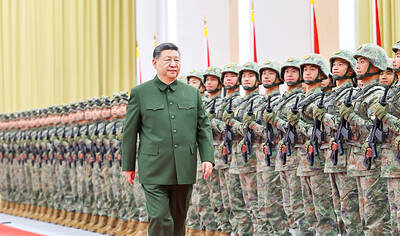
MOTIVES QUESTIONED The PLA considers Xi’s policies toward Taiwan to be driven by personal considerations rather than military assessment, the Epoch Times reports Chinese President Xi Jinping’s (習近平) latest purge of the Chinese People’s Liberation Army (PLA) leadership might have been prompted by the military’s opposition to plans of invading Taiwan, the Epoch Times said. The Chinese military opposes waging war against Taiwan by a large consensus, putting it at odds with Xi’s vision, the Falun Gong-affiliated daily said in a report on Thursday, citing anonymous sources with insight into the PLA’s inner workings. The opposition is not the opinion of a few generals, but a widely shared view among the PLA cadre, the Epoch Times cited them as saying. “Chinese forces know full well that


 RSS
RSS