


A secret memorandum of understanding (MOU) signed between China and the WHO in 2005 directly affects Taiwan’s participation in the annual World Health Assembly (WHA) and other WHO-related events, Minister of Foreign Affairs Joseph Wu (吳釗燮) said yesterday.
Given the existence of the MOU, which Taiwan found out about in 2007, the nation needs greater international support for its bid to attend the WHA and participate in other WHO-related events, and to increase pressure on the WHO Secretariat and Beijing, Wu told lawmakers during a legislative session in Taipei.
“To overcome the hurdle represented by the MOU, we need stronger support from the international community, and so far this year, the atmosphere around the world has been increasingly in favor of Taiwan,” Wu said.
However, despite growing support for Taiwan’s WHA bid, Wu said it would be “extremely difficult” for the nation to secure an invitation to the annual meeting of the WHO’s decisionmaking body.
“However, we will not stop our efforts just because it is difficult to achieve,” he added.
Although the content of the MOU was never made public, Taipei has said it stipulates that the nation has to apply for WHO technical assistance through China and that all exchanges between Taiwan and the WHO must be approved by Beijing.
Neither China nor the WHO Secretariat consulted Taiwan over the MOU before it was signed. In the MOU, Taiwan is treated as a part of China, referred to as “Taiwan, China.”
The government has repeatedly protested to the WHA over the MOU as denigrating its national status, but to no avail.
Meanwhile, Wu said the US and other like-minded countries have adopted the measures they considered “most appropriate” to aid Taiwan’s bid to attend this year’s WHA.
“If they consider [making official proposals at the WHA] is not appropriate, it could have a negative effect if we continue to push them to do so,” Wu said.
Wu was responding to a question by Chinese Nationalist Party (KMT) Legislator Chiang Chi-chen (江啟臣), who asked why the US has not made an official proposal to discuss Taiwan’s participation as an observer at the WHA.
Instead, Taiwan has asked its 15 diplomatic allies to make such requests.
The WHO last week said that two of its members have formally proposed that member states consider Taiwan’s participation as an observer at this year’s WHA, without naming the countries.
The Ministry of Foreign Affairs later said that the countries are two of Taiwan’s diplomatic allies and more would join the efforts, but declined to name them.
The WHA is to hold its 73rd session on Monday and Tuesday next week, which is to be held virtually due to travel restrictions caused by the COVID-19 pandemic.

LOUD AND PROUD Taiwan might have taken a drubbing against Australia and Japan, but you might not know it from the enthusiasm and numbers of the fans Taiwan might not be expected to win the World Baseball Classic (WBC) but their fans are making their presence felt in Tokyo, with tens of thousands decked out in the team’s blue, blowing horns and singing songs. Taiwanese fans have packed out the Tokyo Dome for all three of their games so far and even threatened to drown out home team supporters when their team played Japan on Friday. They blew trumpets, chanted for their favorite players and had their own cheerleading squad who dance on a stage during the game. The team struggled to match that exuberance on the field, with
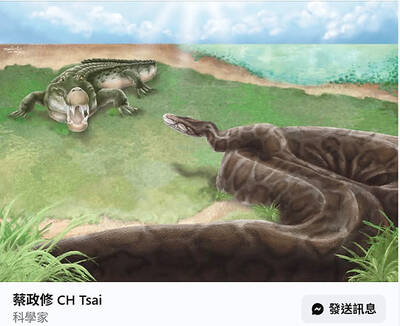
Taiwanese paleontologists have discovered fossil evidence that pythons up to 4m long inhabited Taiwan during the Pleistocene epoch, reporting their findings in the international scientific journal Historical Biology. National Taiwan University (NTU) Institute of Ecology and Evolutionary Biology associate professor Tsai Cheng-hsiu (蔡政修) led the team that discovered the largest snake fossil ever found in Taiwan. The single trunk vertebra was discovered in Tainan at the Chiting Formation, dated to between 400,000 and 800,000 years ago in the Middle Pleistocene, the paper said. The area also produced Taiwan’s first avian fossil, as well as crocodile, mammoth, saber-toothed cat and rhinoceros fossils, it said. Discoveries

Taiwanese paleontologists have discovered fossil evidence that pythons up to 4m long inhabited Taiwan during the Pleistocene epoch, reporting their findings in the international scientific journal Historical Biology. National Taiwan University (NTU) Institute of Ecology and Evolutionary Biology associate professor Tsai Cheng-hsiu (蔡政修) led the team that discovered the largest snake fossil ever found in Taiwan. A single trunk vertebra was discovered in Tainan at the Chiting Formation, dated to between 800,000 to 400,000 years ago in the Middle Pleistocene, the paper said. The area also produced Taiwan’s first avian fossil, as well as crocodile, mammoth, sabre-toothed cat and rhinoceros fossils, it said. Discoveries

Whether Japan would help defend Taiwan in case of a cross-strait conflict would depend on the US and the extent to which Japan would be allowed to act under the US-Japan Security Treaty, former Japanese minister of defense Satoshi Morimoto said. As China has not given up on the idea of invading Taiwan by force, to what extent Japan could support US military action would hinge on Washington’s intention and its negotiation with Tokyo, Morimoto said in an interview with the Liberty Times (sister paper of the Taipei Times) yesterday. There has to be sufficient mutual recognition of how Japan could provide


 RSS
RSS