


The government plans to budget NT$390 million (US$13.02 million) in subsidies to telecoms building base stations along more than 100 backcountry hiking trails, near several large mountain huts and along the South Link Line, the National Communications Commission (NCC) said yesterday.
The subsidies were proposed in line with the Executive Yuan’s policy of opening up the nation’s mountains and forests to visitors, the commission said, adding that one reason to improve communication quality in these areas is so that mountaineers can call 112 in an emergency.
The nation’s Telecommunication Universal Service Fund (電信普及服務基金) gives subsidies to telecoms that build infrastructure in remote townships — defined as areas where the population density is 20 percent lower than the national average, NCC Department of Infrastructure and Cybersecurity Director Cheng Ming-tsung (鄭明宗) said.
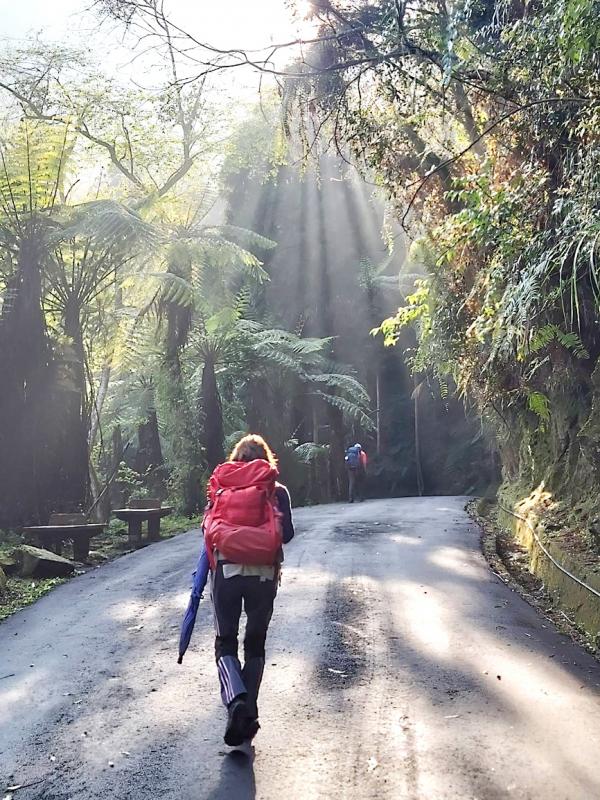
Photo: Chang Hsieh-sheng, Taipei Times
The five large mountain huts — Jiujiu Lodge (九九山莊), Tianchi Lodge (天池山莊), Kuaigu Lodge (檜谷山莊), Siangyang Cabin (向陽山屋) and Jiaminghu Cabin and Camping Ground (嘉明湖山屋) — and the 112 mountain trails where the base stations are to be built are more remote than such townships, Cheng said, adding that the locations are mainly accessed by mountaineers and rescuers.
Construction costs are expected to reach NT$180 million and no fund had previously covered building telecom infrastructure in these areas.
The South Link Line, part of the nation’s mass transportation system, has a few railway stations in mountainous areas that need base stations, Cheng said.
The government subsidies — to be funded by the Executive Yuan’s Secondary Reserve Fund — would cover 49 percent of the cost of building the base stations, Cheng said.
If the Executive Yuan only agrees to fund part of the subsidies, the commission would request its permission to use part of the Communication Supervision and Management Fund (通訊傳播監督管理基金) to cover the remainder, he said.
The Ministry of Education is coordinating the various government agencies implementing the policy to open up mountainous and forested areas, and the Forestry Bureau provided the list of mountain huts and trails, Cheng said.
The commission aims to add reception to the mountainous areas and improve reception along the South Link Line by the end of this year, Cheng said.
Last year, the government worked with telecoms to have a base station constructed on the north peak of Yushan (玉山) at a cost of NT$40 million.

The manufacture of the remaining 28 M1A2T Abrams tanks Taiwan purchased from the US has recently been completed, and they are expected to be delivered within the next one to two months, a source said yesterday. The Ministry of National Defense is arranging cargo ships to transport the tanks to Taiwan as soon as possible, said the source, who is familiar with the matter. The estimated arrival time ranges from late this month to early next month, the source said. The 28 Abrams tanks make up the third and final batch of a total of 108 tanks, valued at about NT$40.5 billion

Two Taiwanese prosecutors were questioned by Chinese security personnel at their hotel during a trip to China’s Henan Province this month, the Mainland Affairs Council (MAC) said yesterday. The officers had personal information on the prosecutors, including “when they were assigned to their posts, their work locations and job titles,” MAC Deputy Minister and spokesman Liang Wen-chieh (梁文傑) said. On top of asking about their agencies and positions, the officers also questioned the prosecutors about the Cross-Strait Joint Crime-Fighting and Judicial Mutual Assistance Agreement, a pact that serves as the framework for Taiwan-China cooperation on combating crime and providing judicial assistance, Liang
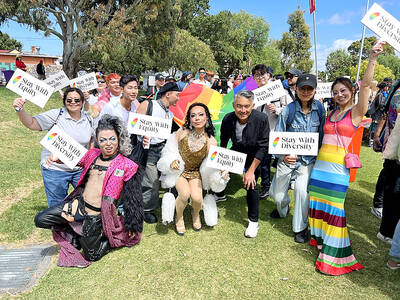
A group from the Taiwanese Designers in Australia association yesterday represented Taiwan at the Midsumma Pride March in Melbourne. The march, held in the St. Kilda suburb, is the city’s largest LGBTQIA+ parade and the flagship event of the annual Midsumma Festival. It attracted more than 45,000 spectators who supported the 400 groups and 10,000 marchers that participated this year, the association said. Taiwanese Designers said they organized a team to march for Taiwan this year, joining politicians, government agencies, professionals and community organizations in showing support for LGBTQIA+ people and diverse communities. As the first country in Asia to legalize same-sex
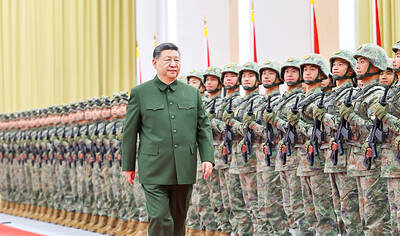
MOTIVES QUESTIONED The PLA considers Xi’s policies toward Taiwan to be driven by personal considerations rather than military assessment, the Epoch Times reports Chinese President Xi Jinping’s (習近平) latest purge of the Chinese People’s Liberation Army (PLA) leadership might have been prompted by the military’s opposition to plans of invading Taiwan, the Epoch Times said. The Chinese military opposes waging war against Taiwan by a large consensus, putting it at odds with Xi’s vision, the Falun Gong-affiliated daily said in a report on Thursday, citing anonymous sources with insight into the PLA’s inner workings. The opposition is not the opinion of a few generals, but a widely shared view among the PLA cadre, the Epoch Times cited them as saying. “Chinese forces know full well that


 RSS
RSS