


Democratic Progressive Party (DPP) Legislator Chao Tien-lin (趙天麟) yesterday called on law enforcement authorities to treat the recent paint attack on Lam Wing-kei (林榮基), a former co-owner of Hong Kong’s Causeway Bay Books, as a national security matter.
Chao said that if it was treated like a regular criminal case, it would easily get swept under the rug, so authorities should deal with it as a national security issue involving coordinated criminal groups.
“If the masterminds behind the plot are not identified, then attacks like this will recur again and again. The dark forces behind them will continue to operate from abroad, out of reach of our laws, and they will continue to pose a danger to democracy activists,” he said.
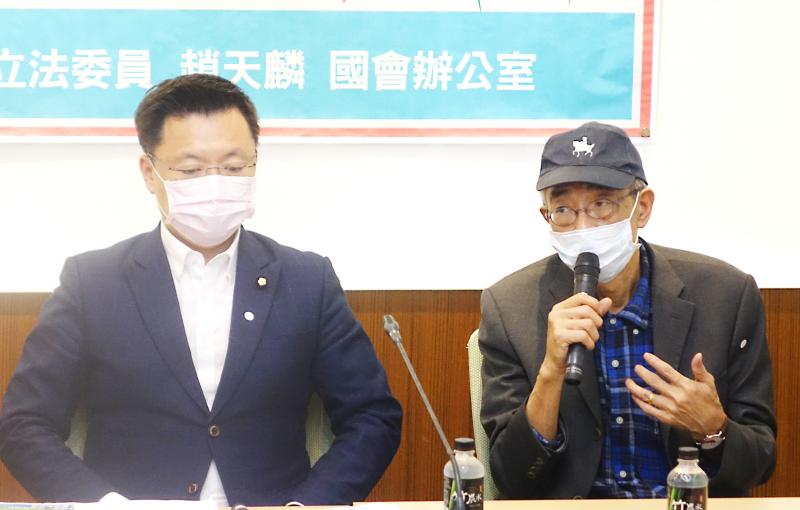
Photo: Wang Yi-sung, Taipei Times
Chao invited Lam to attend yesterday’s briefing, along with Criminal Investigation Bureau Deputy Commissioner Liao Hsun-cheng (廖訓誠) and officials from the National Security Bureau’s (NSB) Third Department.
“I read in media reports that the judges went easy on the suspects, as they were released on bail of a few thousand New Taiwan dollars,” Lam said. “Is this not encouraging these suspects to continue to carry out such attacks?”
“The judges said they considered the human rights of the suspects … but the victims who were hurt in the assault, they should have their human rights protected as well,” he added.
“These people likely received money from China,” Lam said. “If judges hand out lenient sentences, then I will really [fear for myself], worrying that these people are looking for me again.”
“Although these suspects promised they would not hurt me, they have committed a crime once and they can do it again a second time... If that happens, then what can I do? Do I not have human rights as well?” he said.
Chao said that Lam was not the only Hong Konger to be attacked in the past few years.
Hong Kong activist Joshua Wong (黃之鋒), singer Denise Ho (何韻詩) and others were attacked when they visited Taiwan, but the courts usually found the suspects not guilty, or released them on bail, he said.
“Together, the police departments, criminal investigation agencies, prosecutors and all the way to the NSB, they should upgrade the paint attack on Lam” to a national security-level issue, Chao said,
The authorities must uncover the masterminds and cut off their money, “because it is not just an attack on one victim, it is also an attack on Taiwan’s democracy and freedom,” he said.
The authorities should not just sit on their hands, he said.
They should be proactive in gathering evidence and sharing intelligence to ensure that “our citizens and democracy activists in Taiwan can have security ... and to prove to everyone that Taiwan is a country in which we do not allow the forces of Chinese Communist Party and their proxies to run rampant,” he added.
“We have asked our field operation office to find out if China was involved into this case, and also asked the public to provide us with information,” said Lin Shih-wei (林世偉), section chief of the National Security Division of the Ministry of Justice’s Investigation Bureau (MJIB). “The bureau will certainly investigate this case and possible breaches of the Anti-Infiltration Act [反滲透法].”
Lam said that the government should review related laws and fortify them, as it is his hope that the law not just protects Hong Kongers, but also Taiwanese.
Lam was one of five shareholders and staff at Causeway Bay Books in Hong Kong, which sold controversial books about China’s leaders.
He disappeared into Chinese custody at the end of 2015, and was released on bail and allowed to return to Hong Kong in June 2016 to retrieve a hard drive listing the bookstore’s customers. Instead, he jumped bail and went public.
He fled to Taiwan in April last year and on Saturday last week opened a bookstore in Taipei. He was splashed with paint by two men the previous Tuesday.

The manufacture of the remaining 28 M1A2T Abrams tanks Taiwan purchased from the US has recently been completed, and they are expected to be delivered within the next one to two months, a source said yesterday. The Ministry of National Defense is arranging cargo ships to transport the tanks to Taiwan as soon as possible, said the source, who is familiar with the matter. The estimated arrival time ranges from late this month to early next month, the source said. The 28 Abrams tanks make up the third and final batch of a total of 108 tanks, valued at about NT$40.5 billion

Two Taiwanese prosecutors were questioned by Chinese security personnel at their hotel during a trip to China’s Henan Province this month, the Mainland Affairs Council (MAC) said yesterday. The officers had personal information on the prosecutors, including “when they were assigned to their posts, their work locations and job titles,” MAC Deputy Minister and spokesman Liang Wen-chieh (梁文傑) said. On top of asking about their agencies and positions, the officers also questioned the prosecutors about the Cross-Strait Joint Crime-Fighting and Judicial Mutual Assistance Agreement, a pact that serves as the framework for Taiwan-China cooperation on combating crime and providing judicial assistance, Liang
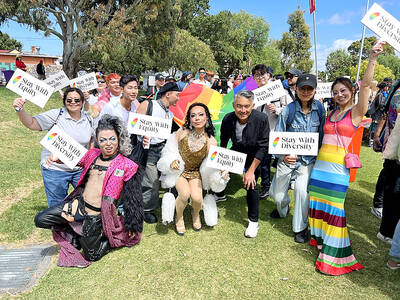
A group from the Taiwanese Designers in Australia association yesterday represented Taiwan at the Midsumma Pride March in Melbourne. The march, held in the St. Kilda suburb, is the city’s largest LGBTQIA+ parade and the flagship event of the annual Midsumma Festival. It attracted more than 45,000 spectators who supported the 400 groups and 10,000 marchers that participated this year, the association said. Taiwanese Designers said they organized a team to march for Taiwan this year, joining politicians, government agencies, professionals and community organizations in showing support for LGBTQIA+ people and diverse communities. As the first country in Asia to legalize same-sex
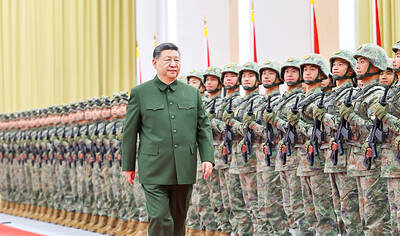
MOTIVES QUESTIONED The PLA considers Xi’s policies toward Taiwan to be driven by personal considerations rather than military assessment, the Epoch Times reports Chinese President Xi Jinping’s (習近平) latest purge of the Chinese People’s Liberation Army (PLA) leadership might have been prompted by the military’s opposition to plans of invading Taiwan, the Epoch Times said. The Chinese military opposes waging war against Taiwan by a large consensus, putting it at odds with Xi’s vision, the Falun Gong-affiliated daily said in a report on Thursday, citing anonymous sources with insight into the PLA’s inner workings. The opposition is not the opinion of a few generals, but a widely shared view among the PLA cadre, the Epoch Times cited them as saying. “Chinese forces know full well that


 RSS
RSS