


As the nation is tomorrow to begin the three-day International Workers’ Day weekend, lawmakers on the Legislative Yuan’s Transportation Committee yesterday passed a motion asking the Ministry of Transportation and Communications to launch a mobile app to regulate crowds at nearly 300 popular tourist attractions nationwide only after the app passes stress tests at randomly selected hot spots before the holiday.
Functions of the “Freeway 1968” app, which previously only helped motorists avoid congestion on freeways, have received public scrutiny after they were upgraded to allow travelers to monitor vehicular and foot traffic at attractions during holiday weekends.
The changes are part of the government’s plan to allow the public to enjoy their holiday travel plans without compromising the nation’s hard-won disease prevention achievements over the past two months.
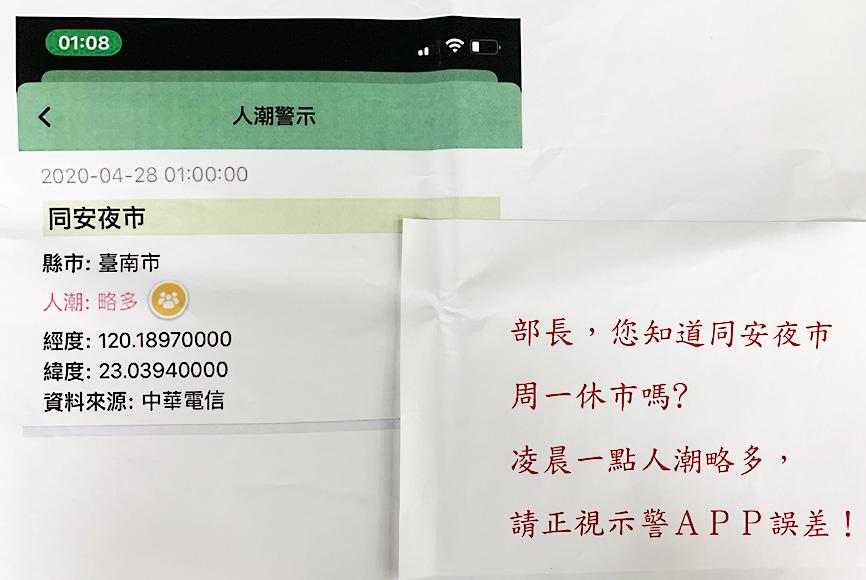
Photo: Wang Mei-hsiu, Taipei Times
As of yesterday, the nation had not reported a confirmed COVID-19 case in four consecutive days or any domestic infections in 17 days.
However, the changes have drawn criticism from local government officials since they were announced.
Tainan Mayor Huang Wei-je (黃偉哲) on Monday said that 17 of the attractions included in the app are in Tainan, compared with only four in Taipei and 15 in New Taipei City.
He questioned the criteria used by the ministry to determine which locations would be listed and expressed concern that travelers would not visit Tainan after seeing the list.
More local officials criticized the app after Minister of Transportation and Communications Lin Chia-lung (林佳龍) yesterday told the committee that the number of attractions listed in the app would be expanded from 216 to nearly 300 on orders from the Central Epidemic Command Center.
The app was upgraded to help control the number of people at attractions during a long weekend, the ministry said.
It displays crowd levels in green, yellow and red — normal, slightly more crowded than normal and crowded respectively, it added.
However, Democratic Progressive Party (DPP) Legislator Lee Kun-tse (李昆澤) said that some users found that a yellow alert was shown for the Hsinchu Zoo, even though it was closed at the time.
Meanwhile, the citron daylily blossom in Changhua County’s Huatan Township (花壇) was not included in the app, even though it often draws huge crowds on holidays, Lee said, adding that the data and logic the app uses to issue alerts are inaccurate and unclear.
Chinese Nationalist Party (KMT) Legislator Hung Mong-kai (洪孟楷) said that the center sent crowd warning text messages to visitors at 11 attractions during the four-day Tomb Sweeping Day weekend earlier this month.
While the nation has had zero new confirmed COVID-19 cases for several days in a row, the number of attractions that would be monitored closely has jumped to nearly 300, he said, describing the decision as mind-boggling.
Travelers might decide to skip some attractions if they see a yellow or red alert has been issued and shops would end up with no customers, which would create a lose-lose situation for visitors and small businesses, he added.
Lin said that the app uses average foot traffic in the previous two to three months as a baseline and engineers have set parameters to reflect changes in volume.
The app could show a yellow or red alert if there is a slight change in foot traffic, Lin said, adding that the ministry would regularly update the app’s functionality and make necessary changes.
The ministry said that a meeting with representatives of Chunghwa Telecom’s big data department and the Freeway Bureau found that the app did not take into consideration the number of visitors each attraction can accommodate, which is why it failed to accurately reflect crowd sizes.
Chunghwa Telecom has been asked to revise the parameters before the holiday, it added.

Actor Darren Wang (王大陸) was sentenced to six months in prison, commutable to a fine, by the New Taipei District Court today for contravening the Personal Data Protection Act (個人資料保護法) in a case linked to an alleged draft-dodging scheme. Wang allegedly paid NT$3.6 million (US$114,380) to an illegal group to help him evade mandatory military service through falsified medical documents, prosecutors said. He transferred the funds to Chen Chih-ming (陳志明), the alleged mastermind of a draft-evasion ring, although he lost contact with him as he was already in detention on fraud charges, they said. Chen is accused of helping a

SECURITY: Starlink owner Elon Musk has taken pro-Beijing positions, and allowing pro-China companies to control Taiwan’s critical infrastructure is risky, a legislator said Starlink was reluctant to offer services in Taiwan because of the nation’s extremely high penetration rates in 4G and 5G services, the Ministry of Digital Affairs said yesterday. The ministry made the comments at a meeting of the legislature’s Transportation Committee, which reviewed amendments to Article 36 of the Telecommunications Management Act (電信管理法). Article 36 bans foreigners from holding more than 49 percent of shares in public telecommunications networks, while shares foreigners directly and indirectly hold are also capped at 60 percent of the total, unless specified otherwise by law. The amendments, sponsored by Chinese Nationalist Party (KMT) Legislator Ko

The eastern extension of the Taipei MRT Red Line could begin operations as early as late June, the Taipei Department of Rapid Transit Systems said yesterday. Taipei Rapid Transit Corp said it is considering offering one month of free rides on the new section to mark its opening. Construction progress on the 1.4km extension, which is to run from the current terminal Xiangshan Station to a new eastern terminal, Guangci/Fengtian Temple Station, was 90.6 percent complete by the end of last month, the department said in a report to the Taipei City Council's Transportation Committee. While construction began in October 2016 with an

NON-RED SUPPLY: Boosting the nation’s drone industry is becoming increasingly urgent as China’s UAV dominance could become an issue in a crisis, an analyst said Taiwan’s drone exports to Europe grew 41.7-fold from 2024 to last year, with demand from Ukraine’s fight against Russian aggression the most likely driver of growth, a study showed. The Institute for Democracy, Society and Emerging Technology (DSET) in a statement on Wednesday said it found that many of Taiwan’s uncrewed aerial vehicle (UAV) sales were from Poland and the Czech Republic. These countries likely transferred the drones to Ukraine to aid it in its fight against the Russian invasion that started in 2022, it said. Despite the gains, Taiwan is not the dominant drone exporter to these markets, ranking second and fourth


 RSS
RSS