


Injuries from falls and poisoning are common among domesticated cats, two animal welfare advocates said, urging cat owners to pay attention to the safety of their pets.
“Placing netting over metal window grates is a common and important measure to protect cats from falling,” said one of the advocates, who used the alias “Cuddy.”
Some owners let their cats roam outdoors, but doing so could be dangerous for the animals, said the other advocate, who used the alias “Mark.”
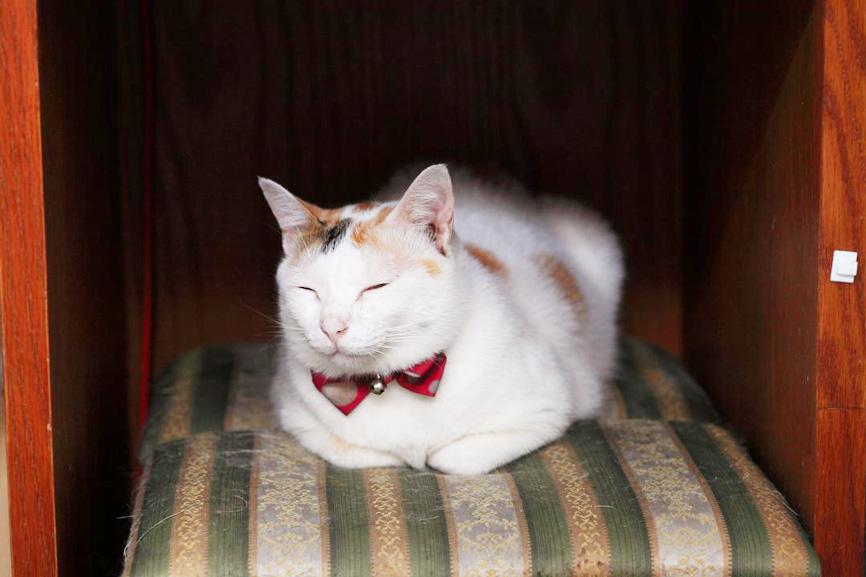
Photo: Pan Tzu-chiang, Taipei Times
As cats love high places and have hunting instincts, they can easily endanger themselves when trying to pounce on birds or bats from a high place, he said.
“It is a common misconception that cats cannot injure themselves by falling, as they generally have a good sense of balance,” he said.
A cat must fall from a height of at least 90cm to right itself and land safely.
However, cats can sustain broken limbs or jawbones if they fall from a height greater than 7m — a phenomenon identified as “high-rise syndrome” in a 1987 study published in the Journal of the American Veterinary Medical Association.
Owners should not rely solely on window and door screens to keep cats indoors, as the animals can cut through them with their claws, Mark said, adding that in some cases cats have been known to ram screens and break through them.
Owners who keep cats in apartments accessed through a balcony should install robust netting to prevent falls, he added.
They should also use retractable metal rods in the bases of window frames to prevent their cats sliding the windows open, Cuddy said.
While cats are at higher risk of falling when outdoors, they could also sustain a fall indoors, she said.
“My cat loves to dart about, and once it slipped on the floor and fell down the stairs, breaking some of its teeth. I later installed garden netting made of durable material so that my cat can recover and stand up if it slides into it,” Cuddy said.
Tainan veterinarian Hsu Chia-chan (許嘉展) said that owners should also prevent their cats from eating plants or food found outside, which could cause poisoning.
“Most pet owners are aware that things like chocolate, onions or garlic can make a cat sick, but they must also prevent their cats from eating plants, some of which can be poisonous even in small quantities,” he said.
For example, Rohdea japonica, poinsettias and Indian azaleas can be toxic to cats, he added.
Owners must also be careful to avoid leaving residue from cleaning solutions on surfaces, as cats might be attracted to the smell and lick the surface, he said, adding that farming families must be cautious with cats near fertilizer and pesticides.

The Ministry of Finance this afternoon announced the winning numbers for the March-April uniform invoice lottery. The winning number for the NT$10 million (US$318,060) special prize is 19531471, and the winning number for the NT$2 million grand prize is 85941329. Three numbers were drawn for the NT$200,000 first prize: 07225810, 20231230 and 83518781. Those with receipts matching the last seven digits of any of the first-prize numbers will win the NT$40,000 second prize, while those matching the last six digits will win the NT$10,000 third prize. Those whose receipts match the last five digits of the first-prize numbers can claim the NT$4,000 fourth prize,

SIX SUBSIDIES: The monthly allowance for older farmers is to increase to NT$10,000, and NT$5,000 is to be given to homemakers under the national pension system, Lai said The government is to implement major welfare policies for disadvantaged groups, including raising the monthly allowance for older farmers to NT$10,000 and providing homemakers with NT$5,000 per month, President William Lai (賴清德) said yesterday. Lai made the remarks during a visit to Wangling Temple in Chiayi County, saying that the planned increases were being introduced amid economic growth and an increase in tax revenue. Touting a policy, in which the government plans to provide a monthly allowance of NT$5,000 for every child under the age of 18 in a bid to address Taiwan’s low birthrate, Lai said that if received for the
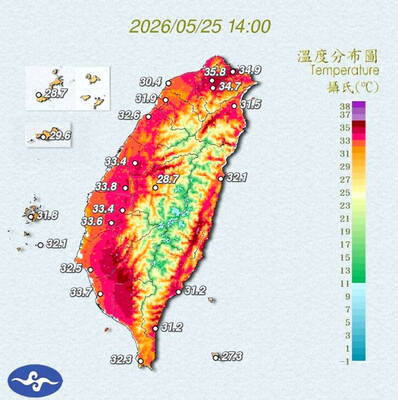
STAY COOL: The HPA recommended that people stay hydrated, use air-conditioning or fans while indoors, wear loose-fitting clothes and walk in the shade while outdoors Employers must implement measures such as installing cooling equipment, and providing drinking water and rest breaks for outdoor workers starting from Monday next week, the Taipei Department of Labor said on Sunday. Employers who fail to comply could face fines of NT$30,000 to NT$300,000 under the Occupational Safety and Health Act (職業安全衛生法), the department said. Businesses in Taipei employing fewer than 100 workers, as well as registered self-employed workers with labor insurance coverage, could receive on-site assessments and guidance from occupational safety consultants to help them apply for central government subsidies to implement or improve heat-protection measures, it said. Under the Ministry of
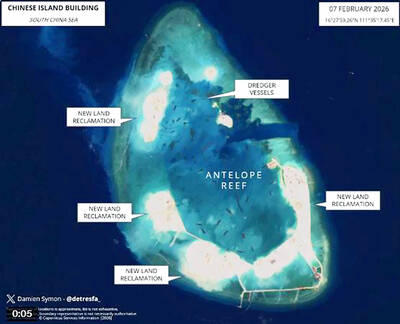
ISOLATION: The outposts would serve as support and backup bases, forcing US forces to either face China head-on or reroute, increasing travel time and operational costs China’s outposts in the South China Sea could be used to delay and constrain foreign forces during a conflict in the Taiwan Strait, giving Beijing a critical window to carry out amphibious landing and blockade operations, a report said. The Chinese Communist Party’s (CCP) forward operating bases on islands and reclaimed features in the South China Sea could delay foreign forces long enough for the Chinese People’s Liberation Army (PLA) to secure a key 48-to-72-hour window in the Taiwan Strait, a report commissioned by the Mainland Affairs Council found. The report, conducted by the Institute for National Defense and Security Research, examined


 RSS
RSS