


Three Democratic Progressive Party (DPP) legislators on Friday proposed amending the Legislators’ Conduct Act (立法委員行為法) to require lawmakers who have attended political conclaves in China to be transparent about their upcoming visits to the country.
The proposal came after Chinese Nationalist Party (KMT) Legislator Wu Sz-huai (吳斯懷) sparked controversy by asking for confidential military information from the Ministry of National Defense.
The amendment, sponsored by DPP legislators Lai Jui-lung (賴瑞隆), Su Chen-ching (蘇震清) and Rosalia Wu (吳思瑤), states that as China has not renounced compromising Taiwan’s territory or security, lawmakers who have attended a conclave and could have accessed Taiwan’s national secrets must report to the Legislative Yuan Secretariat their upcoming trips to China and publish their schedules online for public viewing.
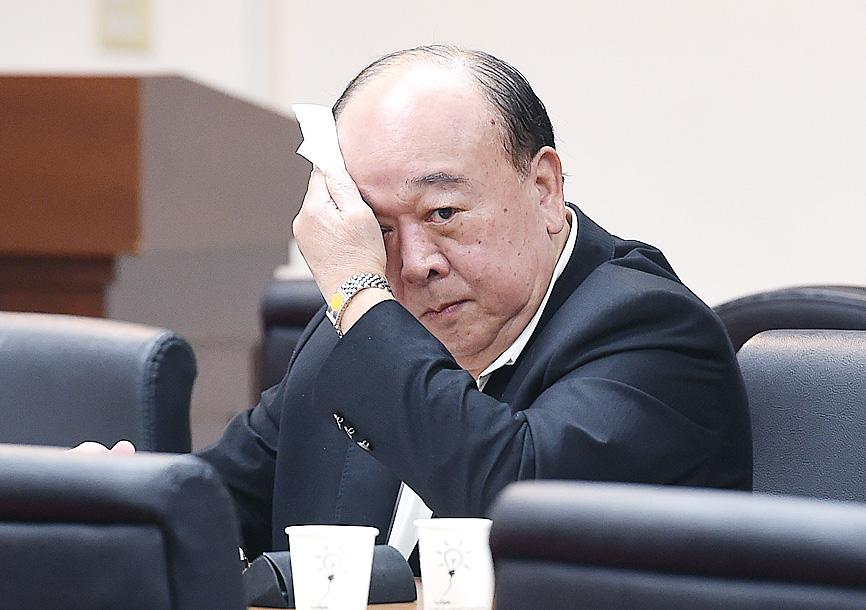
Photo: Liao Chen-huei, Taipei Times
The legislature’s Judiciary and Organic Laws and Statutes Committee is to review the proposal.
The ministry on Thursday confirmed that Wu had requested confidential information.
Local Chinese-language media quoted a high-ranking officer as saying that the request included materials on cyberdefense units at the new Information and Electronic Warfare Command, and troop deployments for all three major branches of the armed forces, as well as updates on combined service units and military operations plans.
The ministry reportedly sent officials to brief Wu in his office regarding the information he had requested.
The draft amendment would also require lawmakers who are part of a conclave to report their “related party”: assistant, spouse, direct or lateral family member within two degrees of consanguinity, as well as, if any, the trustee of their assets.
Lawmakers who leak information during a conclave or a trip to China, Hong Kong or Macau, and who do not notify the secretariat of their trip would face the legislature’s Discipline Committee and a judicial investigation, the amendment says.
Asked about the proposal, Lai said that as Chinese infiltration tactics improve, Taiwan should improve its protection of classified information, especially from the reach of “pro-China” lawmakers.
However, as cross-strait exchanges could not be completely avoided, the proposal seeks to bolster public scrutiny by requiring lawmakers to publish details of their trips to China, he said.
Asked whether the proposal was targeting Wu, Lai did not give a direct answer, saying that there is a general distrust of Wu among his colleagues.
Even the KMT caucus has asked more tenured lawmakers to remain in the Foreign Affairs and National Defense Committee to decrease the chances of Wu landing a seat on the committee, he said.
Lai called on the KMT caucus to support his proposal, which he said would “save them a lot of trouble” if passed.
Reached for comment, Wu said that all legislators should be kept in check, without elaborating.
KMT caucus secretary-general Chiang Wan-an (蔣萬安) said that the proposal should clearly define what it means by a “conclave.”
He asked whether secret meetings held by the legislature’s Economics Committee over procurement plans would also count as conclaves.
If data leakage is the problem, then the scope of the proposed amendment should include nations and territories other than China, Hong Kong and Macau, he said, adding that a legal amendment should be all-encompassing and must be approached with more prudence.
China has not stopped threatening the nation, and if lawmakers leak national secrets they are let in on by virtue of their position, it would negatively affect the nation, New Power Party caucus whip Chiu Hsien-chih (邱顯智) said.
The tensions between the two sides of the Taiwan Strait call for safeguards when it comes to the protection of sensitive information, Taiwan People’s Party caucus whip Jang Chyi-lu (張其祿) said.
However, the proposal is too personal and its scope needs to be more clearly defined to avoid it having overly deep implications, he said.
DPP caucus whip Ker Chien-ming (柯建銘) said that the proposal was filed under the names of individual lawmakers, not the caucus, which is open to the proposed amendment.
Additional reporting by staff writer

The manufacture of the remaining 28 M1A2T Abrams tanks Taiwan purchased from the US has recently been completed, and they are expected to be delivered within the next one to two months, a source said yesterday. The Ministry of National Defense is arranging cargo ships to transport the tanks to Taiwan as soon as possible, said the source, who is familiar with the matter. The estimated arrival time ranges from late this month to early next month, the source said. The 28 Abrams tanks make up the third and final batch of a total of 108 tanks, valued at about NT$40.5 billion

Two Taiwanese prosecutors were questioned by Chinese security personnel at their hotel during a trip to China’s Henan Province this month, the Mainland Affairs Council (MAC) said yesterday. The officers had personal information on the prosecutors, including “when they were assigned to their posts, their work locations and job titles,” MAC Deputy Minister and spokesman Liang Wen-chieh (梁文傑) said. On top of asking about their agencies and positions, the officers also questioned the prosecutors about the Cross-Strait Joint Crime-Fighting and Judicial Mutual Assistance Agreement, a pact that serves as the framework for Taiwan-China cooperation on combating crime and providing judicial assistance, Liang
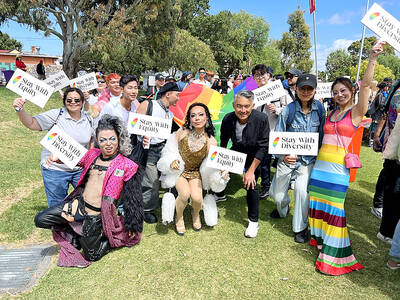
A group from the Taiwanese Designers in Australia association yesterday represented Taiwan at the Midsumma Pride March in Melbourne. The march, held in the St. Kilda suburb, is the city’s largest LGBTQIA+ parade and the flagship event of the annual Midsumma Festival. It attracted more than 45,000 spectators who supported the 400 groups and 10,000 marchers that participated this year, the association said. Taiwanese Designers said they organized a team to march for Taiwan this year, joining politicians, government agencies, professionals and community organizations in showing support for LGBTQIA+ people and diverse communities. As the first country in Asia to legalize same-sex
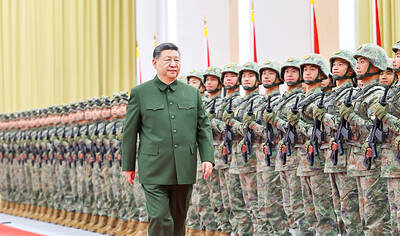
MOTIVES QUESTIONED The PLA considers Xi’s policies toward Taiwan to be driven by personal considerations rather than military assessment, the Epoch Times reports Chinese President Xi Jinping’s (習近平) latest purge of the Chinese People’s Liberation Army (PLA) leadership might have been prompted by the military’s opposition to plans of invading Taiwan, the Epoch Times said. The Chinese military opposes waging war against Taiwan by a large consensus, putting it at odds with Xi’s vision, the Falun Gong-affiliated daily said in a report on Thursday, citing anonymous sources with insight into the PLA’s inner workings. The opposition is not the opinion of a few generals, but a widely shared view among the PLA cadre, the Epoch Times cited them as saying. “Chinese forces know full well that


 RSS
RSS