


National Chi Nan University (NCNU) researchers have helped water bamboo farmers in Nantou County cut electricity costs by 80 percent and reduce light pollution by replacing farmers’ sodium lamps with LED ones.
There are up to 1,800 hectares of water bamboo farms in the county’s Puli Township (埔里), which supply nearly 90 percent of the nation’s demand for the crop.
While water bamboo is usually grown from April to October every year, farmers use lighting at night to boost crop yields, but the sodium lights they used emitted a harsh glare, affecting nearby residents and traffic safety.
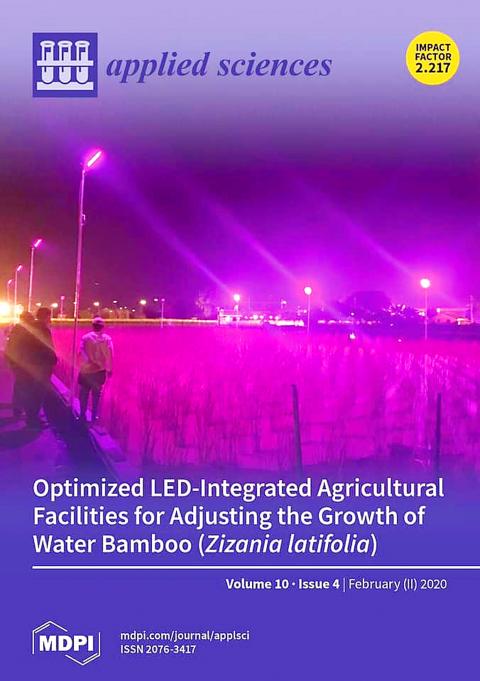
Photo courtesy of National Chi Nan University
Farmers paid electricity fees of NT$6,823 every two months for the sodium lights to illuminate farms covering 1,357.8m2, NCNU College of Science and Technology dean Tsai Yung-pin (蔡勇斌) said on Wednesday.
Tsai led a team in a smart farming and social responsibility project funded by the Ministry of Science and Technology, which began with water bamboo farms in the township’s Fangli Borough (房里).
After switching to LED lights optimized by NCNU researchers, the farmers’ electricity bills fell to NT$1,199, or savings of more than 80 percent, he said.
The amount of water bamboo produced under the two lighting methods was similar at 1,200kg to 1,300kg, while LED devices, emitting softer purple light, mostly reduced light pollution, he said.
The team detailed their findings in a paper published in the journal Applied Sciences last month, with the journal’s cover featuring an image of water bamboo farms bathed in purple light.
The team is to extend the research to farms in Jhuge Borough (珠格) this year, hoping to determine how many LED lamps are needed for farms covering up to 0.5 hectares, Department of Civil Engineering chairman Chen Ku-fan (陳谷汎) said.
While an LED lamp costs NT$3,500, which is more expensive than a NT$2,000 sodium lamp, the former is more durable and energy-efficient in the long run, NCNU Department of Applied Chemistry chairman Kuo Ming-yu (郭明裕) said.
Kuo advised the Council of Agriculture to consider adding such LED lamps to its funding list for agricultural materials and equipment to help alleviate the financial burden on farmers.
He aims to improve the LED lights to make their direction adjustable and allow the light to be more evenly distributed over broader areas, Kuo added.

FUKUOKA SITUATION: Japanese media reported that the pathogen is expected to be identified by the summer, while the CDC downplayed the idea that it was hMPV A “mysterious cold-like illness” reported in Japan’s Fukuoka Prefecture does not seem to be a new disease, but Japanese authorities have been asked about the situation, the Centers for Disease Control (CDC) said yesterday. The Fukuoka Prefectural Medical Association on Wednesday told a news conference that a “mystery cold” that has become a hot topic on social media is “highly likely to be caused by some kind of viral infection,” Japan’s KBC News reported. “Many people are experiencing symptoms starting with a sore throat, followed by a runny nose, phlegm and a severe cough,” KBC News reported, citing association officials. Health authorities are

Nvidia Corp CEO Jensen Huang (黃仁勳) arrived in Taiwan yesterday ahead of upcoming AI and technology events, saying he plans to meet with clients and Taiwan Semiconductor Manufacturing Co Chairman C.C. Wei (魏哲家) during his visit. After landing at Taipei Songshan Airport, Huang posed for photos with fans and handed out Yakult drinks to reporters and supporters waiting at the scene, saying he has “a lot to do” during the trip. Asked about reports that Nvidia’s planned headquarters site in Taipei’s Beitou Shilin Technology Park could break ground on May 27, Huang said that if the company holds an event, he would

The Ministry of Finance this afternoon announced the winning numbers for the March-April uniform invoice lottery. The winning number for the NT$10 million (US$318,060) special prize is 19531471, and the winning number for the NT$2 million grand prize is 85941329. Three numbers were drawn for the NT$200,000 first prize: 07225810, 20231230 and 83518781. Those with receipts matching the last seven digits of any of the first-prize numbers will win the NT$40,000 second prize, while those matching the last six digits will win the NT$10,000 third prize. Those whose receipts match the last five digits of the first-prize numbers can claim the NT$4,000 fourth prize,
Taiwan Travelogue (臺灣漫遊錄), which earlier this week became the first Taiwanese novel to win the International Booker Prize, is to be adapted into a television series through a Taiwan-Japan coproduction, producer Chang Chen-yu (張辰漁) said yesterday. Chang, a producer at World Softest Production Film Co, wrote on Facebook that the company had been searching for projects with international appeal that retain a strong Taiwanese identity after colleagues and Japanese partners strongly recommended the novel. After reading the book, Chang said he immediately decided to pursue the screen rights. “A great story has the power to transcend time and borders, and connect countless people,”


 RSS
RSS