


The Taipei Zoo on Wednesday and Thursday performed two artificial inseminations of its female giant panda, which is in its high fertility season, in the hopes of conceiving a new cub for its panda family.
Zookeepers on Feb. 9 started noticing signs of impending estrus and ovulation in the panda, known as Yuan Yuan (圓圓), including vulvar swelling, scent-marking behaviors, playing in the water and restlessness, the zoo said in a news release on Friday.
As the chance of ovulation would be highest when Yuan Yuan’s hormone levels peaked on Thursday, the zoo performed artificial inseminations on Wednesday and Thursday with semen collected from Tuan Tuan (團團), its male giant panda, the zoo said.
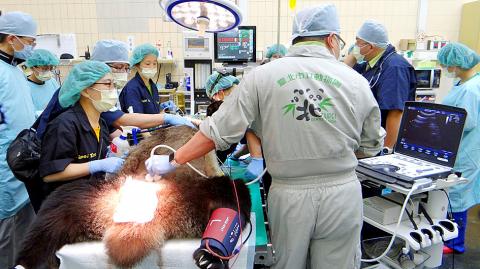
Photo provided by Taipei Zoo
During previous panda mating seasons, Chinese experts from the China Conservation and Research Center for the Giant Panda visited the zoo, but they could not travel to Taiwan this year due to an outbreak of COVID-19 in China, it said.
A team set up a videoconference with the center and researcher Wang Chengdong (王承東) providing advice on breeding, it added.
On Wednesday afternoon, the team inseminated Yuan Yuan with part of the semen collected hours earlier from Tuan Tuan, the zoo said, adding that a sample had a sperm count of approximately 400 million, with 96 percent sperm motility.
On Thursday morning, the team inserted the remaining semen, which had a sperm count of about 450 million and sperm motility of 93 percent, it said.
In the afternoon, the zoo placed the pandas together, hoping to increase the odds of fertilization through natural mating, but with no results, as they either lost interest in mating or simply did not know how, it added.
Besides the tasks related to artificial insemination, the two pandas also received annual dental and abdominal check-ups, the zoo said.
Tuan Tuan and Yuan Yuan were gifted by China to Taiwan in 2008. Their only cub, Yuan Zai (圓仔), was born in 2013 at the zoo following artificial insemination.

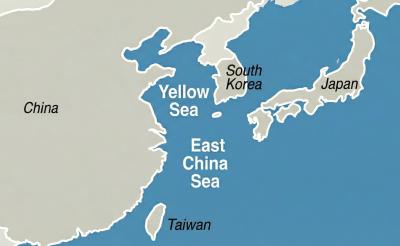
China has reserved offshore airspace in the Yellow Sea and East China Sea from March 27 to May 6, issuing alerts usually used to warn of military exercises, although no such exercises have been announced, the Wall Street Journal (WSJ) reported yesterday. Reserving such a large area for 40 days without explanation is an “unusual step,” as military exercises normally only last a few days, the paper said. These alerts, known as Notice to Air Missions (Notams), “are intended to inform pilots and aviation authorities of temporary airspace hazards or restrictions,” the article said. The airspace reserved in the alert is
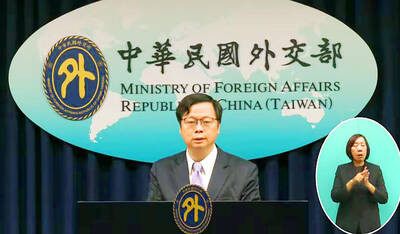
NAMING SPAT: The foreign ministry called on Denmark to propose an acceptable solution to the erroneous nationality used for Taiwanese on residence permits Taiwan has revoked some privileges for Danish diplomatic staff over a Danish permit that lists “Taiwan” as “China,” Eric Huang (黃鈞耀), head of the Ministry of Foreign Affairs’ Department of European Affairs, told a news conference in Taipei yesterday. Reporters asked Huang whether the Danish government had responded to the ministry’s request that it correct the nationality on Danish residence permits of Taiwanese, which has been listed as “China” since 2024. Taiwan’s representative office in Denmark continues to communicate with the Danish government, and the ministry has revoked some privileges previously granted to Danish representatives in Taiwan and would continue to review
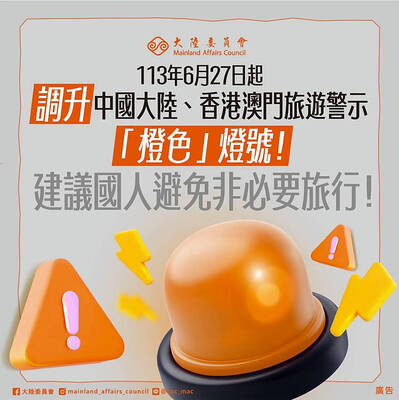
More than 6,000 Taiwanese students have participated in exchange programs in China over the past two years, despite the Mainland Affairs Council’s (MAC) “orange light” travel advisory, government records showed. The MAC’s publicly available registry showed that Taiwanese college and university students who went on exchange programs across the Strait numbered 3,592 and 2,966 people respectively. The National Immigration Agency data revealed that 2,296 and 2,551 Chinese students visited Taiwan for study in the same two years. A review of the Web sites of publicly-run universities and colleges showed that Taiwanese higher education institutions continued to recruit students for Chinese educational programs without
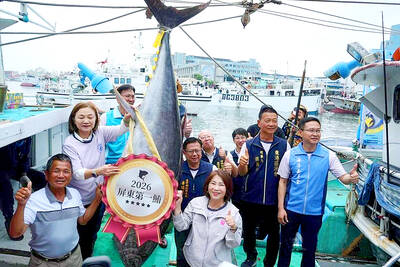
The first bluefin tuna of the season, brought to shore in Pingtung County and weighing 190kg, was yesterday auctioned for NT$10,600 (US$333.5) per kilogram, setting a record high for the local market. The auction was held at the fish market in Donggang Fishing Harbor, where the Siaoliouciou Island-registered fishing vessel Fu Yu Ching No. 2 delivered the “Pingtung First Tuna” it had caught for bidding. Bidding was intense, and the tuna was ultimately jointly purchased by a local restaurant and a local company for NT$10,600 per kilogram — NT$300 ,more than last year — for a total of NT$2.014 million. The 67-year-old skipper


 RSS
RSS